The words into and onto look similar, and both describe movement from one place to another. However, they have different meanings. Into usually describes movement to the inside of something, while onto describes movement to a surface. Knowing when to use each word helps you write clearer sentences and speak English more naturally.
For example, when you put your books into a bag, the books move inside the bag. When you put your books onto a table, they move to the table’s surface. These small differences matter in everyday conversations, school assignments, emails, and other types of writing. Although both words can describe movement, they are not interchangeable in every sentence. This guide explains the meaning of into vs onto, shows you how to use each word correctly, and provides simple examples to help you remember the difference.
Quick Answer: Into vs Onto
Into describes movement from the outside to the inside of something. Onto describes movement toward or to a surface. For example, “She walked into the room” means she entered the room, while “She climbed onto the roof” means she moved to the roof’s surface.
Why Do People Confuse Into and Onto?
People often confuse into and onto because both words can show movement and end with the word “to.” They also appear in similar sentence structures.
However, the main difference is the destination:
- Into: Movement to the inside of something.
- Onto: Movement to a surface or position on something.
Consider these sentences:
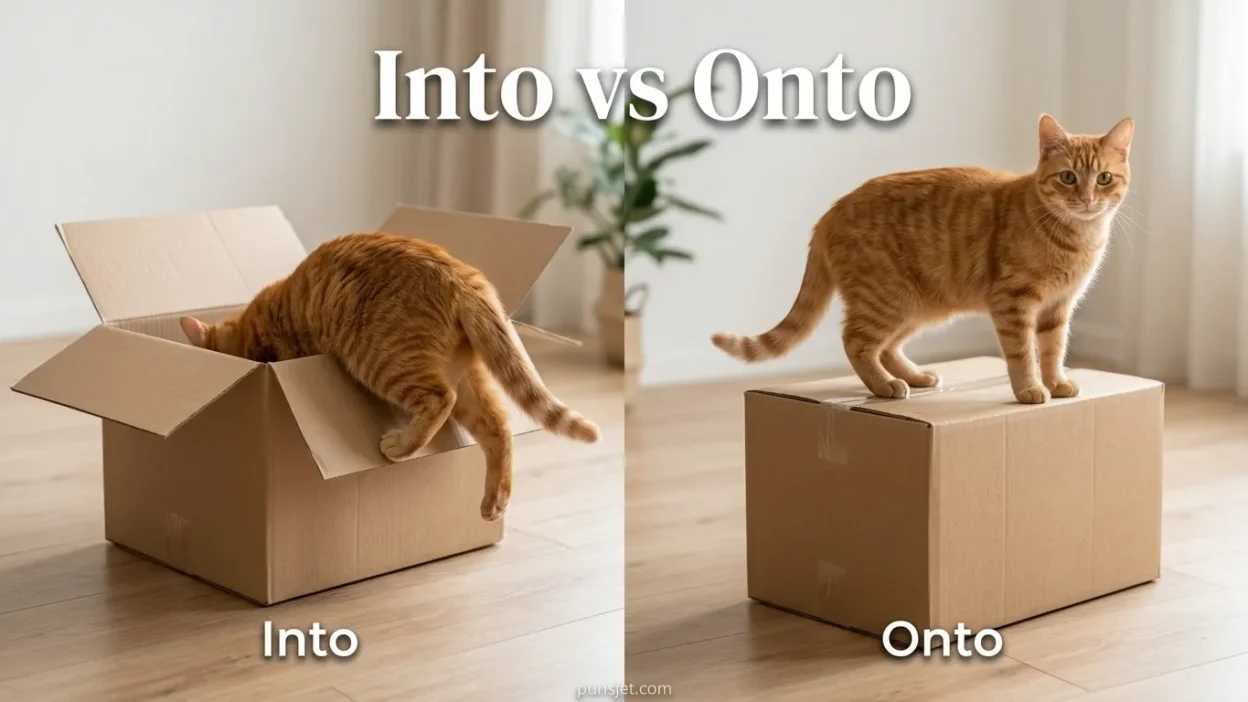
- The cat jumped into the box.
- The cat jumped onto the box.
In the first sentence, the cat lands inside the box. In the second sentence, the cat lands on top of the box.
The correct choice depends on where the person or object moves.
What Does Into Mean?
Into is a preposition that commonly describes movement from the outside to the inside of a place, container, or space. It can also describe a change in condition or involvement in an activity.
1. Into Means Movement Inside
Use into when someone or something enters an enclosed space or moves within a particular area.
Examples:
- She walked into the classroom.
- He put the keys into his pocket.
- The dog ran into the house.
- Pour the milk into the glass.
- The children jumped into the swimming pool.
In each example, the person or object moves from outside to inside.
2. Into Can Describe a Change
Into can also show that something changes from one form, state, or condition to another.
Examples:
- The caterpillar turned into a butterfly.
- The water changed into ice.
- The small company grew into a large business.
- The old building was turned into a museum.
Here, into describes a change rather than physical movement into a container.
3. Into Can Describe Interest or Involvement
In informal English, into can mean interested in or involved with something.
Examples:
- She is into music.
- He is really into football.
- My brother is into learning new languages.
This meaning does not describe physical movement. It tells us about someone’s interests.
What Does Onto Mean?
Onto is a preposition that commonly describes movement to a surface or position on something. It often shows that a person or object moves from one place and ends up on another object or area.
1. Onto Means Movement to a Surface
Use onto when someone or something moves to the top or surface of an object.
Examples:
- The cat jumped onto the table.
- She climbed onto the stage.
- He placed the bag onto the chair.
- The child stepped onto the bus.
- The ball rolled onto the road.
In these sentences, the person or object moves to a surface or position.
2. Onto Can Describe Movement to a Platform
Onto can also describe movement to a platform, website, or other destination where something is placed or displayed.
Examples:
- She uploaded the photo onto the website.
- He transferred the file onto his computer.
- The workers loaded the boxes onto the truck.
- The students moved onto the next activity.
In these examples, the word emphasizes movement or placement on a destination or the transition to another stage.
3. Onto Can Mean Discovering Something
In informal English, the expression “be onto something” can mean that someone has discovered an important fact, recognized a clue, or found a promising idea.
Examples:
- The detective is onto something important.
- I think you are onto a good idea.
- The teacher was onto the reason for the mistake.
This expression has a special meaning and does not describe literal movement to a surface.
Into vs Onto: Comparison Table
| Feature | Into | Onto |
|---|---|---|
| Main meaning | Movement to the inside | Movement to a surface or position |
| Typical destination | Room, box, bag, building | Table, roof, stage, platform |
| Example | She went into the room. | She stepped onto the stage. |
| Change of state | The ice turned into water. | Not its usual use |
| Common expression | Into music | Onto something |
| Main question | Where did it enter? | Where did it land or get placed? |
The easiest way to choose between them is to ask whether the destination is an inside space or a surface.
When Should You Use Into or Onto?
When to Use Into
Use into when:
- Someone enters a room, building, or other space.
- Something is placed inside a container.
- A person or object moves from outside to inside.
- Something changes from one form or condition to another.
- You describe an interest, such as being into art or sports.
Examples:
- The boy ran into the garden shed.
- Put the documents into the folder.
- The company turned the idea into a product.
When to Use Onto
Use onto when:
- Someone climbs or jumps to a surface.
- Something is placed on an object.
- An object moves to a platform or other supporting surface.
- Something is transferred or uploaded to a destination.
- You use an expression such as “be onto something.”
Examples:
- The child climbed onto the bed.
- Place the plate onto the counter.
- She uploaded the video onto the platform.
Can Into and Onto Both Be Correct?
Yes, both can be correct with the same verb, but they describe different actions.
- The boy jumped into the pool. He entered the water.
- The boy jumped onto the pool cover. He landed on its surface.
The destination determines which preposition is correct.
12 Examples of Into vs Onto in Sentences
Here are 12 examples showing how to use into and onto correctly in everyday English.
- She walked into the kitchen to make breakfast.
- The puppy jumped onto the sofa.
- He dropped his wallet into his backpack.
- The bird flew onto the fence.
- Please pour the juice into the bottle.
- The actor stepped onto the stage.
- The frog jumped into the pond.
- The boy climbed onto the ladder.
- The workers moved the furniture into the house.
- She placed the book onto the desk.
- The caterpillar changed into a butterfly.
- The detective knew he was onto something important.
Notice that into often focuses on entering a space or changing form, while onto often focuses on reaching a surface or position.
Common Mistakes When Using Into and Onto
Even English learners sometimes use these words incorrectly. Here are common mistakes and their corrections.
Mistake 1: Using Onto for an Inside Space
Incorrect: She walked onto the room.
Correct: She walked into the room.
Why? A room is an enclosed space, and she is entering it.
Mistake 2: Using Into for a Surface
Incorrect: He jumped into the table.
Correct: He jumped onto the table.
Why? If he lands on top of the table, onto is the correct word.
Mistake 3: Confusing Movement With Location
Compare these sentences:
- She went into the room.
- She is in the room.
Into describes movement toward the inside. In describes a location.
Similarly:
- He climbed onto the roof.
- He is on the roof.
Onto describes movement to the roof, while on describes his position there.
Mistake 4: Forgetting That Into Has Other Meanings
Incorrect: The ice melted onto water.
Correct: The ice melted into water.
Why? The sentence describes a change in state, not movement to a surface.
Mistake 5: Using Onto for Every Type of Movement
Not every movement toward something requires onto. If a person enters a building, use into. If the person climbs to the roof, use onto.
Always think about the destination before choosing a preposition.
What Is an Easy Memory Trick for Into vs Onto?
Use this simple memory trick:
- INTO = IN. Think of going inside a box, room, or building.
- ONTO = ON. Think of moving onto a table, chair, or stage.
Imagine placing a toy in two different places:
- Put the toy into the box, and it goes inside.
- Put the toy onto the box, and it rests on top.
Remembering inside versus surface will help you choose the correct word in most everyday situations.
Into vs Onto in American and British English
Both into and onto are standard English words used in American and British English. Their main meanings are the same in both varieties.
| Usage | American English | British English |
|---|---|---|
| Entering a room | She went into the room. | She went into the room. |
| Moving to a surface | He climbed onto the roof. | He climbed onto the roof. |
| Interest | I’m into music. | I’m into music. |
There is no major American-versus-British spelling difference between these words. The choice depends on the meaning of the sentence, not the variety of English you speak.
Similar Words to Into and Onto
Several related prepositions can help you describe movement and location more accurately.
- In: Describes being inside a place. Example: The keys are in the drawer.
- On: Describes a position on a surface. Example: The book is on the desk.
- Inside: Emphasizes the interior of something. Example: The children are inside the house.
- Outside: Describes a position beyond the inside of something. Example: The dog is outside the gate.
- Through: Describes movement from one side or part of something to another. Example: She walked through the tunnel.
- Toward: Describes movement in the direction of something without necessarily reaching it. Example: He walked toward the door.
- Across: Describes movement from one side to another. Example: They ran across the field.
These words are related, but they are not always interchangeable. Choose the one that best describes the movement or position you mean.
FAQs:
1. What is the main difference between into and onto?
Into usually describes movement to the inside of something, while onto describes movement to a surface or position on something. For example, you walk into a room but climb onto a roof.
2. Is it into the car or onto the car?
Both are correct, depending on the action. Use into the car when someone enters the car and sits inside. Use onto the car when someone climbs or jumps onto its roof or another exterior surface.
3. Is it jump into the pool or jump onto the pool?
Usually, jump into the pool is correct when someone enters the water. Jump onto the pool is generally unnatural because a pool is not normally treated as a surface. You could say “jump onto the pool cover” if you mean landing on a cover above the pool.
4. Can into and onto be used with the same verb?
Yes. For example, “The cat jumped into the box” means it entered the box, while “The cat jumped onto the box” means it landed on the box. The preposition changes the meaning of the action.
5. Is into one word or two words?
Into is one word. It is a preposition that often describes movement to the inside of something. Do not confuse it with in to, which uses two words when in and to have separate grammatical roles.
6. Is onto one word or two words?
Onto is generally written as one word when it means movement to a surface or position. For example, “She climbed onto the bed.” The two-word combination on to can also be correct when on belongs to a verb or expression and to introduces what follows.
7. Can into mean interested in something?
Yes. In informal English, into can mean interested in or enthusiastic about something. For example, “He is into photography” means photography is one of his interests.
Remember This
- Into = movement to the inside.
- Onto = movement to a surface or position.
- In = a location inside something.
- On = a location on a surface.
- Into can also describe a change, as in “water turned into ice.”
- Onto can appear in expressions such as “You’re onto a good idea.”
When you are unsure, ask yourself: Does the person or object enter something, or does it move onto a surface?
Conclusion
Learning the difference between into and onto makes everyday English easier to understand and use. Although the words look similar, they describe different destinations. Into usually means moving inside a space, while onto usually means moving to a surface. Practicing with familiar examples, such as putting a book into a bag or placing it onto a table, will help you remember the difference.
The key is to focus on the action and its destination rather than the similarity between the words. With regular practice, you will become more confident using into and onto in conversations, schoolwork, and everyday writing. Remember: into means inside, and onto means on a surface.

Joshua Paul is a creative writer and contributor at PunsJet.com who enjoys crafting witty puns and clever wordplay. With a strong sense of humor and a love for language, he creates entertaining content that readers can easily share and enjoy. Joshua’s goal is to spread laughter through fun and memorable jokes.