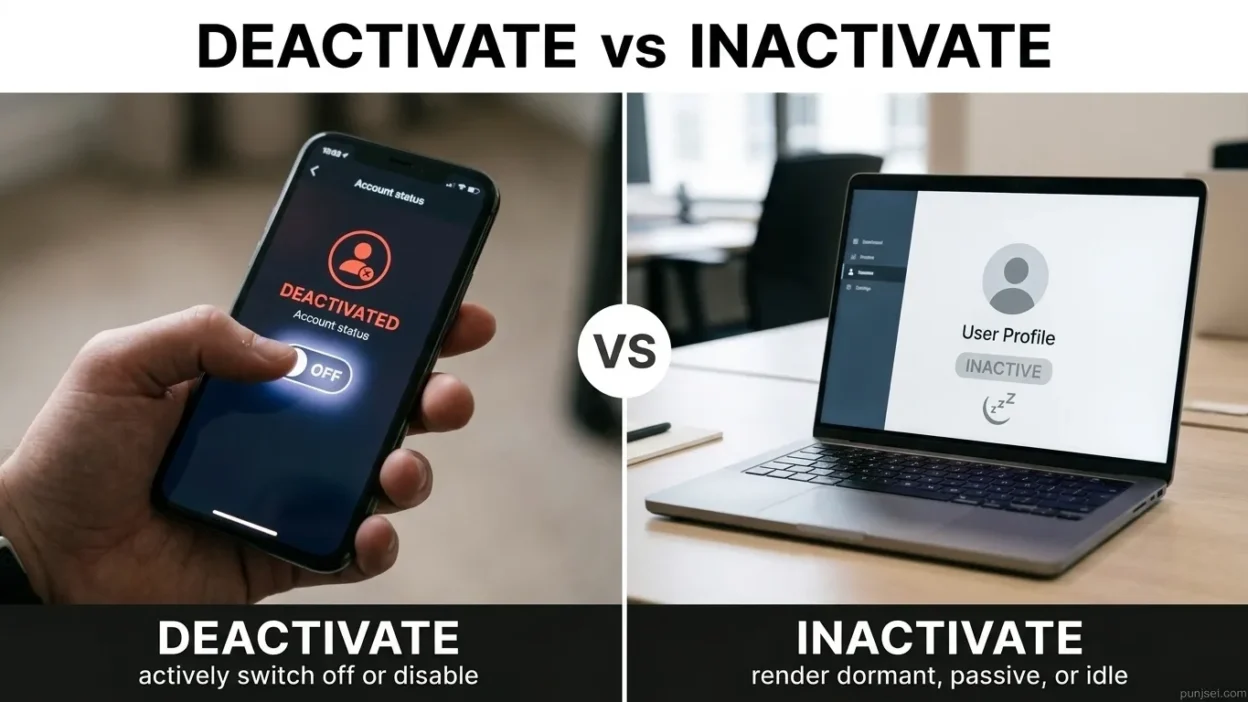
The words deactivate and inactivate may look similar because both describe something that is no longer active. However, they are not always used in the same situations. Choosing the right word depends on what you are talking about, such as a social media account, a computer system, a membership, an enzyme, or a chemical process.
In everyday English, deactivate is the more common choice when you want to turn something off, disable a feature, or stop an account from being active. For example, you might deactivate a Facebook account or deactivate a security alarm. Inactivate is more common in scientific, medical, technical, and specialized contexts, where it often describes making something inactive or causing it to lose its activity. Learning the difference will help you choose the right word in emails, conversations, reports, and technical writing.
Quick Answer
Deactivate means to turn something off, disable it, or stop it from operating. Inactivate means to make something inactive or cause it to lose its activity. Deactivate is generally more common in everyday English, especially for accounts, devices, and systems. Inactivate is often used in scientific and technical contexts, such as describing enzymes or biological processes.
Why Do People Confuse Deactivate and Inactivate?
People confuse these words because they share a similar meaning: both describe a change from an active state to an inactive one.
The prefix de- can suggest reversing an action or removing an active state. The prefix in- can mean “not,” as it does in the word inactive. Both words can therefore describe something that is no longer functioning or working as before.
However, their usual contexts are different.
- Deactivate is commonly used for devices, accounts, services, alarms, and security systems.
- Inactivate is commonly used for enzymes, viruses, biological substances, and certain scientific processes.
- Both words can appear in technical writing, but one may sound more natural than the other in a particular sentence.
The important point is that the words overlap in meaning, but they are not interchangeable in every situation.
What Does Deactivate Mean?
Deactivate means to turn something off, disable it, or make it stop functioning in its active state.
It is a familiar word in everyday English. People use it when discussing technology, online accounts, electronic devices, security systems, and services.
Examples of Deactivate
- I decided to deactivate my social media account.
- Please deactivate the alarm before entering the building.
- The company will deactivate the old access card.
- You can deactivate notifications in the settings.
- The technician needs to deactivate the machine before repairs.
In each example, something that was active is being turned off or disabled.
When Is Deactivate Commonly Used?
You will often see deactivate in situations involving:
- Online accounts: Deactivate an account temporarily or permanently, depending on the service’s rules.
- Technology: Deactivate a device, feature, or software function.
- Security: Deactivate an alarm, key card, or security system.
- Services: Deactivate a subscription feature or user profile.
- Equipment: Deactivate a machine or system so it no longer operates in its active mode.
Simple definition: Deactivate means to turn something off or disable it.
What Does Inactivate Mean?
Inactivate means to make something inactive or cause it to lose its activity. It is a valid English word, but it is less common in ordinary conversation than deactivate.
The word is especially useful in scientific and technical contexts. For example, researchers may describe a process that inactivates an enzyme or a treatment that inactivates a virus.
Examples of Inactivate
- Heat can inactivate certain enzymes.
- The treatment was designed to inactivate the virus.
- Researchers studied how the chemical could inactivate a protein.
- The process may inactivate a biological substance.
- Certain conditions can inactivate an enzyme.
In these examples, the focus is on losing biological, chemical, or functional activity rather than simply switching a device off.
When Is Inactivate Commonly Used?
You will often see inactivate in situations involving:
- Biology: Making an enzyme or biological component inactive.
- Medical research: Describing methods that reduce or eliminate the activity of certain biological agents.
- Chemistry: Describing a substance or process that loses its activity.
- Laboratory work: Explaining how a treatment changes the activity of a sample.
- Technical processes: Describing the loss of function or activity in a specialized system.
Simple definition: Inactivate means to make something inactive or cause it to lose its activity.
Deactivate vs Inactivate: Comparison Table
| Feature | Deactivate | Inactivate |
|---|---|---|
| Basic meaning | Turn off or disable | Make inactive or remove activity |
| Everyday use | Very common | Less common |
| Technology | Common | Possible in specialized contexts |
| Online accounts | Common | Unusual |
| Security systems | Common | Unusual |
| Scientific writing | Used when appropriate | Often useful |
| Biological processes | Sometimes used | Common in suitable contexts |
| Natural example | Deactivate an alarm | Inactivate an enzyme |
| General tone | Everyday and technical | More specialized and technical |
Both words describe inactivity, but the context helps determine which one sounds most natural.
When Should You Use Deactivate or Inactivate?
Choosing between these words becomes easier when you consider what is becoming inactive.
Use Deactivate for Accounts, Devices, and Systems
Choose deactivate when you mean to turn something off, disable a function, or stop an account or system from operating.
Examples:
- I want to deactivate my old email account.
- The administrator will deactivate the employee’s access card.
- Please deactivate the alarm before testing the equipment.
- She decided to deactivate her profile for a while.
- The technician will deactivate the system during maintenance.
In these cases, deactivate is the natural choice for most everyday English speakers.
Use Inactivate for Scientific and Biological Activity
Choose inactivate when discussing the loss of activity in a scientific, biological, or technical process.
Examples:
- The researchers found a way to inactivate the enzyme.
- The treatment may inactivate certain viruses under specific conditions.
- Scientists measured how quickly the process could inactivate the biological agent.
- The chemical reaction can inactivate the protein.
The exact scientific meaning depends on the substance, treatment, and conditions being discussed.
Can You Use Both Words in Technical Writing?
Yes. Some technical contexts allow either word, depending on the intended meaning and the terminology used in that field.
For example, a software system might be described as deactivated if its operation has been disabled. A biological component might be described as inactivated if it has lost its activity.
When writing for a specialized audience, follow the terminology used in the relevant technical documentation or scientific field.
12 Examples of Deactivate vs Inactivate in Sentences
The following examples show how each word works in everyday and specialized situations.
- Deactivate: I will deactivate my old account today.
- Deactivate: The guard had to deactivate the security alarm.
- Deactivate: You can deactivate this feature from the settings menu.
- Deactivate: The administrator decided to deactivate the unused user profile.
- Deactivate: Please deactivate the machine before cleaning it.
- Deactivate: The company plans to deactivate the outdated access cards.
- Inactivate: High temperatures can inactivate certain enzymes.
- Inactivate: The scientists studied how the treatment could inactivate the virus.
- Inactivate: Researchers examined the conditions needed to inactivate the protein.
- Inactivate: The chemical may inactivate the biological component under certain conditions.
- Inactivate: The laboratory tested a method to inactivate the enzyme.
- Inactivate: The researchers measured the substance’s activity before and after the process.
Notice how deactivate usually fits actions involving devices and systems, while inactivate often fits descriptions of scientific activity.
Common Mistakes When Using Deactivate and Inactivate
Even experienced English speakers sometimes choose the less natural word for a particular context. Here are common mistakes to avoid.
Mistake 1: Using Inactivate for Every Online Account
Incorrect or unnatural in ordinary usage: “I want to inactivate my social media account.”
Better: “I want to deactivate my social media account.”
Although readers may understand the first sentence, deactivate is the usual choice for online accounts.
Mistake 2: Assuming Deactivate and Inactivate Always Mean Exactly the Same Thing
The words overlap, but context matters. Deactivating a machine often means disabling its operation. Inactivating an enzyme means causing it to lose its activity.
Choose the word that matches the process you are describing.
Mistake 3: Thinking Inactivate Is Not a Real Word
Inactivate is a correct English verb. It is simply less common in everyday conversation and more common in specialized writing.
For example, “The treatment may inactivate the enzyme” is a natural scientific sentence.
Mistake 4: Using Deactivate When Scientific Precision Is Needed
In a scientific report, the specific term inactivate may better describe the loss of activity of an enzyme or biological agent.
Always consider the terminology used in your field.
Mistake 5: Assuming Deactivate Always Means Permanent Removal
Deactivating an account or service does not necessarily mean deleting it permanently. Some services allow users to reactivate a deactivated account.
Check the relevant service’s rules before assuming what deactivation does.
Memory Trick: How to Remember the Difference
Use this simple memory trick:
- Deactivate = Disable. Think of turning off a device, account, alarm, or feature.
- Inactivate = Inactivity. Think of a substance or biological component losing its activity.
For example:
- You deactivate your account.
- You inactivate an enzyme.
Remember that this is a helpful guide, not an absolute rule. Technical terminology can vary depending on the subject.
Deactivate vs Inactivate in American and British English
There is no major American-versus-British spelling difference between deactivate and inactivate. Both forms are accepted in American and British English.
The main difference is usage rather than spelling.
| Context | American English | British English |
|---|---|---|
| Online account | Deactivate an account | Deactivate an account |
| Security alarm | Deactivate an alarm | Deactivate an alarm |
| Enzyme activity | Inactivate an enzyme | Inactivate an enzyme |
| Scientific research | Both may be used as appropriate | Both may be used as appropriate |
The same general guidelines apply in both varieties. Deactivate is usually more natural for everyday technology and accounts, while inactivate is often suitable for scientific descriptions of lost activity.
Similar Words to Deactivate and Inactivate
Several related words can help you express the same or a similar idea. However, each has its own meaning.
1. Disable
Disable means to prevent something from working or being used.
Example: “The administrator disabled the feature.”
It is often interchangeable with deactivate in technology, although the best choice depends on the context.
2. Turn Off
Turn off is a simple, everyday expression for stopping a device or function.
Example: “Please turn off the alarm.”
It is less formal than deactivate.
3. Switch Off
Switch off is commonly used for electrical devices and systems.
Example: “Switch off the machine before cleaning it.”
It is especially familiar in British English, although Americans understand it too.
4. Suspend
Suspend means to temporarily stop an activity, service, or privilege.
Example: “The company suspended the user’s access.”
Suspension often suggests a temporary interruption rather than simply turning something off.
5. Neutralize
Neutralize means to make something ineffective or reduce its effect.
Example: “The substance neutralized the chemical’s effect.”
It does not always mean the same thing as inactivate, so use it only when it accurately describes the process.
6. Reactivate
Reactivate means to make something active again.
Example: “You can reactivate your account by following the instructions.”
It is a common related word when discussing previously deactivated accounts or systems.
FAQs:
1. Is deactivate or inactivate the correct word?
Both are correct English words. Use deactivate for turning off or disabling accounts, devices, and systems. Use inactivate when describing something losing its activity, especially in scientific or technical contexts.
2. What is the main difference between deactivate and inactivate?
The main difference is their typical usage. Deactivate commonly describes disabling something that is operating or available. Inactivate commonly describes making something inactive or causing it to lose activity.
3. Is inactivate a real English word?
Yes. Inactivate is a standard English verb used particularly in scientific and technical writing. It can describe a process that makes an enzyme, protein, or other biological component inactive.
4. Can I say inactivate an account?
People may understand this expression, but deactivate an account is much more natural in ordinary English. Use the term chosen by the particular website or service when describing its account settings.
5. Can deactivate and inactivate be used interchangeably?
Sometimes, but not always. Both can describe a loss of activity, especially in technical contexts. However, deactivate is generally preferred for accounts and devices, while inactivate is often preferred for enzymes and biological processes.
6. What is the difference between deactivate and disable?
Both words can mean stopping something from working. Deactivate often suggests switching off an active function or system, while disable emphasizes preventing something from operating or being used. In many technology contexts, either may be appropriate.
7. What is the opposite of deactivate?
The usual opposite is activate, which means to make something active or operational. Reactivate is also common when something that was previously active is made active again.
8. What is the past tense of inactivate?
The past tense is inactivated. For example: “The treatment inactivated the enzyme.” The past tense of deactivate is deactivated, as in “The administrator deactivated the account.”
Remember This
- Deactivate = turn off or disable something.
- Inactivate = make something inactive or cause it to lose activity.
- Deactivate an account is the usual everyday expression.
- Inactivate an enzyme is a common scientific expression.
- Both words are correct, and the best choice depends on context.
Conclusion
The difference between deactivate and inactivate is mainly about how the words are used. Both describe a change from an active state to an inactive one, but deactivate is the more common choice in everyday English. It works naturally when discussing online accounts, electronic devices, alarms, and computer systems.
Inactivate is particularly useful in scientific and technical writing, especially when describing enzymes, proteins, viruses, or other biological components losing their activity. When deciding which word to use, think about what is becoming inactive and the situation in which you are using the word. If you are talking about turning off an account or device, choose deactivate. If you are describing the loss of biological or scientific activity, inactivate may be the better choice. Understanding this distinction will help you write clearer sentences and communicate more precisely.

Emily Margaret is a writer and humor enthusiast at PunsJet.com. She enjoys creating clever puns and lighthearted content that entertains readers and adds a spark of humor to everyday life. With a love for wordplay and creativity, Emily aims to share fun, relatable jokes that make people smile and laugh.