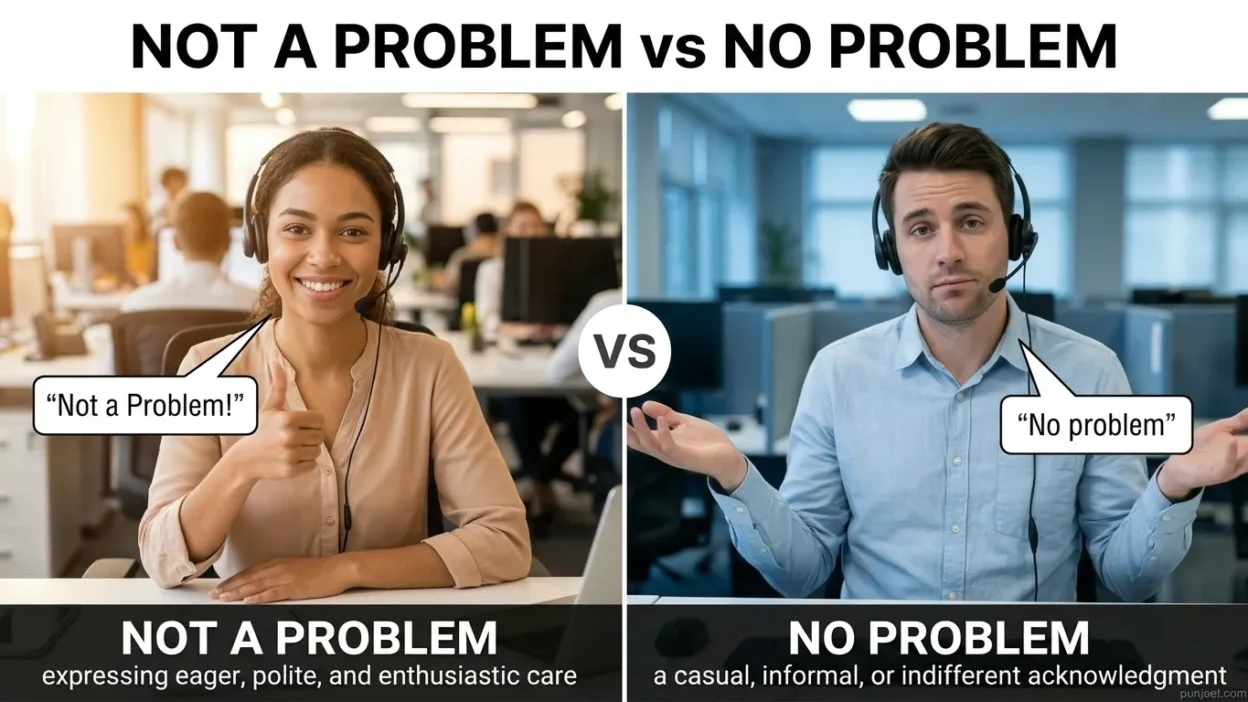
Have you ever wondered whether to say “not a problem” or “no problem” in a conversation? Both expressions are common in everyday English, and they often have almost the same meaning. However, they can sound slightly different depending on the situation.
People use these phrases when someone says thank you, asks for help, or worries about causing trouble. For example, if your friend thanks you for helping with homework, you can reply, “No problem!” You could also say, “It’s not a problem,” to show that helping was easy for you. Although both expressions are correct, they are not always used in exactly the same way.
In this guide, you will learn the meaning of not a problem vs no problem, how these expressions differ, when to use each one, and how to use them naturally in everyday conversations, emails, and messages. Simple examples will help you understand the difference and choose the right expression with confidence.
Quick Answer
“No problem” is a common, friendly way to respond to thanks or show that you are happy to help. “Not a problem” means something is not difficult, troublesome, or inconvenient. Both are correct English expressions, but “no problem” is often more natural as a short reply to “Thank you.”
Why Do People Confuse “Not a Problem” and “No Problem”?
People confuse these expressions because both communicate that something is acceptable, easy, or not troublesome. They can often be used in the same situation without changing the main meaning.
For example:
- “Can you help me with this?” — “No problem!”
- “Can you help me with this?” — “It’s not a problem!”
Both replies tell the other person that helping is not an issue.
The main difference is how the expressions are commonly used. “No problem” works especially well as a short, independent response. “Not a problem” often appears in a complete sentence, such as “That is not a problem for me.”
Context also matters. In a workplace, a casual conversation, or a text message, both expressions can sound natural. The speaker’s tone helps show whether the response is friendly, reassuring, or slightly formal.
1. What Does “Not a Problem” Mean?
“Not a problem” means that something is not difficult, inconvenient, or troublesome. It reassures someone that a request, mistake, or situation is acceptable.
This expression is often used when you want to explain that something will not cause trouble or create difficulties.
Examples of “Not a Problem”
- “Finishing the report today is not a problem.”
- “Your late arrival is not a problem.”
- “Helping you with your homework is not a problem for me.”
- “That small mistake is not a problem.”
- “Changing the meeting time is not a problem.”
You can also use the expression as a short reply in conversation.
Example:
Person A: “Would it be a problem if I called you later?”
Person B: “Not a problem!”
Here, the speaker means that the suggested time is acceptable.
Is “Not a Problem” Correct English?
Yes, “not a problem” is correct English. It can be a complete conversational response or part of a longer sentence.
For example:
- “It is not a problem.”
- “That is not a problem.”
- “Not a problem! I can help.”
In everyday conversation, people often leave out words that are clear from the context. That is why “Not a problem!” works naturally as a short response.
2. What Does “No Problem” Mean?
“No problem” means that something is easy, acceptable, or does not cause trouble. It is especially common when responding to thanks or agreeing to a request.
It is a friendly expression used in conversations with friends, family members, classmates, coworkers, and customers.
Examples of “No Problem”
- “Thank you for your help.” — “No problem!”
- “Can you send me the file?” — “No problem.”
- “Sorry I called so late.” — “No problem.”
- “Could you explain this question?” — “No problem!”
- “Thanks for waiting.” — “No problem at all.”
The phrase can also describe a situation that does not create difficulties.
Example:
“Getting to the station before noon is no problem.”
This means reaching the station before noon is easy or manageable.
Is “No Problem” Polite?
Yes, “no problem” is generally polite and friendly. It is widely used in casual conversations and many professional situations.
For example:
Customer: “Thank you for answering my question.”
Employee: “No problem. Is there anything else I can help you with?”
However, in a very formal letter or official statement, a phrase such as “You are welcome” or “I would be happy to assist” may be more suitable.
3. Not a Problem vs No Problem: Comparison Table
| Feature | Not a Problem | No Problem |
|---|---|---|
| Main meaning | Something is not troublesome | Something causes no trouble |
| Common use | Reassuring someone about a situation | Responding to thanks or requests |
| Tone | Friendly, neutral, reassuring | Friendly, casual, reassuring |
| Short reply to thanks | Correct, but less typical | Very common |
| In complete sentences | “It is not a problem.” | “It is no problem.” |
| Everyday conversations | Very common | Very common |
| Text messages | Natural | Natural |
| Professional settings | Appropriate | Usually appropriate |
| Formal writing | Depends on context | Depends on context |
The key difference: “No problem” is especially common as a quick conversational reply, while “not a problem” often emphasizes that a particular situation or request will not cause difficulty.
Both expressions can overlap, and neither is universally better than the other.
4. When Should You Use Each Expression?
Choosing between “not a problem” and “no problem” is easy once you understand the situation.
Use “No Problem” When Responding to Thanks
This is one of the most common uses of the expression.
Example:
A: “Thank you for helping me study.”
B: “No problem!”
The reply shows that the speaker was happy to help.
Use “No Problem” When Agreeing to a Request
It is a natural way to accept a small task.
Example:
A: “Could you bring my notebook tomorrow?”
B: “No problem.”
The speaker is saying that the request is acceptable.
Use “Not a Problem” to Reassure Someone
Choose this expression when someone is worried about causing trouble or inconvenience.
Example:
A: “I hope changing the appointment won’t cause trouble.”
B: “It’s not a problem.”
The response reassures the other person that the change is acceptable.
Use Either Expression in Everyday Conversation
In many situations, both expressions work.
For example:
- “Can I sit here?” — “No problem.”
- “Can I sit here?” — “That’s not a problem.”
The first reply is shorter and more conversational. The second makes the acceptance of the situation more explicit.
Use More Formal Alternatives When Needed
In a formal business email, you may want to choose wording that sounds more professional.
Examples include:
- “I would be happy to help.”
- “That will be fine.”
- “There is no issue with the proposed change.”
- “You are welcome.”
The best choice depends on your relationship with the reader and the purpose of the message.
5. More Than 10 Examples of “Not a Problem” vs “No Problem”
These examples show how both expressions work in everyday English.
Example 1: Responding to Thanks
- No problem: “Thanks for lending me your pen.” — “No problem!”
- Not a problem: “Thanks for lending me your pen.” — “It’s not a problem!”
Both are correct, but “No problem!” is the more typical short reply.
Example 2: Asking for Help
- No problem: “Can you help me carry these books?” — “No problem.”
- Not a problem: “Can you help me carry these books?” — “That’s not a problem.”
Both responses accept the request.
Example 3: Arriving Late
- No problem: “Sorry I’m five minutes late.” — “No problem.”
- Not a problem: “Sorry I’m five minutes late.” — “It’s not a problem.”
Both replies reassure the late person.
Example 4: Changing an Appointment
- No problem: “Can we move our meeting to Friday?” — “No problem.”
- Not a problem: “Can we move our meeting to Friday?” — “That’s not a problem.”
Both show that the change is acceptable.
Example 5: Workplace Requests
- No problem: “Could you review this document?” — “No problem.”
- Not a problem: “Could you review this document?” — “Reviewing it today is not a problem.”
The second version explains more clearly that the task can be completed without difficulty.
Example 6: Helping a Friend
- No problem: “Thanks for helping me clean the room.” — “No problem!”
- Not a problem: “Helping you clean the room is not a problem for me.”
Both communicate willingness to help.
Example 7: A Small Mistake
- No problem: “I’m sorry I made a small mistake.” — “No problem.”
- Not a problem: “I’m sorry I made a small mistake.” — “It’s not a problem.”
Both can reassure the person, depending on the situation.
Example 8: Borrowing Something
- No problem: “Can I borrow your charger?” — “No problem.”
- Not a problem: “Can I borrow your charger?” — “That’s not a problem.”
Both responses indicate permission or acceptance.
Example 9: Email Communication
- No problem: “Thank you for sending the updated file.” — “No problem.”
- Not a problem: “Sending the updated file again is not a problem.”
The first is a reply to thanks. The second describes an action as easy or acceptable.
Example 10: Making Plans
- No problem: “Can we meet a little later?” — “No problem.”
- Not a problem: “Meeting a little later is not a problem for me.”
Both show flexibility.
Example 11: Asking a Question
- No problem: “Sorry to bother you with another question.” — “No problem!”
- Not a problem: “Answering another question is not a problem.”
Both reassure the person asking.
Example 12: Customer Service
- No problem: “Thank you for your patience.” — “No problem.”
- Not a problem: “Changing your booking is not a problem.”
The first responds to appreciation, while the second confirms that a requested change is manageable.
6. Common Mistakes to Avoid
Although both expressions are simple, learners sometimes use them in ways that sound unnatural.
Mistake 1: Thinking Only One Expression Is Correct
Incorrect belief: “Not a problem” is wrong, and only “no problem” is correct.
Correct understanding: Both are standard English expressions. Their most natural uses can differ slightly.
Mistake 2: Using “No Problem” in Every Situation
“No problem” is useful, but repeating it in every conversation can sound casual or repetitive.
Instead, try:
- “You’re welcome.”
- “Of course.”
- “I’d be happy to help.”
- “That’s perfectly fine.”
Choose the expression that fits the situation.
Mistake 3: Assuming “Not a Problem” Is Always More Formal
“Not a problem” is not automatically more formal than “no problem.” Both are common in everyday speech.
For formal communication, consider the full sentence and the relationship between the speakers.
Mistake 4: Confusing “No Problem” With “No Problems”
Both forms can be correct, but they are used differently.
- “No problem!” is a common conversational response.
- “There are no problems with the report” means that the report has no identified issues.
Use the singular expression when responding casually to thanks or requests.
Mistake 5: Forgetting the Context
A phrase can be grammatically correct but unsuitable for the situation. For example, a serious complaint may require a careful explanation rather than a quick “No problem.”
Think about what the other person needs to hear before choosing your response.
7. Memory Trick: How to Remember the Difference
Use this simple memory trick:
No problem = No trouble!
Remember “no problem” as a quick, friendly reply to thanks or requests.
Not a problem = It isn’t an issue!
Remember “not a problem” as a way to explain that something will not cause difficulty.
For example:
- “Thanks for helping!” — “No problem!”
- “Will the delay affect your plans?” — “It’s not a problem.”
Both phrases can be used in similar situations, so think of this trick as a helpful guide rather than a strict rule.
8. American vs British English
Both “not a problem” and “no problem” are used in American and British English. Neither expression belongs exclusively to one variety.
In American English, “no problem” is a familiar response to thanks, requests, and apologies. “Not a problem” is also widely understood and used.
In British English, both expressions are common, too. Depending on the speaker and setting, you may also hear “you’re welcome,” “that’s fine,” or “no worries.”
Here are some examples:
| Situation | American English | British English |
|---|---|---|
| Responding to thanks | “No problem!” | “No problem!” |
| Accepting a request | “That’s not a problem.” | “That’s not a problem.” |
| Responding casually to thanks | “You’re welcome.” | “You’re welcome.” |
| Reassuring a friend | “No problem.” | “No worries.” |
These are general tendencies, not fixed rules. People in both countries use a range of expressions, and individual preferences vary.
9. Similar Words and Expressions
Several other English phrases have meanings similar to “not a problem” and “no problem.”
You’re Welcome
This is a direct and widely accepted response to thanks.
Example: “Thank you for your help.” — “You’re welcome.”
No Worries
This casual expression can reassure someone that something is acceptable or that they do not need to worry.
Example: “Sorry I forgot to call.” — “No worries.”
It’s All Right
This phrase can reassure someone after an apology or confirm that a situation is acceptable.
Example: “I’m sorry for the delay.” — “It’s all right.”
That’s Fine
Use this phrase to accept a suggestion, request, or change.
Example: “Can we start at ten?” — “That’s fine.”
Of Course
This expression shows willingness or agreement, often in a warm and helpful way.
Example: “Could you explain this again?” — “Of course.”
Don’t Mention It
This phrase is a friendly response to thanks, suggesting that the help was not a burden.
Example: “Thanks for giving me a ride.” — “Don’t mention it.”
It’s No Trouble
This expression emphasizes that an action does not cause inconvenience.
Example: “Thank you for staying late.” — “It’s no trouble.”
Each alternative has its own tone and best use. Choose the one that sounds natural for your conversation.
FAQs:
1. Is it “not a problem” or “no problem”?
Both expressions are correct. “No problem” is especially common as a short response to thanks or requests, while “not a problem” often describes something that is not difficult or troublesome.
2. Is “no problem” a polite response to “thank you”?
Yes. “No problem” is generally friendly and polite in everyday conversation. “You’re welcome” is another good option, particularly when you want a more traditional response.
3. Is “not a problem” grammatically correct?
Yes. You can say “It is not a problem,” “That is not a problem,” or simply “Not a problem!” as a conversational reply.
4. Can I use “no problem” in a professional email?
Yes, especially in friendly workplace communication. However, “You’re welcome,” “I’d be happy to help,” or “That will be fine” may be more suitable for a formal message.
5. Does “not a problem” sound more formal than “no problem”?
Not necessarily. Both expressions can sound casual or neutral. Their level of formality depends on the sentence, tone, and situation.
6. What is another way to say “no problem”?
Common alternatives include “You’re welcome,” “No worries,” “Of course,” “That’s fine,” and “It’s no trouble.” The best choice depends on whether you are responding to thanks, accepting a request, or reassuring someone.
7. Are “no problem” and “no worries” the same?
They are similar, but not identical in every context. Both can reassure someone or respond to thanks. “No worries” often sounds particularly casual, while “no problem” is widely used in both casual and many professional conversations.
8. Which expression should English learners use?
For a simple reply to “Thank you,” “No problem!” is an excellent choice. When explaining that a task or situation will not cause difficulty, “It’s not a problem” is also natural. Learning both will help you communicate more comfortably.
Remember This
- No problem: A friendly, common reply to thanks or requests.
- Not a problem: A way to say something is not difficult, troublesome, or inconvenient.
- Both are correct: Choose according to the situation and the message you want to express.
- For formal situations: Consider alternatives such as “You’re welcome” or “I’d be happy to help.”
Conclusion
Understanding the difference between “not a problem” and “no problem” can make everyday English conversations easier. Both expressions tell someone that a situation is acceptable or does not cause trouble. However, “no problem” is especially common when replying to thanks, while “not a problem” often emphasizes that a task or situation is not an issue.
The easiest way to remember the difference is to think about the purpose of your reply. If someone thanks you or asks for help, “No problem!” is a natural choice. If someone worries about causing inconvenience, “It’s not a problem” can reassure them. With practice, you will learn when to use each phrase naturally in conversations, emails, and messages.