Have you ever wondered if to use see, look, or watch in a sentence? These three English words are related to vision, but they do not mean exactly the same thing. Many students and English learners confuse them because all three describe using your eyes. However, each word is used in a different situation.
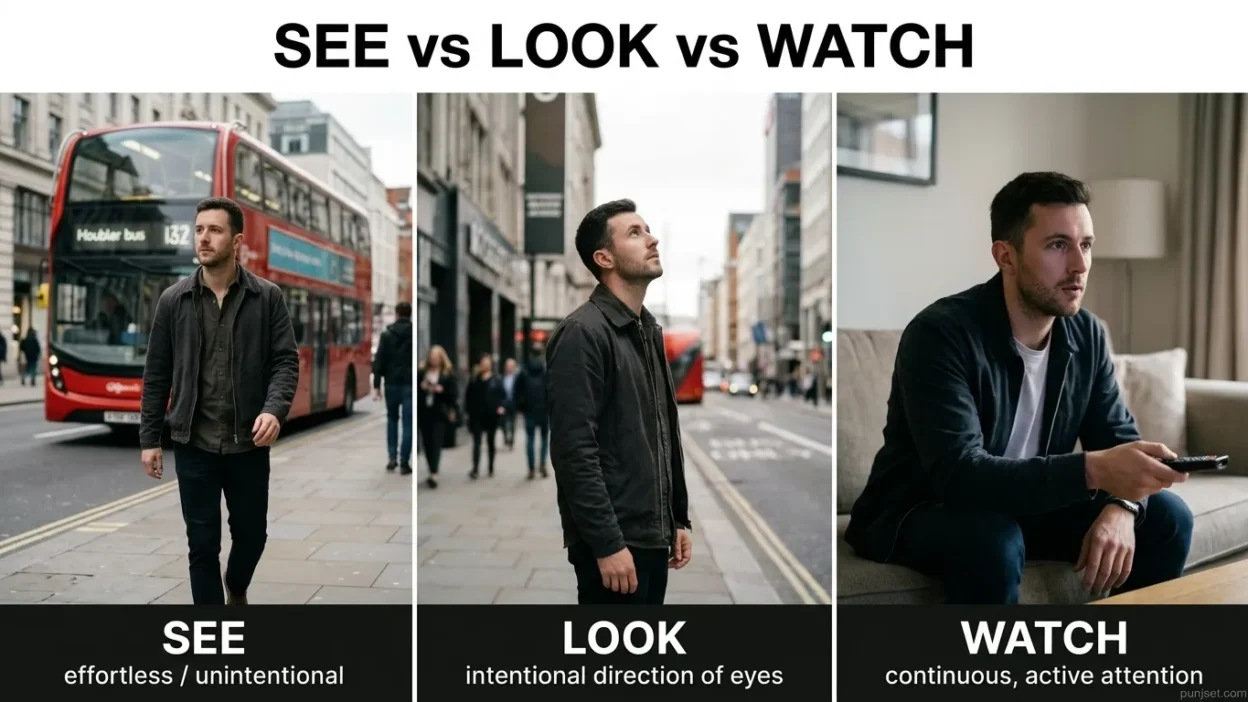
The main difference is how you use your eyes. You usually see something when your eyes notice it, even without trying. You look at something when you direct your eyes toward it. You watch something when you pay attention to it for some time, especially when it is moving or changing. Learning these differences can help you speak naturally, write clearly, and avoid common English mistakes. In this guide, you will find simple definitions, a comparison table, everyday examples, common mistakes, and easy memory tricks to help you understand when to use each word.
Quick Answer
- See: To notice something with your eyes, often without trying. Example: I can see a bird.
- Look: To direct your eyes toward something intentionally. Example: Look at that bird!
- Watch: To pay attention to something for a period of time, especially when it moves or changes. Example: We watch birds in the garden.
Why Do People Confuse See, Look, and Watch?
People confuse see vs look vs watch because all three words relate to eyesight. They can sometimes describe the same object, but they focus on different actions.
For example, you might see a football match on television, look at the players, or watch the match from beginning to end. The object may be the same, but the meaning changes depending on what you are doing.
Another reason is that these verbs follow different sentence patterns. We commonly say “look at something,” “watch something,” and “see something.” Understanding these patterns makes it easier to choose the right word.
1. What Does See Mean?
See means to notice or become aware of something through your eyes. It often happens naturally, without making a special effort to look.
You do not always need to choose to see something. If a car passes your window and you notice it, you can say that you saw a car.
Examples of See
- I can see the moon tonight.
- Did you see my keys on the table?
- She can see a rainbow in the sky.
- We saw a deer near the road.
- I want to see the new movie this weekend.
The last example shows another common use. See can also mean to visit someone, meet someone, or experience something, such as seeing a doctor or seeing a movie.
When Should You Use See?
Use see when you talk about noticing something, having the ability to use your eyesight, or meeting and experiencing something.
Examples:
- I see a dog outside.
- Can you see the board?
- I need to see the dentist.
- We saw an interesting film yesterday.
Remember that see does not always mean passive eyesight. You can intentionally see a movie or go to see a person. The meaning depends on the context.
2. What Does Look Mean?
Look means to direct your eyes toward a person, place, or thing. It usually describes an intentional action.
When someone says, “Look at this picture,” they want you to turn your attention toward the picture.
Examples of Look
- Look at the beautiful flowers.
- Please look at the board.
- He looked at his watch.
- She is looking out of the window.
- Look carefully before crossing the road.
Why Do We Say “Look At”?
When you direct your eyes toward a particular object, you usually use look at.
Examples:
- Look at the sky.
- Look at this photograph.
- She looked at me.
- He is looking at the map.
However, look does not always need “at.” You can say “Look!” when asking someone to pay attention, or “Look outside” when directing someone to a place.
When Should You Use Look?
Use look when you want to describe the action of directing your eyes somewhere.
Examples:
- Look at my new shoes.
- She looked in the mirror.
- He looked around the room.
- Look over there!
Important: Looking at something does not guarantee that you see it clearly. You can look for your glasses without seeing them.
3. What Does Watch Mean?
Watch means to look at something carefully for a period of time. It is especially common when something is moving, happening, or changing.
For example, you watch a football match because the action continues over time. You watch a baby because you need to pay attention to what the baby is doing.
Examples of Watch
- We watch television after dinner.
- They watched the football match together.
- Please watch the children while I cook.
- She is watching the birds fly.
- He likes to watch the rain through the window.
When Should You Use Watch?
Use watch when you give attention to an activity, event, or process over time.
Examples:
- I watch the news every evening.
- We watched the sunset.
- The teacher watched the students during the test.
- She watched the machine carefully.
Watch can also mean to take care or be alert, as in “Watch your step!” or “Watch out!” In these expressions, it does not simply mean viewing something.
See vs Look vs Watch: Comparison Table
| Feature | See | Look | Watch |
|---|---|---|---|
| Main meaning | Notice with your eyes | Direct your eyes | Observe over time |
| Usually intentional? | Often unintentional | Usually intentional | Usually intentional |
| Focus | What you notice | Where you direct your eyes | An activity or changing event |
| Common pattern | See something | Look at something | Watch something |
| Example | I see a bird. | Look at the bird. | Watch the bird fly. |
| Common use | Seeing a person or object | Examining or directing attention | Watching sports, films, or movement |
When Should You Use See, Look, or Watch?
Choosing the right word becomes easier when you think about the action you want to describe.
Use See When You Notice Something
Choose see when something comes into your view or when you talk about visual ability.
- I can see the mountains.
- Did you see that accident?
- She saw a cat near the gate.
Use Look When You Direct Your Eyes
Choose look when you intentionally turn your eyes toward something.
- Look at the blackboard.
- He looked at the clock.
- Look carefully at this answer.
Use Watch When You Observe Something Over Time
Choose watch when you pay attention to an activity, movement, or event.
- We watch movies on weekends.
- The children watched the parade.
- I watched the dog run across the field.
Can You Use All Three Words for the Same Thing?
Yes. You can use all three words to describe different actions involving the same object.
Consider a bird in a tree:
- See: I can see a bird in the tree.
- Look: Look at the bird in the tree.
- Watch: Watch the bird build its nest.
The first sentence reports noticing the bird. The second directs someone’s attention toward it. The third asks someone to observe an activity.
12 Examples of See vs Look vs Watch in Everyday English
Here are practical examples to help you understand how these verbs work in daily conversations.
- See: I can see the bus coming.
- Look: Look at the bus number.
- Watch: Watch the bus as it turns the corner.
- See: Did you see my phone?
- Look: Look under the table for your phone.
- Watch: Watch your phone while I get the tickets.
- See: I saw your brother at the store.
- Look: Look at your brother’s new jacket.
- Watch: We watched your brother play football.
- See: She can see the stars clearly.
- Look: Look at those bright stars.
- Watch: We watched the stars appear in the night sky.
More Examples in Short Conversations
Conversation 1
A: Can you see the sign?
B: Yes, I can see it.
A: Look at the smaller letters, too.
Conversation 2
A: What are you doing?
B: I am watching a football match.
A: Can I watch it with you?
Conversation 3
A: Look over there!
B: What is it?
A: I can see a fox. Let’s watch it from here.
These conversations show how naturally the three words can appear together.
Common Mistakes With See, Look, and Watch
English learners sometimes use these verbs interchangeably. The following mistakes are easy to correct.
Mistake 1: Saying “Look the Picture”
Incorrect: Look the picture.
Correct: Look at the picture.
Use “look at” when directing your eyes toward a particular object.
Mistake 2: Saying “Watch at the Movie”
Incorrect: I watch at the movie every night.
Correct: I watch the movie every night.
You do not normally use “at” after watch when it takes a direct object.
Mistake 3: Saying “I Am Seeing a Bird” for a Simple Observation
Less natural in an ordinary situation: I am seeing a bird.
More natural: I can see a bird.
Use “I can see” to describe something visible at the moment. However, “I am seeing” is correct in other contexts, such as “I am seeing a doctor tomorrow.”
Mistake 4: Using See Instead of Watch for an Ongoing Activity
Less precise: I saw the football match for two hours.
More natural: I watched the football match for two hours.
Use watch when you want to emphasize observing an event over a period of time. “I saw the match” is also correct when referring to the experience of attending or viewing it.
Mistake 5: Forgetting That Look and Watch Can Have Different Meanings
Incorrect: I looked television last night.
Correct: I watched television last night.
Use watch for the activity of viewing a television program. You can say “look at the television” if you mean directing your eyes toward the television set.
Easy Memory Trick for See vs Look vs Watch
Use this simple trick to remember the difference:
- See = Notice. Something enters your view.
- Look = Direct. You point your eyes toward something.
- Watch = Observe. You pay attention to something happening over time.
Think of a moving car:
- You see a car on the road.
- You look at the car’s color.
- You watch the car drive away.
If you remember “notice, direct, observe,” you can usually choose the correct word.
American vs British English: Is There a Difference?
The meanings of see, look, and watch are generally the same in American and British English. Speakers in both varieties use these words in similar ways.
For example:
- American English: I watch TV every evening.
- British English: I watch TV every evening.
Both are correct.
There can be differences in everyday expressions and preferences, but the basic distinction between seeing something, looking at something, and watching an activity remains the same.
Similar Words: Observe, View, Glance, and Stare
Several other English words relate to seeing and looking. Understanding them can help you express yourself more precisely.
Observe
Observe means to watch or examine something carefully, often to learn about it.
Example: The scientist observed the birds in their natural habitat.
View
View means to look at or watch something, often a picture, film, display, or scene.
Example: We viewed the photographs from our holiday.
Glance
Glance means to look quickly at something.
Example: She glanced at the clock before leaving.
Stare
Stare means to look at someone or something for a long time, often with wide-open eyes or without looking away.
Example: The child stared at the giant balloon.
Watch vs Observe
Both words can describe paying attention over time. Watch is more common in everyday conversation, while observe often suggests careful attention or study.
Example: We watched the birds in the garden.
Example: Researchers observed the birds to study their behavior.
FAQs:
1. What is the main difference between see, look, and watch?
See means to notice something, look means to direct your eyes toward something, and watch means to observe something over time. For example, you see a bird, look at the bird, and watch it fly.
2. Is it correct to say “look at” or “watch”?
Both are correct, but they have different uses. Say “look at the picture” when directing someone’s attention toward it. Say “watch the video” when viewing an activity or sequence over time.
3. Do you watch a movie or see a movie?
Both expressions are correct. “Watch a movie” emphasizes the activity of viewing it, while “see a movie” often refers to the experience of going to view it. For example, “We watched a movie at home” and “We saw a movie at the cinema” are both natural.
4. Can you see something without looking at it?
Yes. You can notice something in your field of vision without intentionally directing your eyes toward it. For example, you might see a person walking past while you are reading.
5. Can you look at something without seeing it?
Yes. You can direct your eyes toward something without noticing it clearly or understanding what you are looking at. For example, you might look at a page but fail to notice a spelling mistake.
6. Why do we say “watch TV” instead of “look at TV”?
We usually say watch TV because we pay attention to programs, stories, and events over time. “Look at the TV” usually means directing your eyes toward the television set itself.
7. What is the easiest way to remember see, look, and watch?
Remember three words: notice, direct, observe. See means notice, look means direct your eyes, and watch means observe something over time. This simple rule works for many everyday situations.
Remember This
- See: I see a bird.
- Look: Look at the bird.
- Watch: Watch the bird fly.
The words are related, but they are not always interchangeable. Think about whether you are noticing something, directing your eyes toward it, or following an activity over time.
Conclusion
Understanding see vs look vs watch is an important step toward using everyday English correctly. Although all three verbs relate to vision, each describes a different kind of attention. You see something when you notice it, look when you direct your eyes toward it, and watch when you pay attention to an activity or event over time.
The best way to learn these words is to practice them in real situations. Look at objects around you, notice what you can see, and watch things as they move or change. With regular practice, you will find it easier to choose the right word and speak English more confidently.

Donald Andrew is the creative mind behind PunsJet.com, where he shares clever wordplay and humorous puns for readers around the world. With a passion for language and comedy, Donald enjoys crafting witty jokes that bring smiles to everyday conversations. His goal is to make humor simple, fun, and easy to share.