Have you ever wondered if to write who’s or whose in a sentence? These two words sound exactly the same, but they have different meanings and grammatical uses. Choosing the wrong one can make your writing confusing, especially in emails, school assignments, professional messages, and everyday conversations.
The difference between who’s and whose is simple once you understand their purpose. Who’s is a contraction of who is or who has, while whose is a possessive word used to ask or show who something belongs to. Although they sound alike, they cannot be used interchangeably. In this guide, updated for 2026, you will learn their meanings, grammar rules, differences, and common mistakes. You will also find practical examples and easy memory tricks to help you choose the correct word every time.
Quick Answer: Who’s vs Whose
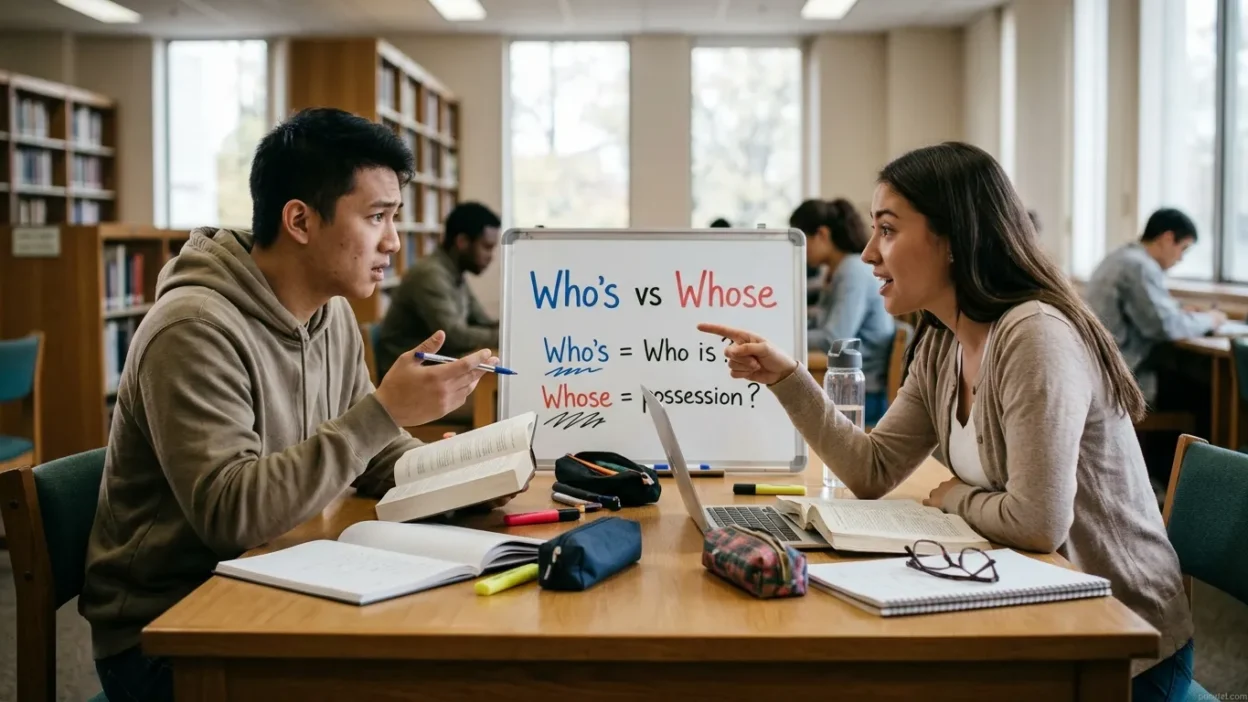
Who’s is a contraction of who is or who has. For example, “Who’s coming to the party?” Whose shows ownership or possession. For example, “Whose bag is this?” Both words sound alike, but their meanings and grammatical functions are different.
Why Do People Confuse Who’s and Whose?
People often confuse these words because they are homophones. This means they have the same pronunciation but different meanings and spellings.
There are three main reasons for this confusion:
- Same pronunciation: Who’s and whose sound identical in everyday speech.
- Similar spelling: Both words begin with “who,” making them easy to mix up.
- Different grammar rules: One is a contraction, while the other expresses possession.
For example:
- Who’s your English teacher? (Who is your English teacher?)
- Whose English book is this? (Who owns this English book?)
The easiest way to avoid mistakes is to understand what each word does in a sentence.
1. What Does Who’s Mean?
Who’s is the contracted form of either who is or who has. It combines two words into one and is commonly used in informal conversations, everyday writing, messages, and questions.
The apostrophe replaces the missing letters in the contraction.
Who’s as a Contraction of Who Is
Use who’s when you mean “who is.”
Examples:
- Who’s at the door? (Who is at the door?)
- Who’s your favorite singer? (Who is your favorite singer?)
- Who’s responsible for this project? (Who is responsible for this project?)
- Who’s ready for dinner? (Who is ready for dinner?)
Who’s as a Contraction of Who Has
Who’s can also mean “who has,” especially when followed by a past participle.
Examples:
- Who’s finished the assignment? (Who has finished the assignment?)
- Who’s taken my notebook? (Who has taken my notebook?)
- Who’s seen this movie? (Who has seen this movie?)
- Who’s completed the homework? (Who has completed the homework?)
Important grammar tip: If you can replace who’s with “who is” or “who has” without changing the intended meaning, who’s is the correct choice.
2. What Does Whose Mean?
Whose is a possessive form of the pronoun “who.” It is used to ask about ownership or identify the person something belongs to.
It can also introduce a relative clause that provides more information about someone or something.
Unlike who’s, whose does not contain an apostrophe.
Whose in Questions About Ownership
Use whose when asking who owns something or who something belongs to.
Examples:
- Whose phone is ringing?
- Whose shoes are these?
- Whose car is parked outside?
- Whose idea was this?
In each example, whose asks about ownership or the person connected to something.
Whose in Statements
Whose is also used in statements to show possession or a relationship.
Examples:
- I know a girl whose brother is a doctor.
- The student whose bag was missing found it.
- She is the writer whose book won an award.
- We met a family whose house is near the beach.
Important grammar tip: Use whose when you are talking about ownership, relationships, or something associated with a person.
Who’s vs Whose: Comparison Table
The following table makes the difference between these two commonly confused words easy to understand.
| Feature | Who’s | Whose |
|---|---|---|
| Meaning | Who is or who has | Belonging to whom |
| Grammar | Contraction | Possessive pronoun/determiner |
| Apostrophe | Yes | No |
| Main purpose | Asking about a person or action | Showing ownership |
| Example | Who’s calling? | Whose phone is this? |
| Replacement test | Who is / who has | Belonging to whom |
| Usage | Questions and statements | Questions and statements |
When Should You Use Who’s or Whose?
Knowing when to use each word will help you write clearer and more grammatically correct sentences.
When to Use Who’s
Choose who’s when you can replace it with “who is” or “who has.”
Use it when:
- Asking who someone is.
- Asking who is performing an action.
- Talking about someone’s current condition.
- Asking who has completed an activity.
- Writing informal questions or statements.
Examples:
- Who’s your new neighbor?
- Who’s waiting outside?
- Who’s been working here?
- Who’s responsible for the decision?
When to Use Whose
Choose whose when you want to show ownership or a connection between people and things.
Use it when:
- Asking who owns an object.
- Identifying someone’s belongings.
- Describing family relationships.
- Explaining who something is associated with.
- Adding information about a person in a sentence.
Examples:
- Whose jacket is on the chair?
- Whose children are playing outside?
- I met a teacher whose students love reading.
- Do you know whose keys these are?
15 Examples of Who’s vs Whose in Sentences
Here are 15 practical examples to help you understand the correct usage of both words.
Examples Using Who’s
- Who’s coming to the birthday party tonight?
- Who’s your favorite football player?
- Who’s responsible for cleaning the classroom?
- Who’s calling me so late?
- Who’s ready to start the meeting?
- Who’s completed the English assignment?
- Who’s been using my computer?
Examples Using Whose
- Whose notebook is lying on the desk?
- Whose shoes are these?
- Whose birthday is tomorrow?
- I have a friend whose father is a pilot.
- Do you know whose car is parked outside?
- The woman whose bag was stolen called the police.
- Whose idea was it to organize the event?
- We visited a family whose children study abroad.
These examples show that who’s refers to “who is” or “who has,” while whose expresses ownership or a relationship.
Common Mistakes When Using Who’s and Whose
Even experienced English speakers sometimes mix up these words. Here are some common mistakes and their corrections.
| Incorrect Sentence | Correct Sentence | Reason |
|---|---|---|
| Whose coming today? | Who’s coming today? | Means who is coming. |
| Who’s book is this? | Whose book is this? | Asks about ownership. |
| Whose responsible for this? | Who’s responsible for this? | Means who is responsible. |
| Who’s phone is ringing? | Whose phone is ringing? | Asks who owns the phone. |
| Who’s been to London? | Who’s been to London? | Means who has been. |
Mistake 1: Adding an Apostrophe to Whose
Incorrect: Whose’s bag is this?
Correct: Whose bag is this?
Whose already expresses possession, so it does not need an apostrophe.
Mistake 2: Using Who’s to Show Ownership
Incorrect: Who’s laptop is this?
Correct: Whose laptop is this?
Who’s means “who is” or “who has,” not “belonging to whom.”
Mistake 3: Assuming Every Possessive Word Needs an Apostrophe
Words such as his, hers, yours, and whose show possession without apostrophes.
For example:
- Whose jacket is this?
- Is this yours?
- That book is hers.
Easy Memory Trick: How to Remember Who’s vs Whose
Here is a simple trick to remember the difference:
Remember WHO’S = WHO IS or WHO HAS.
If you can expand who’s into either of these phrases, use the apostrophe.
Remember WHOSE = POSSESSION.
If you are asking who owns something or describing someone’s relationship to something, use whose.
Try these quick examples:
- Who’s your best friend? → Who is your best friend?
- Whose phone is this? → Who owns this phone?
The simple rule: Who’s has an apostrophe because it is shortened. Whose has no apostrophe because it already shows possession.
Who’s vs Whose in American and British English
There is no spelling difference between American and British English when it comes to who’s and whose.
Both varieties follow the same grammar rules:
- Who’s means who is or who has.
- Whose expresses possession or association.
Examples in both varieties:
- Who’s going to the meeting?
- Whose coat is hanging here?
- Who’s been using the printer?
- The student whose essay won the prize was delighted.
Although vocabulary and spelling can vary between American and British English, these two words are used in the same way in both.
Similar Words That Are Often Confused
English contains several words that sound alike or have similar spellings but different meanings. Learning these pairs can improve your grammar and writing.
- Your vs You’re: Your shows possession, while you’re means you are.
- Its vs It’s: Its shows possession, while it’s means it is or it has.
- There vs Their vs They’re: There refers to a place, their shows possession, and they’re means they are.
- Whose vs Who’s: Whose expresses possession, while who’s means who is or who has.
- To vs Too: To is commonly used as a preposition or before a verb, while too means also or excessively.
- Then vs Than: Then relates to time or sequence, while than is used in comparisons.
Understanding these differences will help you avoid common spelling and grammar mistakes.
Final Verdict
The correct choice depends on what you want to express.
- Use who’s when you mean “who is” or “who has.”
- Use whose when asking about ownership or describing a relationship.
For example:
- Who’s coming to dinner? (Who is coming?)
- Whose dinner invitation is this? (Who owns or sent the invitation?)
Both words are correct English, but they serve different grammatical purposes. Remember their meanings, and you will rarely confuse them again.
FAQs:
1. What is the main difference between who’s and whose?
Who’s is a contraction of “who is” or “who has,” whereas whose is a possessive word used to ask who owns something or to describe a relationship.
2. Is whose ever written with an apostrophe?
No. Whose does not need an apostrophe because it is already a possessive word. Writing “who’s” when you mean ownership is incorrect.
3. Is who’s short for who has?
Yes. Who’s can mean “who has” when asking about an action or experience.
Example: Who’s finished the project?
This means “Who has finished the project?”
4. How do I know whether to use who’s or whose?
Replace who’s with “who is” or “who has.” If the sentence still makes sense, use who’s. If you are asking about ownership, use whose.
5. Can whose be used for people and things?
Yes. Whose is commonly used for people and can also refer to organizations, animals, and things in certain contexts.
Example: The company whose products are popular opened a new office.
6. Are who’s and whose pronounced the same?
Yes. Both words are generally pronounced the same way in standard English. This is why people often confuse them when writing.
7. Which is correct: who’s book or whose book?
“Whose book” is correct because the sentence asks who owns the book.
Example: Whose book is lying on the table?
Remember This
- Who’s = Who is or Who has.
- Whose = Shows possession or association.
- Who’s always contains an apostrophe.
- Whose never needs an apostrophe.
- Both words sound the same but have different meanings.
- Use the replacement test to choose the correct word.
Conclusion
Understanding the difference between who’s and whose is an easy way to improve your English grammar. Although these words sound identical, their meanings are different. Who’s is a contraction of “who is” or “who has,” while whose is used to show ownership or describe a relationship. Learning these simple rules will help you avoid common writing mistakes.
Whenever you are unsure which word to use, try replacing who’s with “who is” or “who has.” If neither replacement works and you are asking about ownership, choose whose. With regular practice and the examples in this guide, you can confidently use both words in emails, conversations, schoolwork, and everyday writing.

Donald Andrew is the creative mind behind PunsJet.com, where he shares clever wordplay and humorous puns for readers around the world. With a passion for language and comedy, Donald enjoys crafting witty jokes that bring smiles to everyday conversations. His goal is to make humor simple, fun, and easy to share.