Have you ever wondered if to use switch or swap when talking about changing something? These two English words are closely related, and both describe situations where something changes. However, they do not always mean the same thing. Choosing the correct word depends on what you are changing and how that change happens.
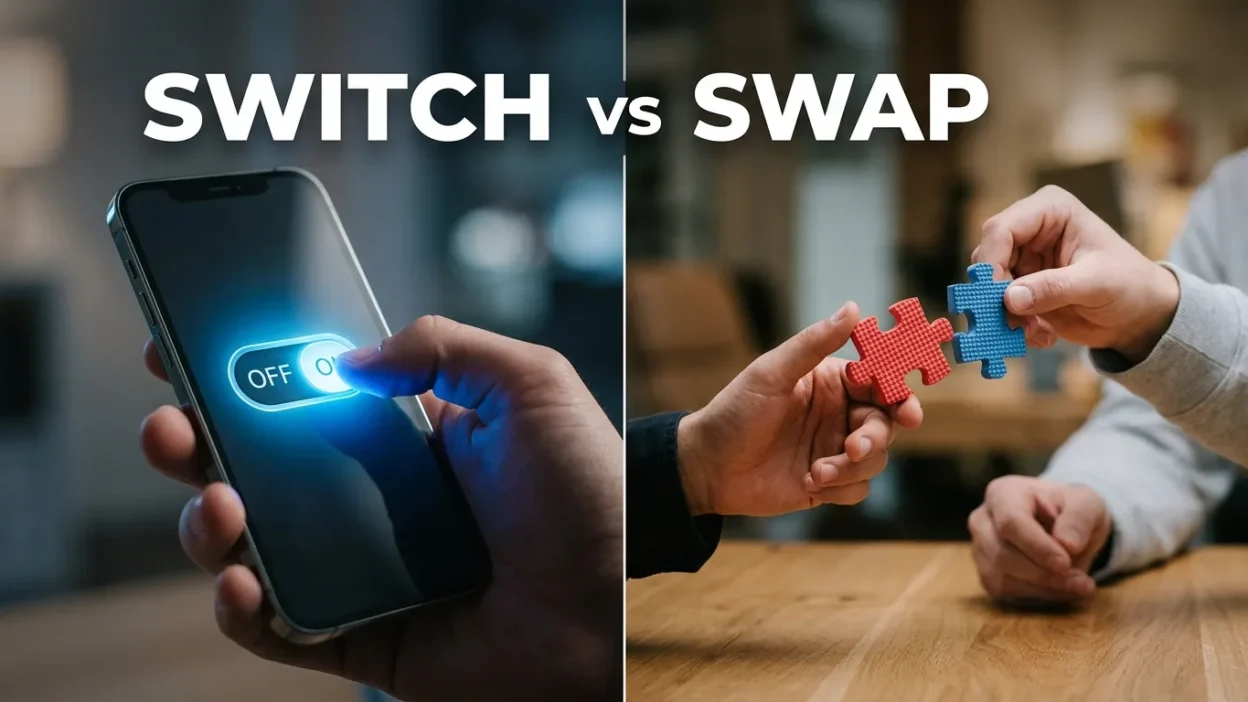
The main difference between switch and swap is that switch usually means to change from one thing, option, or position to another, while swap means to exchange one thing for another, often between two people or places. For example, you can switch off a light, switch jobs, or switch to another phone. You can swap clothes with a friend, swap seats, or swap gifts. Understanding this small difference will help you use both words naturally in conversations, emails, schoolwork, and everyday writing.
Quick Answer: Switch vs Swap
Switch means to change something from one option, position, or condition to another. Swap means to exchange two things, usually so that each person or place gets what the other had. For example, you switch channels on a television but swap seats with a friend.
Why Do People Confuse Switch and Swap?
People often confuse switch and swap because both words describe changing something.
In everyday English, their meanings sometimes overlap. For example:
- We switched seats.
- We swapped seats.
Both sentences can describe two people changing seats. However, swapped seats more clearly suggests that the people exchanged their original seats.
The confusion also happens because both words can be used as verbs and nouns.
The easiest way to remember their difference is:
- Switch: Change from one thing or option to another.
- Swap: Exchange one thing for another.
Let’s look at each word separately.
What Does Switch Mean?
Switch is a verb and noun that means to change from one thing, choice, position, or condition to another.
It often describes moving from one option to a different option. The change does not always involve another person or an exchange.
Switch as a Verb
As a verb, switch means to change something or move to another option.
Examples:
- I want to switch my phone.
- She switched her job last year.
- Please switch off the lights.
- We switched to a different channel.
- He switched from coffee to tea.
In these examples, something changes from its previous state or option.
Switch as a Noun
As a noun, switch can mean a device used to turn something on or off, or an act of changing.
Examples:
- Turn on the light switch.
- There was a sudden switch in plans.
- The switch controls the fan.
Common Expressions with Switch
Here are some common expressions:
- Switch on: Turn something on.
- Switch off: Turn something off.
- Switch over: Change to another channel, system, or option.
- Switch to: Move to a different choice.
- Switch places: Exchange positions with someone.
What Does Swap Mean?
Swap is a verb and noun that means to exchange one thing for another.
It usually involves two people, objects, positions, or things that are exchanged.
Unlike switch, which can simply describe changing an option, swap often suggests that both sides give and receive something.
Swap as a Verb
As a verb, swap means to exchange something with another person or thing.
Examples:
- I swapped my book with my friend.
- They swapped seats during the journey.
- We swapped phone numbers.
- She swapped her red dress for a blue one.
- The children swapped their toys.
In these examples, something is exchanged between two sides.
Swap as a Noun
As a noun, swap means an exchange or arrangement in which people trade things.
Examples:
- We made a book swap at school.
- The players agreed to a shirt swap.
- It was a fair swap.
- They completed the player swap yesterday.
Common Expressions with Swap
- Swap places: Exchange positions.
- Swap seats: Exchange seats.
- Swap stories: Share stories with each other.
- Swap ideas: Exchange thoughts or suggestions.
- Swap something for something: Exchange one item for another.
Switch vs Swap: Comparison Table
| Feature | Switch | Swap |
|---|---|---|
| Main meaning | Change from one thing to another | Exchange things |
| Main purpose | Change an option or condition | Give and receive something |
| Common use | Devices, jobs, plans, choices | Clothes, seats, gifts, items |
| People involved | One or more | Often two or more |
| Verb form | Switch | Swap |
| Past tense | Switched | Swapped |
| -ing form | Switching | Swapping |
| Example | Switch the TV channel | Swap books with a friend |
Important: Both words can sometimes be used in the same situation, but they may emphasize different aspects of the action.
When Should You Use Switch or Swap?
Choosing between these words becomes easier when you understand the situation.
When to Use Switch
Use switch when someone changes from one option, position, or condition to another.
Common situations include:
1. Changing devices or settings
- Switch off your computer.
- I switched my phone to silent mode.
2. Changing jobs or activities
- She switched careers.
- He switched from football to basketball.
3. Changing choices or preferences
- I switched to a healthier diet.
- They switched their travel plans.
4. Changing positions
- We switched places in the classroom.
- The players switched sides.
When to Use Swap
Use swap when two people or things exchange something.
Common situations include:
1. Exchanging personal belongings
- I swapped books with my classmate.
- They swapped their old phones.
2. Exchanging seats or positions
- Can we swap seats?
- The students swapped places.
3. Exchanging information
- We swapped phone numbers.
- They swapped ideas during the meeting.
4. Exchanging gifts or items
- The children swapped presents.
- I swapped my jacket for his coat.
15 Examples of Switch vs Swap in Sentences
The following examples show how to use both words correctly in everyday English.
Examples of Switch
- I decided to switch my internet provider.
- Please switch off the television before leaving.
- She switched from tea to coffee.
- We need to switch our meeting time.
- He switched his attention to another task.
- My brother wants to switch schools next year.
- They switched the game to another channel.
- I switched my phone to airplane mode.
Examples of Swap
- I swapped my lunch with my friend’s sandwich.
- The students swapped their notebooks.
- Can we swap seats for a better view?
- They swapped gifts during the party.
- My sister and I swapped clothes.
- We swapped phone numbers after the meeting.
- The two players swapped jerseys after the match.
Common Mistakes When Using Switch and Swap
Although these words are related, using them incorrectly can sometimes make your meaning unclear.
Here are some mistakes to avoid.
Mistake 1: Thinking Both Words Always Mean the Same Thing
Incorrect understanding: Switch and swap can be used in every situation.
Correct understanding: Switch means changing an option or condition, while swap usually means exchanging things.
Mistake 2: Using Swap for Turning Something On or Off
Incorrect: Please swap off the lights.
Correct: Please switch off the lights.
Switch off is the correct expression when turning off an electrical device.
Mistake 3: Using Switch When You Specifically Mean Exchange
Less clear: I switched books with my friend.
More natural: I swapped books with my friend.
The second sentence clearly communicates that both people exchanged books.
Mistake 4: Forgetting the Correct Past Tense
Both words form their past tense by adding -ed.
- Switch → Switched
- Swap → Swapped
Examples:
- We switched seats yesterday.
- We swapped our books yesterday.
What Is an Easy Memory Trick for Switch vs Swap?
You can remember these words with two simple ideas:
- Switch = Change: Think about switching a television channel or changing your phone settings.
- Swap = Exchange: Think about swapping toys, books, or seats with another person.
Remember this simple sentence:
You switch your choice, but you swap your things.
This trick will help you choose the correct word in most everyday situations.
Switch vs Swap in American and British English
Both switch and swap are commonly used in American and British English.
There is no major spelling difference between the two varieties.
| Word | American English | British English |
|---|---|---|
| Switch | Switch | Switch |
| Swap | Swap | Swap |
| Switched | Switched | Switched |
| Swapped | Swapped | Swapped |
Both expressions are natural in everyday conversations, formal writing, emails, and educational materials.
For example:
- American English: I want to switch my mobile phone plan.
- British English: I want to switch my mobile phone plan.
- American English: Let’s swap seats.
- British English: Let’s swap seats.
The main difference is not regional spelling but the meaning and context of each word.
Similar Words Related to Switch and Swap
Several other English words have meanings related to changing or exchanging things.
Understanding them can help you expand your vocabulary.
| Word | Meaning | Example |
|---|---|---|
| Exchange | Give something and receive another thing | We exchanged gifts. |
| Trade | Exchange goods or services | They traded football cards. |
| Replace | Put something new in place of something old | I replaced my phone. |
| Change | Make something different | She changed her hairstyle. |
| Alternate | Take turns or change between options | We alternate between two activities. |
| Substitute | Use one thing instead of another | You can substitute milk for cream. |
Although these words are related, they are not always interchangeable.
For example, replace usually means putting something else in place of an existing item, while swap emphasizes an exchange.
Final Verdict: Switch or Swap?
The correct word depends on what you want to describe.
Use switch when you mean changing from one option, position, setting, or condition to another. Use swap when you mean exchanging something with another person or thing.
For example:
- Switch the television channel.
- Swap your seat with your friend.
- Switch to another phone plan.
- Swap books with a classmate.
Both words are correct English words, but understanding their different meanings will make your speaking and writing clearer.
FAQs:
1. What is the main difference between switch and swap?
The main difference is that switch means changing from one option or condition to another, while swap means exchanging two things. For example, you switch television channels but swap books with a friend.
2. Are switch and swap interchangeable?
Sometimes, yes. Both words can describe changing positions or places. However, swap emphasizes an exchange, while switch focuses more generally on making a change.
3. Is it correct to say switch seats or swap seats?
Both expressions are correct. Switch seats means changing seats, while swap seats more clearly suggests that two people exchange their seats.
4. Should I say switch clothes or swap clothes?
Both can be correct, depending on the situation. Use swap clothes when two people exchange clothing. Use switch clothes when someone changes from one outfit to another.
5. What is the difference between switch and exchange?
Switch generally means changing something to another option or condition. Exchange specifically means giving something and receiving something else in return.
6. Is swap formal or informal English?
Swap is common in everyday English and is generally conversational. However, it is also acceptable in many professional and written contexts. In more formal situations, exchange may sometimes be preferred.
7. What are the past tense forms of switch and swap?
The past tense of switch is switched, and the past tense of swap is swapped. For example, “We switched our plans” and “We swapped our books.”
Remember This
- Switch = Change from one option, position, or condition to another.
- Swap = Exchange something with another person or thing.
- Switch off the lights.
- Swap books with a friend.
- Both words can sometimes describe the same action, but their meanings are not always identical.
Conclusion
Understanding the difference between switch and swap is easier than it may seem. Both words describe some type of change, but they focus on different actions. Switch is generally used when changing from one option, setting, or condition to another. Swap is used when two people or things exchange something.
The next time you write an English sentence, think about the action you want to describe. Are you simply changing something, or are you exchanging it with someone else? If you are changing an option, use switch. If you are exchanging something, use swap. With regular practice, you will be able to use both words naturally and confidently.