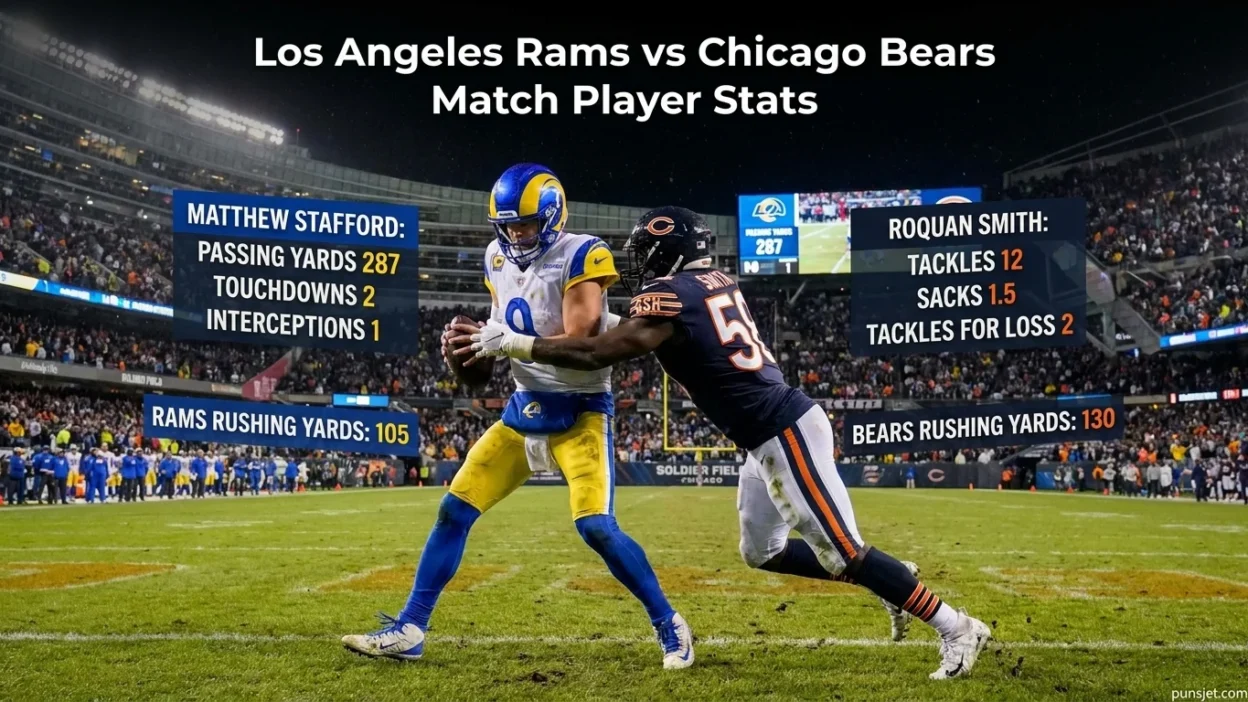
The Los Angeles Rams vs Chicago Bears match player stats from the 2026 NFC Divisional Round show a close game that went to overtime. The Rams defeated the Bears 20–17 at Soldier Field on January 18, 2026. Matthew Stafford completed 20 of 42 passes for 258 yards, while Kyren Williams led the Rams on the ground with 87 rushing yards and two touchdowns. For Chicago, Caleb Williams threw for 257 yards, two touchdowns, and three interceptions.
The game was close in several areas. Chicago produced 417 total net yards, compared with 340 for Los Angeles, and held the ball for more than 39 minutes. However, the Rams made the most important plays late in the game. Harrison Mevis won it in overtime with a 42-yard field goal, sending Los Angeles through to the NFC Championship Game.
Quick Answer
The Rams beat the Bears 20–17 in overtime on January 18, 2026. Kyren Williams was the Rams’ leading rusher with 87 yards and two touchdowns, while Matthew Stafford passed for 258 yards. Caleb Williams threw for 257 yards and two touchdowns but also had three interceptions.
Why Was This Match So Close?
The Rams and Bears produced very different statistical profiles.
Chicago moved the ball effectively, finishing with 417 total yards compared with 340 for Los Angeles. The Bears also controlled possession for 39:15, while the Rams had the ball for 32:26.
However, turnovers became a major difference.
Caleb Williams completed 23 of 42 passes for 257 yards, two touchdowns, and three interceptions. Matthew Stafford completed 20 of 42 for 258 yards without an interception.
That contrast helps explain why the Bears could gain more yards but still lose the game.
Los Angeles Rams Player Stats
Matthew Stafford
Matthew Stafford completed:
- 20 of 42 passes
- 258 passing yards
- 0 passing touchdowns
- 0 interceptions
- 67.4 passer rating
- 4 sacks for 29 yards
Stafford did not have a touchdown pass, but he protected the football and finished with slightly more passing yards than Caleb Williams.
Kyren Williams
Kyren Williams was one of the biggest reasons Los Angeles won.
His rushing numbers were:
- 21 carries
- 87 rushing yards
- 2 rushing touchdowns
- 10-yard long run
- 4 receptions for 30 yards
His two rushing touchdowns accounted for both of the Rams’ touchdowns during regulation.
Puka Nacua
Puka Nacua was an important part of the Rams passing attack:
- 5 receptions
- 56 receiving yards
- 10 targets
- 16-yard longest reception
- 0 touchdowns
Nacua tied Colby Parkinson for the Rams’ receiving-yard lead with 56 yards.
Colby Parkinson
Parkinson also finished with 56 receiving yards:
- 3 receptions
- 56 yards
- 7 targets
- 35-yard longest reception
- 0 touchdowns
His 35-yard reception was the longest catch by a Rams player in the game.
Chicago Bears Player Stats
Caleb Williams
Caleb Williams produced strong yardage numbers but struggled with turnovers.
His final passing line was:
- 23 of 42 completions
- 257 passing yards
- 2 passing touchdowns
- 3 interceptions
- 59.3 passer rating
- 5 rushing attempts
- 40 rushing yards
He also made plays with his legs, averaging 8.0 yards per rushing attempt.
D’Andre Swift
D’Andre Swift led Chicago in rushing:
- 19 carries
- 76 rushing yards
- 4.0 yards per carry
- 13-yard longest run
- 0 touchdowns
Swift also added four receptions for 36 yards according to the game receiving statistics.
D.J. Moore
D.J. Moore was one of Chicago’s top receiving players.
He finished with:
- 5 receptions
- 52 receiving yards
- 8 targets
- 34-yard longest catch
- 1 touchdown
His touchdown came on a three-yard pass from Caleb Williams in the second quarter.
Colston Loveland
Colston Loveland recorded:
- 4 receptions
- 56 yards
- 10 targets
- 23-yard longest reception
- 0 touchdowns
His 56 receiving yards tied him for the Bears’ highest total in the game.
Comparison Table
| Player | Team | Passing | Rushing | Receiving | TDs |
|---|---|---|---|---|---|
| Matthew Stafford | Rams | 258 yds | -1 yd | — | 0 |
| Kyren Williams | Rams | — | 87 yds | 30 yds | 2 |
| Puka Nacua | Rams | — | 6 yds | 56 yds | 0 |
| Colby Parkinson | Rams | — | — | 56 yds | 0 |
| Caleb Williams | Bears | 257 yds | 40 yds | — | 2 pass |
| D’Andre Swift | Bears | — | 76 yds | 36 yds | 0 |
| D.J. Moore | Bears | — | 8 yds | 52 yds | 1 |
| Colston Loveland | Bears | — | — | 56 yds | 0 |
The figures above come from the game’s box score and player-stat tables.
When Should You Look at Each Statistic?
Different statistics explain different parts of an NFL game.
Passing Stats
Passing yards, completions, touchdowns, interceptions, and passer rating help explain quarterback performance.
For this game, Stafford had 258 yards and no interceptions, while Williams had 257 yards and three interceptions.
Rushing Stats
Rushing statistics show how effectively a team moved the ball on the ground.
The Rams had 111 rushing yards, led by Kyren Williams’ 87 yards. Chicago had 160 rushing yards, led by Swift’s 76 yards.
Receiving Stats
Receiving numbers show which players were most involved in the passing game.
For Los Angeles, Nacua and Parkinson each had 56 yards. For Chicago, Loveland had 56 yards, while Moore had 52 yards and a touchdown.
10+ Important Examples From the Game
- Kyren Williams scored two rushing touchdowns.
- Matthew Stafford passed for 258 yards.
- Caleb Williams passed for 257 yards.
- Caleb Williams threw two touchdown passes.
- Caleb Williams threw three interceptions.
- D’Andre Swift rushed for 76 yards.
- Puka Nacua caught five passes for 56 yards.
- Colby Parkinson caught a 35-yard pass.
- D.J. Moore scored one receiving touchdown.
- Cole Kmet also caught a touchdown pass for Chicago.
- Chicago finished with 417 total net yards.
- Los Angeles finished with 340 total net yards.
- Harrison Mevis kicked the game-winning 42-yard field goal in overtime.
Common Mistakes When Reading NFL Player Stats
One common mistake is assuming that the quarterback with more touchdowns automatically had the better overall game. Touchdowns matter, but interceptions can have a major effect on the result.
Another mistake is looking only at total yards. Chicago gained 417 yards, substantially more than Los Angeles’ 340, but the Rams still won.
It is also important to separate passing touchdowns from rushing touchdowns. Stafford had zero passing touchdowns, but Williams scored two rushing touchdowns.
Memory Trick
A simple way to remember the most important numbers is:
“Williams ran, Stafford protected, Mevis finished.”
Kyren Williams scored two rushing touchdowns, Stafford threw no interceptions, and Harrison Mevis kicked the overtime winner.
For Chicago, remember:
“Caleb threw 2, but picked 3.”
That quickly summarizes Caleb Williams’ two touchdown passes and three interceptions.
American vs British English
NFL statistics are normally presented using American football terminology.
Common terms include:
- Yards — not metres
- Touchdown — not a score or try
- Running back — common American football position
- Quarterback — the main passer
- Field goal — a scoring kick
- Overtime — extra playing time after a tied game
British English readers may understand these terms easily, but the vocabulary comes from American football.
Similar Words and Related Football Terms
Several football terms can sound similar but describe different statistics:
- Passing yards: yards gained through completed forward passes.
- Rushing yards: yards gained by running with the ball.
- Receiving yards: yards gained by a player after catching passes.
- Total yards: combined passing and rushing yardage for a team.
- Completion: a successful pass caught by a receiver.
- Target: a pass thrown toward a receiver.
- Interception: a pass caught by the opposing team.
- Touchdown: a scoring play worth six points before any extra-point attempt.
Understanding these terms makes a box score much easier to read.
FAQs:
Who won the Rams vs Bears game?
The Los Angeles Rams defeated the Chicago Bears 20–17 in overtime in the NFC Divisional Round on January 18, 2026.
How many yards did Matthew Stafford have?
Matthew Stafford passed for 258 yards on 20 completions from 42 attempts. He threw no touchdowns and no interceptions.
How many yards did Caleb Williams have?
Caleb Williams passed for 257 yards, completing 23 of 42 attempts. He threw two touchdowns and three interceptions. He also rushed for 40 yards.
How many rushing touchdowns did Kyren Williams score?
Kyren Williams scored two rushing touchdowns and finished with 87 rushing yards on 21 carries.
Who led the Bears in rushing?
D’Andre Swift led Chicago with 76 rushing yards on 19 carries.
Who led the Rams in receiving?
Puka Nacua and Colby Parkinson both finished with 56 receiving yards. Nacua had five receptions, while Parkinson had three.
How did the Rams win in overtime?
Harrison Mevis kicked a 42-yard field goal in overtime, giving Los Angeles a 20–17 victory.
Did the Bears have more total yards?
Yes. Chicago finished with 417 total net yards, while Los Angeles had 340. Despite that advantage, the Bears lost after committing three interceptions.
Remember This
The most important numbers from the game are:
- Final score: Rams 20, Bears 17
- Result: Rams won in overtime
- Stafford: 258 passing yards, 0 INT
- Caleb Williams: 257 passing yards, 2 TD, 3 INT
- Kyren Williams: 87 rushing yards, 2 TD
- D’Andre Swift: 76 rushing yards
- Rams total yards: 340
- Bears total yards: 417
- Game-winning kick: Harrison Mevis, 42 yards
Conclusion
The Rams vs Bears matchup was a strong example of why football statistics need to be viewed together. Chicago gained more total yards and controlled possession, but Los Angeles avoided interceptions and made the decisive plays when the game mattered most. Kyren Williams supplied two important rushing touchdowns, while Stafford managed the passing game without giving the Bears an interception.
For Chicago, Caleb Williams showed his ability to move the ball through the air and on the ground, but his three interceptions became a major factor. The Rams ultimately survived the close contest through overtime, with Harrison Mevis providing the final 42-yard field goal. The 20–17 victory sent Los Angeles onward in the playoffs.

Joshua Paul is a creative writer and contributor at PunsJet.com who enjoys crafting witty puns and clever wordplay. With a strong sense of humor and a love for language, he creates entertaining content that readers can easily share and enjoy. Joshua’s goal is to spread laughter through fun and memorable jokes.