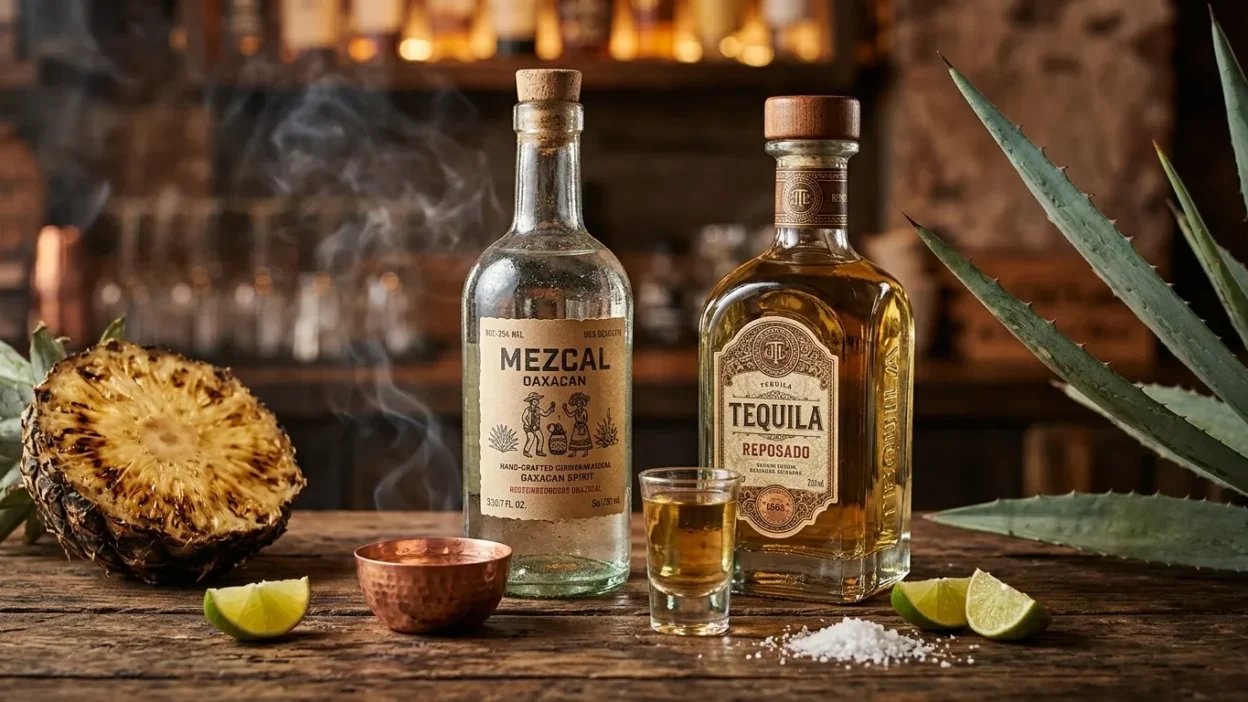
Mezcal vs tequila is a common comparison for people who want to understand the differences between these two popular Mexican spirits. Both drinks are made from agave plants, and both have deep roots in Mexican culture. However, they are not exactly the same. Their ingredients, production methods, flavors, and places of origin help make each drink unique.
The main difference is that tequila is made only from blue Weber agave, while mezcal can be made from many different agave species. Tequila usually has a clean, fresh, and slightly sweet taste, while mezcal often has a smoky flavor because its agave hearts are traditionally cooked in underground pits. However, not every mezcal tastes strongly smoky, and both drinks can have different flavors depending on how they are produced and aged. Understanding these differences can help you recognize each spirit, choose the right one for a recipe, and learn more about Mexican drinks.
Quick Answer
Mezcal and tequila are Mexican spirits made from agave. Tequila must use blue Weber agave and is usually associated with a clean, earthy, or slightly sweet taste. Mezcal can use several agave species and often has a smoky flavor. Both drinks can be enjoyed neat or mixed into cocktails.
Why Do People Confuse Mezcal and Tequila?
People often confuse mezcal and tequila because they share several important features.
- Both are traditional Mexican spirits.
- Both are made from agave plants.
- Both are available in clear and aged varieties.
- Both can be served neat, on ice, or in cocktails.
- Both have earthy flavors that come from agave.
The biggest reason for the confusion is that tequila is a type of mezcal in the historical sense of the word, but modern tequila and mezcal are produced under separate legal rules and standards. They have different requirements for the agave used, production methods, and approved regions.
Think of them as related drinks with different identities rather than two names for exactly the same product.
What Is Mezcal?
Mezcal is a traditional Mexican alcoholic spirit made from the cooked hearts of agave plants. These hearts are called piñas because their shape resembles a pineapple.
Mezcal can be made from different agave species, including espadín, tobalá, and tepeztate. The agave variety, growing conditions, and production method can all affect the final flavor.
How Is Mezcal Made?
Traditional mezcal production often involves several steps:
- Harvesting: Workers cut mature agave plants and remove their leaves.
- Cooking: The agave hearts are often cooked in underground pits with hot stones, which can create a smoky flavor.
- Crushing: The cooked agave is crushed to release its sweet juice and fibers.
- Fermentation: Natural or selected yeasts turn the sugars into alcohol.
- Distillation: The fermented liquid is distilled to produce mezcal.
- Aging: Some mezcal is bottled without aging, while other varieties rest in containers or wooden barrels.
Not every producer follows exactly the same method. Some modern producers use ovens instead of underground pits, so their mezcal may have a lighter smoky taste.
What Does Mezcal Taste Like?
Mezcal can have a wide range of flavors, including:
- Smoky: A flavor often associated with traditional pit cooking.
- Earthy: A natural taste that can remind people of soil or minerals.
- Herbal: Notes similar to fresh herbs or green plants.
- Fruity: Some varieties have citrus, tropical fruit, or other fruit-like notes.
- Sweet: Cooked agave can give the spirit a gentle sweetness.
The flavor depends on the agave species, production process, and aging method. Some mezcal is smoky and bold, while other varieties are lighter and more delicate.
What Is Tequila?
Tequila is a Mexican spirit made exclusively from blue Weber agave. It is produced in designated areas of Mexico under specific regulations. Jalisco is its main production region, although approved areas in other Mexican states can also produce tequila.
Tequila is one of the best-known agave spirits in the world. It is often used in cocktails such as the margarita and the Paloma.
How Is Tequila Made?
Tequila production generally follows these steps:
- Harvesting: Workers collect mature blue Weber agave plants.
- Cooking: The agave hearts are cooked in ovens or other approved equipment to turn their stored carbohydrates into fermentable sugars.
- Extraction: The cooked agave is crushed or processed to collect its juice.
- Fermentation: Yeast converts the sugars into alcohol.
- Distillation: The liquid is distilled to create tequila.
- Aging or bottling: The tequila may be bottled without extended aging or placed in approved containers or wooden barrels.
Compared with traditional pit-cooked mezcal, tequila production often uses ovens that produce less smoke. However, production methods vary, and some tequilas can have roasted, earthy, or smoky notes.
What Does Tequila Taste Like?
Tequila’s flavor depends on the agave, production method, and age.
Common flavor notes include:
- Fresh agave: A sweet, plant-like taste.
- Citrus: Lemon, lime, or orange-like notes.
- Pepper: A gentle spicy flavor.
- Herbal: Green or earthy notes.
- Vanilla and caramel: Flavors that may develop during barrel aging.
Blanco tequila is often fresh and bright, while aged tequila can have deeper flavors from the wooden barrel.
Mezcal vs Tequila: Comparison Table
| Feature | Mezcal | Tequila |
|---|---|---|
| Main ingredient | Several permitted agave species | Blue Weber agave only |
| Origin | Approved Mexican regions | Approved Mexican regions |
| Common flavor | Smoky, earthy, herbal, or fruity | Fresh, sweet, peppery, or earthy |
| Cooking method | Often underground pit cooking | Often oven cooking |
| Production | Traditional and modern methods | Regulated production methods |
| Common cocktail | Mezcal Margarita | Classic Margarita |
| Popular varieties | Joven, reposado, añejo | Blanco, reposado, añejo |
| Appearance | Clear to amber, depending on aging | Clear to amber, depending on aging |
| Alcohol content | Varies by product | Varies by product |
| Best-known feature | Flavor variety and traditional smoky notes | Blue agave flavor and cocktail versatility |
When Should You Choose Mezcal or Tequila?
The right choice depends on the flavor you enjoy and how you plan to serve the drink.
When Should You Choose Mezcal?
Choose mezcal if you want:
- A smoky or earthy flavor in your drink.
- A spirit with a wide range of agave varieties.
- A distinctive ingredient for a cocktail.
- A drink to explore slowly and compare across producers.
- A different flavor profile for a margarita.
For example, a mezcal margarita can have a deeper, smokier taste than one made with a bright blanco tequila.
When Should You Choose Tequila?
Choose tequila if you want:
- A spirit made from blue Weber agave.
- A fresh, clean taste for cocktails.
- A familiar base for margaritas and Palomas.
- A variety of flavors, from bright blanco to rich añejo.
- An option that works well in many classic cocktail recipes.
For example, a classic margarita made with blanco tequila usually highlights citrus and agave flavors.
12 Examples of Mezcal vs Tequila in Everyday Use
These examples show how the two spirits can be discussed in everyday English.
- Mezcal often has a smoky flavor, while tequila may taste fresher and sweeter.
- Maria ordered mezcal because she wanted to try a traditional agave spirit.
- Daniel used tequila to prepare a classic margarita.
- Some mezcal is made from espadín agave.
- Tequila must be made from blue Weber agave.
- The bartender added mezcal to give the cocktail a smoky character.
- A blanco tequila can have fresh agave and citrus notes.
- An aged mezcal may develop woody flavors.
- Both mezcal and tequila are associated with Mexico.
- The restaurant offered a mezcal margarita alongside its traditional tequila version.
- The customer compared the earthy flavors of mezcal with the peppery notes of tequila.
- Although they are related spirits, mezcal and tequila have different production requirements.
Common Mistakes About Mezcal and Tequila
Mistake 1: Thinking They Are Exactly the Same
Both are agave spirits, but they have different legal definitions and production requirements.
Correct understanding: Tequila uses blue Weber agave, while mezcal can use several permitted agave species.
Mistake 2: Assuming All Mezcal Is Smoky
Traditional pit cooking can create smoky flavors, but the strength of that flavor varies.
Correct understanding: Mezcal can be smoky, fruity, herbal, earthy, or relatively mild.
Mistake 3: Believing Tequila Is Always Smooth
Tequila can taste peppery, sharp, sweet, earthy, or complex. Its flavor depends on the product and how it is made.
Correct understanding: Neither spirit has just one flavor.
Mistake 4: Thinking Color Always Shows Quality
Clear spirits are not automatically lower quality, and darker spirits are not automatically better.
Correct understanding: Color can be influenced by aging and other permitted production practices.
Mistake 5: Assuming Mezcal and Tequila Come From the Same Region
Their approved production areas overlap in some places, but their legal geographical requirements are not identical.
Correct understanding: Check the spirit’s label and origin if you want to know where it was produced.
Memory Trick: How to Remember the Difference
Use this simple memory trick:
- Mezcal = Many agave types. Remember that mezcal can be made from several permitted agave species.
- Tequila = Blue agave. Remember that tequila must use blue Weber agave.
For flavor, remember that mezcal is often smoky, while tequila is often fresh and agave-forward.
These are helpful starting points, not strict rules for every bottle.
American vs British English
There is no important spelling difference between mezcal and tequila in American and British English.
Both terms are used in the United States, the United Kingdom, and other English-speaking countries. The spelling stays the same, although pronunciation and local drinking traditions may vary.
Examples:
- American English: “This restaurant serves mezcal and tequila.”
- British English: “This bar offers a selection of mezcal and tequila.”
In both examples, the words refer to the same types of Mexican spirits.
Similar Words and Related Terms
Learning these related terms can make the difference between mezcal and tequila easier to understand.
- Agave: A plant used to produce mezcal and tequila.
- Blue Weber agave: The only agave species permitted for tequila production.
- Espadín: A common agave species used to make mezcal.
- Blanco: A clear spirit, usually bottled with little or no aging.
- Reposado: A spirit aged for a limited period in approved containers, including wooden barrels where permitted.
- Añejo: A spirit aged longer than reposado under the applicable rules.
- Piña: The central heart of an agave plant after its leaves are removed.
- Distillation: The process used to separate and concentrate alcohol from a fermented liquid.
- Fermentation: The process in which yeast converts sugars into alcohol.
- Margarita: A cocktail commonly made with tequila, citrus juice, and an orange-flavored liqueur, though mezcal versions are also popular.
FAQs:
1. Is mezcal the same as tequila?
No. Both are Mexican spirits made from agave, but tequila must use blue Weber agave, while mezcal can use several permitted agave species. Their production requirements also differ.
2. Which is stronger, mezcal or tequila?
Neither is always stronger. Alcohol content varies by bottle and producer. Check the alcohol by volume (ABV) on the label to compare two specific products accurately.
3. Why does mezcal taste smoky?
Many traditional mezcal producers cook agave hearts in underground pits with hot stones. This can give the spirit a smoky flavor. Other production methods may create less smoke.
4. Is tequila a type of mezcal?
Historically, tequila is related to the broader family of agave spirits often called mezcal. Today, however, tequila and mezcal are separately regulated categories with their own production requirements.
5. Can you use mezcal instead of tequila in a margarita?
Yes. Mezcal can replace tequila in a margarita. The result often has a smokier and earthier taste. Blanco tequila generally gives a more familiar, fresh agave flavor.
6. Which is better for beginners, mezcal or tequila?
Blanco tequila may be a familiar starting point for people who enjoy fresh, citrusy flavors. Mezcal may appeal to those who enjoy smoky or earthy notes. Personal taste matters more than the category.
7. Are mezcal and tequila both made in Mexico?
Yes. Both are Mexican spirits with legally defined production regions. Their approved geographical areas differ, although some regions are associated with both categories.
Remember This
- Mezcal can use several permitted agave species.
- Tequila must use blue Weber agave.
- Traditional mezcal is often smoky, but not always.
- Tequila often has fresh, sweet, peppery, or earthy notes.
- Both spirits can be used in cocktails or enjoyed neat.
- The best choice depends on your personal taste.
Conclusion
Understanding mezcal vs tequila is easier when you remember their main ingredient and production differences. Mezcal offers a wide range of flavors because it can be made from different agave species, and traditional cooking methods often give it smoky notes. Tequila uses blue Weber agave and commonly has fresh, sweet, or peppery flavors. Although the spirits are closely related, they are not interchangeable names for the same drink.
When choosing between them, think about the taste you want. Mezcal may be a good option for a smoky cocktail or a spirit with complex earthy notes, while tequila is a popular choice for classic margaritas and other refreshing drinks. Both reflect Mexico’s rich agave traditions, and trying different varieties can help you discover which flavor profile you enjoy most.

Joshua Paul is a creative writer and contributor at PunsJet.com who enjoys crafting witty puns and clever wordplay. With a strong sense of humor and a love for language, he creates entertaining content that readers can easily share and enjoy. Joshua’s goal is to spread laughter through fun and memorable jokes.