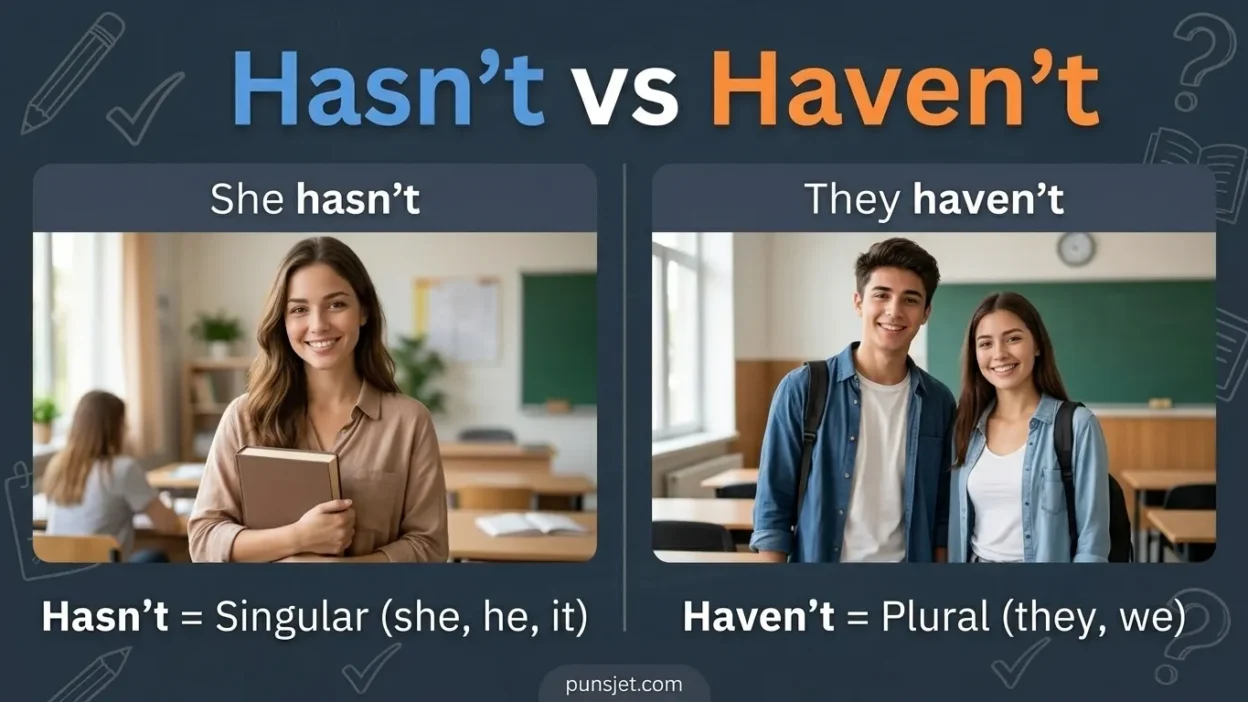
Have you ever wondered whether to write hasn’t or haven’t in a sentence? These two words look similar and both mean that something has not happened or someone does not have something in a particular context. However, they are used with different subjects, so choosing the correct one is important for clear English.
The main difference between hasn’t and haven’t is the subject of the sentence. Hasn’t is the contraction of “has not” and is used with he, she, it, and singular third-person nouns. Haven’t is the contraction of “have not” and is used with I, you, we, they, and plural nouns. Both are common in everyday conversations, emails, schoolwork, and informal writing.
Learning when to use each word will help you avoid common grammar mistakes. Once you understand how subjects work with these contractions, choosing the correct form becomes much easier.
Quick Answer: Hasn’t vs Haven’t
Hasn’t means “has not” and is used with he, she, it, or a singular third-person subject. Haven’t means “have not” and is used with I, you, we, they, or plural subjects. Both express a negative meaning, often in the present perfect tense or when talking about possession.
Examples:
- She hasn’t finished her homework.
- They haven’t finished their homework.
- He hasn’t arrived yet.
- We haven’t arrived yet.
Why Do People Confuse Hasn’t and Haven’t?
People often confuse these words because they have similar spellings, similar meanings, and the same negative word, “not.”
Both contractions are formed by combining a helping verb with “not”:
- Has + not = hasn’t
- Have + not = haven’t
The difficulty comes from knowing which helping verb matches the subject. English uses different forms of “have” depending on who or what the sentence is about.
For example:
- Correct: My brother hasn’t called me.
- Incorrect: My brother haven’t called me.
“My brother” refers to one person and can be replaced by “he,” so hasn’t is correct.
However:
- Correct: My brothers haven’t called me.
- Incorrect: My brothers hasn’t called me.
“My brothers” refers to more than one person, so haven’t is correct.
The key is to identify the subject before choosing the contraction.
What Does Hasn’t Mean?
Hasn’t is the contraction of “has not.” It is used with third-person singular subjects, including he, she, it, and singular nouns.
It commonly appears in the present perfect tense to describe an action that has not happened or a situation that has not changed up to the present moment.
When Should You Use Hasn’t?
Use hasn’t with these subjects:
- He: He hasn’t eaten breakfast.
- She: She hasn’t replied to my message.
- It: It hasn’t stopped raining.
- A singular name: Ahmed hasn’t arrived.
- A singular noun: The teacher hasn’t checked our work.
- An organization or group treated as singular: The company hasn’t announced its decision.
Examples of Hasn’t in Sentences
- She hasn’t completed her assignment.
- He hasn’t called his parents.
- My sister hasn’t returned home.
- The bus hasn’t arrived yet.
- The baby hasn’t fallen asleep.
- This computer hasn’t worked properly today.
- Sarah hasn’t seen that movie.
- The shop hasn’t opened yet.
In these sentences, the subjects are all singular third-person subjects.
Can Hasn’t Show Possession?
Yes, although the wording depends on the type of English being used.
For example:
- He hasn’t got a car.
- She hasn’t got enough time.
These sentences are common in British English and are also used in other varieties of English.
In American English, people often say “He doesn’t have a car” or “She doesn’t have enough time.” These alternatives are especially common when talking about possession.
What Does Haven’t Mean?
Haven’t is the contraction of “have not.” It is used with I, you, we, they, and plural nouns.
Like “hasn’t,” it often appears in the present perfect tense. It can describe an action that has not happened, an experience someone has not had, or a situation that remains unfinished.
When Should You Use Haven’t?
Use haven’t with these subjects:
- I: I haven’t finished my lunch.
- You: You haven’t answered my question.
- We: We haven’t visited that place.
- They: They haven’t arrived yet.
- Plural nouns: The students haven’t completed the test.
Remember that you always takes haven’t, whether you are talking to one person or several people.
Examples of Haven’t in Sentences
- I haven’t finished my homework.
- You haven’t told me the truth.
- We haven’t seen that movie.
- They haven’t completed the project.
- My friends haven’t arrived yet.
- The children haven’t eaten dinner.
- These phones haven’t been repaired.
- The players haven’t started the match.
Each subject matches “have,” making “haven’t” the correct choice.
Can Haven’t Show Possession?
Yes. For example:
- I haven’t got a pen.
- We haven’t got enough money.
- They haven’t got any questions.
In American English, “I don’t have a pen” and “We don’t have enough money” are also very common ways to express these ideas.
Hasn’t vs Haven’t: Comparison Table
| Feature | Hasn’t | Haven’t |
|---|---|---|
| Full form | Has not | Have not |
| Main use | Third-person singular subjects | I, you, we, they, and plural subjects |
| Pronouns | He, she, it | I, you, we, they |
| Singular names | Maria hasn’t called. | Not normally used with a singular third-person name |
| Plural nouns | Not normally used with plural subjects | The students haven’t arrived. |
| Present perfect | He hasn’t eaten. | They haven’t eaten. |
| Possession example | She hasn’t got a car. | We haven’t got a car. |
| Negative meaning | Something has not happened or is not the case | Something has not happened or is not the case |
The easiest rule to remember is this: he, she, and it take hasn’t; I, you, we, and they take haven’t.
When to Use Hasn’t vs Haven’t
Choosing the correct word becomes easier when you look at the subject and the meaning of the sentence.
Use Hasn’t With He, She, and It
Use “hasn’t” when the subject is one person or thing referred to in the third person.
Examples:
- He hasn’t finished his work.
- She hasn’t paid the bill.
- It hasn’t snowed this winter.
- My father hasn’t returned from work.
- The dog hasn’t eaten its food.
Use Haven’t With I, You, We, and They
Use “haven’t” with these pronouns and with plural nouns.
Examples:
- I haven’t finished my work.
- You haven’t paid the bill.
- We haven’t visited our grandparents.
- They haven’t received the package.
- The dogs haven’t eaten their food.
Use the Correct Form in Present Perfect Sentences
Both contractions are frequently used in the present perfect tense.
The basic pattern is:
Subject + hasn’t/haven’t + past participle
Examples:
- She hasn’t written the letter.
- He hasn’t taken his medicine.
- We haven’t written the letter.
- They haven’t taken the test.
Notice that the main verb uses its past participle form. For example, “written” is the past participle of “write,” and “taken” is the past participle of “take.”
Use the Subject to Choose the Correct Contraction
Consider how the sentence changes when the subject changes:
- My brother hasn’t arrived.
- My brothers haven’t arrived.
- The student hasn’t submitted the assignment.
- The students haven’t submitted the assignment.
Changing a singular subject to a plural subject often changes “hasn’t” to “haven’t.”
15 Examples of Hasn’t and Haven’t
These examples show how the two words work in everyday English.
Examples Using Hasn’t
- She hasn’t finished reading the book.
- He hasn’t cleaned his room.
- The teacher hasn’t explained the lesson yet.
- My mother hasn’t prepared dinner.
- The train hasn’t left the station.
- David hasn’t sent the email.
- The weather hasn’t improved today.
- Our team hasn’t won a game this season.
Examples Using Haven’t
- I haven’t finished reading the book.
- You haven’t cleaned your room.
- We haven’t learned this lesson before.
- They haven’t prepared dinner.
- My cousins haven’t visited us this year.
- The workers haven’t completed the repairs.
- The students haven’t submitted their assignments.
Examples in Questions and Conversations
The same distinction applies when asking questions or responding to them.
- Hasn’t she arrived yet?
- Haven’t they arrived yet?
- “Have you finished?” “No, I haven’t.”
- “Has he called?” “No, he hasn’t.”
These short responses are common in everyday conversations.
Common Mistakes With Hasn’t and Haven’t
Even confident English speakers can make mistakes when they choose a contraction without checking the subject.
Mistake 1: Using Haven’t With Consider
Incorrect: She haven’t finished her work.
Correct: She hasn’t finished her work.
Why? “She” is a third-person singular pronoun, so it takes “hasn’t.”
Mistake 2: Using Hasn’t With They
Incorrect: They hasn’t arrived.
Correct: They haven’t arrived.
Why? “They” takes “have,” even when it refers to a group of people.
Mistake 3: Using Hasn’t With I
Incorrect: I hasn’t seen that movie.
Correct: I haven’t seen that movie.
Why? The pronoun “I” always takes “have” in this construction.
Mistake 4: Forgetting the Past Participle
Incorrect: He hasn’t went home.
Correct: He hasn’t gone home.
Why? The present perfect tense uses a past participle after “has” or “have.” The past participle of “go” is “gone,” not “went.”
Other examples:
- Incorrect: She hasn’t ate breakfast.
- Correct: She hasn’t eaten breakfast.
- Incorrect: They haven’t saw the result.
- Correct: They haven’t seen the result.
Mistake 5: Confusing Hasn’t With Doesn’t
These forms are not interchangeable in every sentence.
- He hasn’t finished his homework.
- He doesn’t finish his homework on time.
The first sentence says that the homework remains unfinished. The second describes a habit or repeated situation.
For possession, “He doesn’t have a car” is also correct. Do not say “He doesn’t has a car.”
Memory Trick: How to Remember Hasn’t vs Haven’t
Use this simple trick:
HASn’t = He, She, It
HAVEn’t = I, You, We, They
The letters are not a complete grammatical explanation, but the pattern makes the rule easier to remember.
You can also remember these two sentences:
- She hasn’t finished.
- They haven’t finished.
Now change the subject and check which form sounds correct.
For extra practice, fill in the blanks:
- My sister ______ called me.
- We ______ completed the task.
- The children ______ eaten lunch.
- He ______ received the message.
Answers: 1. hasn’t, 2. haven’t, 3. haven’t, 4. hasn’t.
Hasn’t vs Haven’t in American and British English
The basic subject agreement rule is the same in both American and British English. Both varieties use “hasn’t” with he, she, it, and singular third-person nouns, while “haven’t” is used with I, you, we, they, and plural nouns.
However, the two varieties can differ in how they express possession.
| Meaning | American English | British English |
|---|---|---|
| No car | He doesn’t have a car. | He hasn’t got a car. |
| No time | She doesn’t have time. | She hasn’t got time. |
| No money | We don’t have enough money. | We haven’t got enough money. |
These are general preferences, not strict boundaries. Both constructions can be understood in either variety of English.
Also, British English commonly uses “have got” for possession, but “hasn’t” and “haven’t” still follow the subject agreement rules.
Similar Words: Hasn’t, Haven’t, and Hadn’t
These three contractions are related, but they refer to different grammatical forms.
- Hasn’t: Has not. Used with third-person singular subjects, often for a situation continuing up to the present.
- Haven’t: Have not. Used with I, you, we, they, and plural subjects, often for a situation continuing up to the present.
- Hadn’t: Had not. Used with all subjects when talking about something that had not happened before a past time.
Examples:
- She hasn’t arrived yet.
- They haven’t arrived yet.
- She hadn’t arrived when I left.
- They hadn’t arrived when I left.
Notice that “hadn’t” does not change according to whether the subject is singular or plural.
Another related expression is “doesn’t have,” which is commonly used to describe a lack of possession or a regular situation.
- He doesn’t have a bicycle.
- She hasn’t finished her homework.
Both sentences are correct, but they serve different grammatical purposes.
FAQs:
1. What is the main difference between hasn’t and haven’t?
“Hasn’t” means “has not” and is used with he, she, it, and singular third-person subjects. “Haven’t” means “have not” and is used with I, you, we, they, and plural subjects.
Examples: “She hasn’t arrived” and “They haven’t arrived.”
2. Is it correct to say “I hasn’t”?
No. The correct form is “I haven’t.” The pronoun “I” takes “have,” not “has,” in this construction.
Correct: I haven’t finished my work.
Incorrect: I hasn’t finished my work.
3. Should I use hasn’t or haven’t with everyone?
Use hasn’t with “everyone” because it is grammatically singular.
Correct: Everyone hasn’t arrived yet.
However, this sentence can be ambiguous. If you mean that no one has arrived, “No one has arrived yet” is clearer. If you mean that not everyone has arrived, write “Not everyone has arrived yet.”
4. Do you say “the team hasn’t” or “the team haven’t”?
Both forms can occur, depending on the variety of English and the intended meaning. American English generally treats collective nouns such as “team” as singular, so “The team hasn’t won” is standard. British English can use a plural verb when the members of a group are considered individually.
5. Is “hasn’t have” grammatically correct?
It depends on the sentence, but “hasn’t have” is generally incorrect when forming the present perfect or expressing possession in the usual way.
Correct present perfect: She hasn’t had breakfast.
Correct possession in American English: She doesn’t have a car.
Correct possession in a common British construction: She hasn’t got a car.
6. Can hasn’t and haven’t be used in questions?
Yes. They can appear at the beginning of negative questions.
Examples:
- Hasn’t he finished his work?
- Haven’t they finished their work?
These questions often express surprise, expectation, or a request for confirmation.
7. What is the difference between haven’t and hadn’t?
“Haven’t” is the contraction of “have not” and is commonly used for situations connected to the present. “Hadn’t” is the contraction of “had not” and refers to something that had not happened before a particular time in the past.
Examples:
- I haven’t eaten yet.
- I hadn’t eaten when they arrived.
8. Can I use hasn’t and haven’t in formal writing?
Yes. Both are grammatically correct, but contractions are often more common in conversational and informal writing. In formal academic writing or other contexts that require a more formal tone, you can use “has not” and “have not” instead.
Remember This
- Hasn’t = has not: He, she, it, or a singular third-person subject.
- Haven’t = have not: I, you, we, they, or a plural subject.
- Use a past participle after hasn’t or haven’t in the present perfect tense.
- Use “hadn’t” when referring to something that had not happened before a past event.
- Check the subject before choosing the contraction.
Conclusion
Understanding the difference between hasn’t and haven’t is simple once you learn which subjects use each word. Hasn’t goes with he, she, it, and singular third-person nouns, while haven’t goes with I, you, we, they, and plural nouns. Both forms help you express negative ideas naturally and clearly, especially when talking about actions that have not happened yet.
The best way to remember this rule is to practise using both contractions in everyday sentences. Try changing the subject from “she” to “they” or from “he” to “we” and notice how the helping verb changes. With regular practice, you will find it easier to choose the correct form in conversations, messages, school assignments, and formal writing.

Donald Andrew is the creative mind behind PunsJet.com, where he shares clever wordplay and humorous puns for readers around the world. With a passion for language and comedy, Donald enjoys crafting witty jokes that bring smiles to everyday conversations. His goal is to make humor simple, fun, and easy to share.