
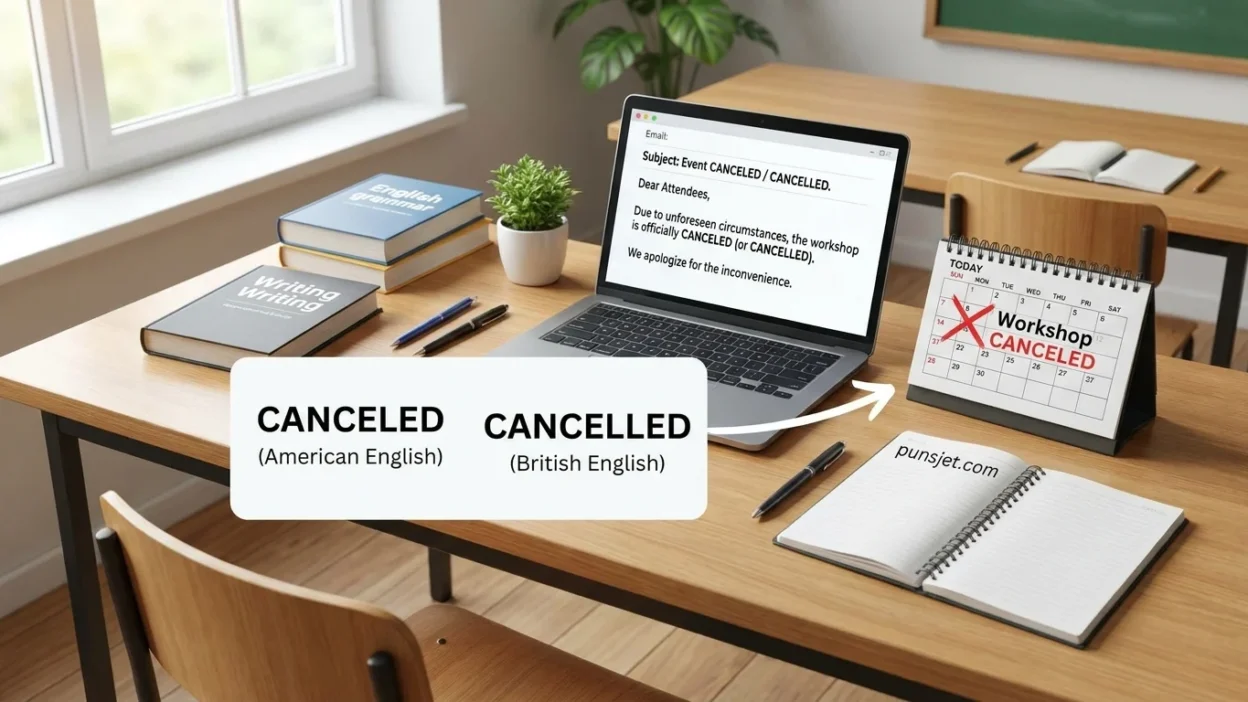
Have you ever written “canceled” and wondered if it should be “cancelled” instead? You are not alone. These two spellings look almost identical, sound the same, and have the same meaning.
The good news is that both “canceled” and “cancelled” are correct. The main difference is where the English is being used.
Canceled is the spelling most commonly used in American English.
Cancelled is the spelling most commonly used in British English and many other forms of English influenced by British spelling.
The difference comes from spelling rules rather than meaning. Once you understand which style you are using, choosing the correct spelling becomes easy.
Quick Answer
- Canceled is the usual spelling in American English.
- Cancelled is the usual spelling in British English.
- Both words mean that something was stopped, called off, or no longer going to happen.
- Canceled has one L before the ending.
- Cancelled has two L’s before the ending.
- The same spelling pattern applies to related words such as canceling/cancelling.
- Neither spelling is wrong; the best choice depends on the type of English you are writing.
Easy rule to remember
American English → canceled
British English → cancelled
A Simple Background
The word cancel comes from an older word connected with marking something out or crossing something off. Over time, it developed into the English verb we use today when we stop an event, appointment, order, plan, or arrangement.
The spelling difference developed because American and British English followed somewhat different spelling traditions.
One important difference is how some words ending in a consonant are handled when an ending such as -ed or -ing is added.
In British English, the final l is often doubled:
- cancel → cancelled
- cancel → cancelling
In American English, the final l is usually not doubled in this word:
- cancel → canceled
- cancel → canceling
This is why you may see both forms in books, emails, newspapers, websites, and messages.
Canceled vs. Cancelled: The Main Difference
The most important thing to understand is that there is no difference in meaning.
Both canceled and cancelled are the past-tense and past-participle forms of cancel.
For example:
The meeting was canceled.
and
The meeting was cancelled.
Both sentences mean that the meeting will not happen.
The only difference is the spelling style.
Canceled
Canceled is the standard spelling in American English.
Examples:
- The flight was canceled.
- She canceled her appointment.
- The school canceled the event.
- My order was canceled.
- They canceled the meeting.
Cancelled
Cancelled is the standard spelling in British English.
Examples:
- The flight was cancelled.
- She cancelled her appointment.
- The school cancelled the event.
- My order was cancelled.
- They cancelled the meeting.
The meaning remains exactly the same.
Comparison Table
| Feature | Canceled | Cancelled |
|---|---|---|
| Common English style | American English | British English |
| Number of L’s | One L | Two L’s |
| Meaning | Stopped or called off | Stopped or called off |
| Pronunciation | Same | Same |
| Verb | Cancel | Cancel |
| Past tense | Canceled | Cancelled |
| Present participle | Canceling | Cancelling |
| Common in the US | Yes | Less common |
| Common in the UK | Less common | Yes |
Which One Should You Use?
The easiest way to decide is to consider your audience and the type of English you are using.
Use “canceled” in American English
Choose canceled if you are writing for an American audience or following American English spelling.
For example:
The concert was canceled because of heavy rain.
The customer canceled the order yesterday.
Our flight was canceled due to bad weather.
Use “cancelled” in British English
Choose cancelled if you are following British English spelling.
For example:
The concert was cancelled because of heavy rain.
The customer cancelled the order yesterday.
Our flight was cancelled due to bad weather.
What about international writing?
If your readers come from different countries, either form can be understood easily. However, it is better to choose one spelling style and use it consistently.
For example, if the rest of your writing follows British spelling, use cancelled. If you are using American spelling throughout, use canceled.
Consistency makes your writing look cleaner and more natural.
Common Mistakes
1. Thinking one spelling is always wrong
A common mistake is believing that canceled or cancelled is incorrect.
That is not true.
Both spellings are accepted. The difference is mainly regional.
2. Mixing spelling styles
A writer may use American spelling in one sentence and British spelling in another.
For example:
The event was canceled, but the meeting was cancelled.
This is not a serious grammar error, but it can make your writing look inconsistent.
It is better to choose one style:
The event was canceled, but the meeting was canceled.
Or:
The event was cancelled, but the meeting was cancelled.
3. Forgetting the difference in “-ing”
The same spelling difference appears when -ing is added.
American English:
cancel → canceling
British English:
cancel → cancelling
For example:
We are canceling the reservation.
British style:
We are cancelling the reservation.
4. Writing “cancelled” because it looks more formal
Some learners think the spelling with two L’s is more formal or more correct.
It is not.
Canceled and cancelled are simply different regional spellings.
Everyday Examples
Understanding these words becomes easier when you see them in everyday situations.
In emails
American English:
Unfortunately, tomorrow’s meeting has been canceled.
British English:
Unfortunately, tomorrow’s meeting has been cancelled.
Both are completely clear.
In news reports
You might see:
The game was canceled because of bad weather.
An American publication may use this spelling.
A British publication may write:
The game was cancelled because of bad weather.
Again, the meaning is the same.
On social media
People may write:
Concert canceled 😢
or:
Concert cancelled 😢
Both messages tell readers that the concert will no longer take place.
In travel
You could see:
My flight was canceled.
Or:
My flight was cancelled.
Both mean that the airline stopped the planned flight.
In daily conversation
Someone might say:
I canceled my appointment.
A British English speaker might write:
I cancelled my appointment.
The pronunciation does not change just because the spelling changes.
A Simple Learning Trick
If you are a student or beginner, do not try to memorize a complicated rule.
Just remember this:
US = canceled
UK = cancelled
Think of the extra L as a feature of the British spelling.
You can also remember the related forms:
| American English | British English |
|---|---|
| canceled | cancelled |
| canceling | cancelling |
When you learn one form, learn its partner at the same time.
Why Does English Have Two Spellings?
English is used in many countries, and different regions have developed their own spelling habits.
American English and British English share most of their vocabulary, grammar, and pronunciation patterns, but some spelling rules are different.
You can see this in many other words too:
- color / colour
- favorite / favourite
- traveled / travelled
- canceled / cancelled
These differences do not mean that one variety is better than the other. They simply show that English has different regional forms.
The important thing is to know which style you are following.
FAQs:
1. Is “canceled” correct?
Yes. Canceled is correct and is the usual spelling in American English.
2. Is “cancelled” correct?
Yes. Cancelled is correct and is the usual spelling in British English.
3. Do canceled and cancelled mean the same thing?
Yes. They have exactly the same basic meaning. Both mean that something was stopped or called off.
4. Which spelling is used in the United States?
American English normally uses canceled, with one L.
5. Which spelling is used in the United Kingdom?
British English normally uses cancelled, with two L’s.
6. Is “canceling” or “cancelling” correct?
Both are correct. Canceling is common in American English, while cancelling is common in British English.
7. Can I use “canceled” in British English?
People in Britain will understand canceled, but cancelled is the usual British spelling. If you are writing in British English, it is better to use cancelled consistently.
8. Can I use “cancelled” in American English?
People in the United States will understand cancelled, but canceled is the standard American spelling. If you are following American English, use canceled.
Final Conclusion
Canceled and cancelled are both correct spellings. They have the same meaning and are pronounced the same way.
The main difference is regional:
- Canceled → American English
- Cancelled → British English
If you are writing for an American audience, choose canceled. If you are following British English, choose cancelled.
The most important lesson is not to worry about one being “right” and the other being “wrong.” Instead, learn to recognize both forms and keep your spelling consistent.
Once you remember “American: canceled, British: cancelled,” this commonly confusing pair becomes very easy to use correctly.

Donald Andrew is the creative mind behind PunsJet.com, where he shares clever wordplay and humorous puns for readers around the world. With a passion for language and comedy, Donald enjoys crafting witty jokes that bring smiles to everyday conversations. His goal is to make humor simple, fun, and easy to share.