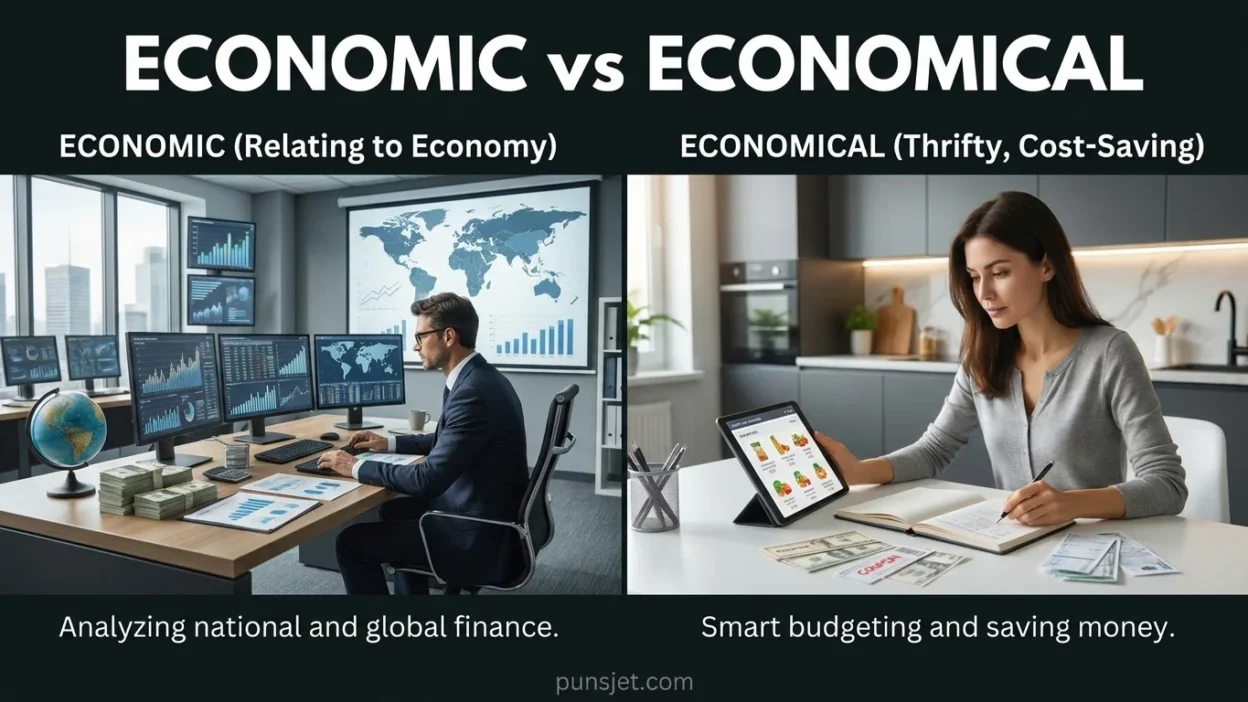
Economic and economical look very similar, so it is easy to mix them up. Both words are related to money, spending, business, and resources. However, they do not have the same meaning.
The main difference is simple: economic usually describes something related to the economy, money, business, or financial conditions. Economical describes something that uses money, time, fuel, or other resources carefully and does not waste them.
For example, you might read about an economic problem in the news. This means a problem connected with the economy. But if a car uses very little fuel, you can call it an economical car.
Learning this small difference can make your English clearer and help you choose the right word in everyday writing and speaking.
Quick Answer: Economic vs. Economical
Here is the easiest way to remember the difference:
- Economic = related to the economy, business, money, or financial matters.
- Economical = using money or resources carefully and avoiding waste.
- Economic growth means growth in a country’s or region’s economy.
- An economical car uses less fuel and costs less to operate.
- Economic often describes large or general financial matters.
- Economical often describes a choice, product, method, or person that saves resources.
Simple memory trick
Think:
Economic → Economy
Economical → Saves money
This simple connection can help you remember which word to use.
What Do These Words Mean?
What Does “Economic” Mean?
Economic is an adjective connected with the economy.
An economy includes the way money, goods, services, jobs, businesses, and resources are produced and used in a country or area.
For example:
- The country is facing an economic problem.
- The government announced a new economic policy.
- The report discusses economic growth.
- Many families are affected by economic changes.
In these examples, the word economic is connected to larger financial or business matters.
It does not mean “cheap” or “good at saving money.”
What Does “Economical” Mean?
Economical means using something carefully so that you do not waste money, time, fuel, energy, or other resources.
For example:
- This car is very economical.
- Walking is an economical way to travel short distances.
- We need an economical solution to the problem.
- This washing machine is more economical because it uses less water.
Here, economical means that something helps you avoid unnecessary spending or waste.
A Simple Background of the Words
Both economic and economical are connected to the idea of managing resources.
The word economic is closely related to economy. It is commonly used when talking about the financial system of a country, region, company, or group.
The word economical developed with a more practical meaning. It describes something that avoids waste and makes good use of available resources.
Because both words come from the same family, their meanings can overlap in some situations. But their usual uses are different.
A useful question to ask is:
Am I talking about the economy, or am I talking about saving resources?
If you are talking about the economy, use economic.
If you are talking about saving money, fuel, time, or other resources, economical is usually the better choice.
Economic vs. Economical: The Main Difference
The clearest difference is the focus of each word.
Economic focuses on the economy
Use economic when something is related to:
- A country’s economy
- Business conditions
- Employment
- Trade
- Prices
- Government financial policies
- Economic growth
- Economic problems
- Financial systems
For example:
The country is experiencing economic growth.
This means the country’s economy is growing.
Another example:
The news discussed the economic situation.
This means the news discussed the condition of the economy.
Economical focuses on saving resources
Use economical when something helps save:
- Money
- Fuel
- Energy
- Time
- Materials
- Water
- Other resources
For example:
This small car is economical.
This means the car does not cost much to run, especially because it uses less fuel.
Another example:
Cooking at home can be more economical than eating at restaurants.
This means cooking at home can save money.
Easy Comparison Table
| Word | Basic Meaning | Common Use | Example |
|---|---|---|---|
| Economic | Related to the economy | Countries, business, money, trade | Economic growth is increasing. |
| Economical | Avoiding waste or saving resources | Products, choices, methods, vehicles | This car is economical. |
| Economic | Connected with financial conditions | Economic policy | The government changed its economic policy. |
| Economical | Not expensive to use | Fuel, energy, money | This machine is economical to operate. |
| Economic | About the wider economy | Economic crisis | The country faced an economic crisis. |
| Economical | Careful use of resources | Everyday choices | Walking is an economical way to travel. |
Which One Should You Use and When?
Choosing between these words becomes easy when you look at what you are describing.
Use “economic” for the economy
Use economic for topics such as:
- Economic growth
- Economic development
- Economic conditions
- Economic policy
- Economic problems
- Economic activity
- Economic changes
- Economic research
- Economic news
Examples
The country has seen strong economic growth.
The company is affected by economic changes.
The newspaper published an article about economic conditions.
In all these examples, the word refers to wider financial or economic matters.
Use “economical” for saving
Use economical when something is efficient and does not waste resources.
Examples
This car is economical because it uses little fuel.
Buying food in larger quantities can sometimes be economical.
We are looking for an economical way to solve the problem.
The new lights are economical because they use less electricity.
Here, the focus is on saving money or resources.
Common Mistakes People Make
Mistake 1: Using “economical” for the economy
Incorrect:
The country is facing an economical crisis.
Better:
The country is facing an economic crisis.
A crisis affecting the economy is an economic crisis.
Mistake 2: Using “economic” when you mean cheap to operate
Incorrect:
This car is very economic because it uses little fuel.
Better:
This car is very economical because it uses little fuel.
The car saves fuel, so economical is the natural choice.
Mistake 3: Thinking economical always means cheap
Economical does not simply mean “cheap.”
Something can have a high purchase price but still be economical if it costs little to operate.
For example, an energy-efficient machine might cost more at first but use less electricity over time.
So economical is more about avoiding waste and reducing running costs than simply having a low price.
Mistake 4: Confusing “economic” with “financial”
These words can sometimes appear in similar situations, but they are not always interchangeable.
Economic usually has a wider meaning connected with the economy.
Financial often relates more directly to money, income, spending, debts, investments, or the finances of a person or organization.
For example:
The country has economic problems.
The company has financial problems.
Both sentences are possible, but they describe slightly different things.
Everyday Real-Life Examples
In Emails
You may see economic in professional or formal emails:
“We will discuss the current economic situation at the meeting.”
You may see economical when discussing costs:
“We are looking for a more economical way to deliver the products.”
The first sentence is about the economy. The second is about reducing costs.
In News
News reports often use economic:
- Economic growth
- Economic changes
- Economic policy
- Economic conditions
- Economic challenges
For example:
“The report examines the country’s economic growth.”
The word economic is natural because the topic is the country’s economy.
On Social Media
People may use economical when recommending products or choices:
“This is an economical car for daily travel.”
They may use economic when discussing news:
“The latest economic news is affecting businesses.”
In Daily Life
You might say:
Taking the bus is an economical choice.
This means it can save money.
You might say:
The country is going through economic changes.
This means the country’s economy is changing.
A Simple Learning Trick for Students
Remember these two short formulas:
Economic = Economy
If you can replace the idea with “related to the economy,” use economic.
Economic policy
= policy related to the economy
Economic growth
= growth of the economy
Economic problem
= problem related to the economy
Economical = Saves
If you can replace the idea with “uses less” or “avoids waste,” use economical.
Economical car
= car that uses less fuel or costs less to run
Economical solution
= solution that avoids unnecessary cost
Economical method
= method that uses resources carefully
This trick is especially useful for students and English learners.
More Example Sentences
Economic
- The country needs a stronger economic plan.
- Economic growth can affect employment.
- The report explains recent economic changes.
- Many businesses are watching economic conditions carefully.
- The government introduced a new economic policy.
- The economic situation has changed over the past year.
Economical
- This car is economical to drive.
- We need an economical solution.
- Using less electricity is more economical.
- The small apartment is economical for a student.
- This printer is economical because it uses less ink.
- Cooking at home can be an economical choice.
FAQs:
1. What is the main difference between economic and economical?
Economic means related to the economy. Economical means using money or other resources carefully and avoiding waste.
2. Is “economic car” correct?
It can be understood in some contexts, but economical car is normally used when you mean a car that is cheap to run or uses little fuel.
3. Is it “economic growth” or “economical growth”?
The correct common expression is economic growth because it refers to growth in the economy.
4. Is an economical product always cheap?
No. An economical product may cost more to buy but save money during use because it needs less fuel, electricity, water, or maintenance.
5. Can economical describe a person?
Yes. An economical person is careful about spending and does not waste money or resources.
For example:
She is economical with her money.
6. What does economic mean in simple English?
Economic means connected with the economy, business, money, trade, jobs, or financial conditions.
7. What does economical mean in simple English?
Economical means using money, time, fuel, energy, or other resources carefully so that less is wasted.
8. What is the easiest way to remember the difference?
Remember:
Economic = economy
Economical = saving
If the subject is the economy, choose economic. If the subject is saving resources, choose economical.
Conclusion
Economic and economical are similar-looking words, but their meanings are different.
Use economic when you are talking about the economy or matters connected with it. You will often see it in phrases such as economic growth, economic policy, economic conditions, and economic problems.
Use economical when you are talking about saving money, fuel, time, energy, or other resources. Common examples include an economical car, an economical solution, and an economical choice.
The easiest rule is:
Economic = related to the economy.
Economical = avoids waste and saves resources.
Once you connect economic with economy and economical with saving, the difference becomes much easier to remember and use correctly.