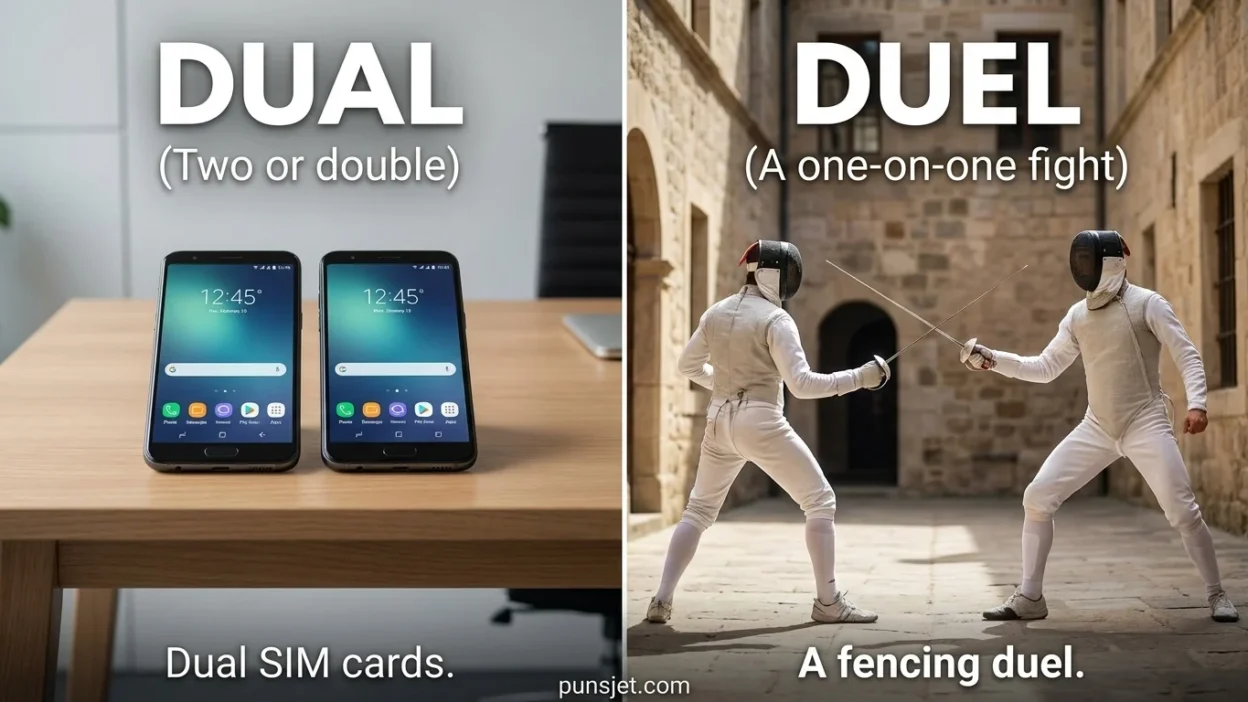
English has many words that sound almost the same but have completely different meanings. Dual and duel are two such words. They look and sound very similar, so it is easy to confuse them when writing or speaking.
The good news is that their meanings are quite different.Dual is connected with two. It describes something that has two parts, two features, or two sides.Duel is connected with a fight between two people. It usually means a formal fight or contest between two opponents.
For example:
- A phone with two SIM cards has a dual-SIM feature.
- The two characters agreed to a duel.
Learning the difference is simple once you connect each word with its main idea.
Quick Answer: Dual vs. Duel
Here is the easiest way to remember the difference:
- Dual = having two parts, features, or sides.
- Duel = a fight or contest between two people.
- Dual is often used as an adjective.
- Duel can be used as a noun or a verb.
- You can talk about a dual purpose, dual role, or dual system.
- You can watch, fight, or challenge someone to a duel.
Easy memory trick
Think:
Dual → Duo → Two
Both dual and duo are connected with the idea of two.
For duel, think:
Duel → Two opponents fighting
This small memory trick can help you choose the correct word quickly.
What Does “Dual” Mean?
Dual means having two of something or involving two parts, sides, or purposes.
It is usually used as an adjective.
For example:
She has a dual role as a teacher and a manager.
This means she has two roles.
Another example is:
This phone has a dual-camera system.
This means the phone has two cameras in the system.
The two things do not have to be exactly the same. They simply need to involve two parts, functions, roles, or sides.
Common expressions with “dual”
You may see dual in phrases such as:
- dual purpose
- dual role
- dual citizenship
- dual language
- dual camera
- dual control
- dual function
- dual system
- dual screen
- dual responsibility
Examples
- The building has a dual purpose: offices and classrooms.
- She has dual citizenship.
- The device has a dual-camera setup.
- He has a dual role in the company.
- The course offers dual-language instruction.
In all of these examples, dual points to the idea of two.
What Does “Duel” Mean?
Duel means a fight or contest between two people.
Traditionally, a duel was a formal fight between two people, often using weapons. In older times, people might challenge each other to a duel because of an argument, insult, or serious disagreement.
Today, the word can also be used more generally for a competition or direct contest between two people or sides.
For example:
The two players had a fierce duel on the tennis court.
Here, duel does not mean a traditional sword fight. It means the two players were directly competing against each other.
Duel can be a noun or a verb.
As a noun
The two warriors prepared for a duel.
Here, duel means a fight between two people.
As a verb
The two fighters agreed to duel.
Here, duel means to fight or compete against each other.
More examples
- The two knights entered a duel.
- The movie ends with a dramatic duel.
- The players dueled for the championship.
- The two teams dueled throughout the final match.
The main idea is always a direct contest or fight involving two opponents.
Dual vs. Duel: The Main Difference
The biggest difference is very easy:
Dual is about two things. Duel is about two opponents fighting or competing.
Consider these two sentences:
The car has dual airbags.
This means the car has two airbags or a system involving two airbags.
Now look at:
The two characters had a duel.
This means the characters had a fight or direct contest.
The words may sound similar, but they belong to different meanings.
Remember this rule
If you are talking about two parts, features, roles, purposes, or sides, use dual.
If you are talking about a fight or direct contest between two opponents, use duel.
Dual and Duel Comparison Table
| Word | Meaning | Main Idea | Common Use | Example |
|---|---|---|---|---|
| Dual | Having two parts or features | Two | Dual role | She has a dual role. |
| Duel | A fight or contest between two opponents | Fighting or competing | A duel | The two men fought a duel. |
| Dual | Involving two purposes or functions | Two functions | Dual purpose | The room has a dual purpose. |
| Duel | To fight or compete directly | Two opponents | Duel as a verb | They decided to duel. |
A simple way to remember the table is:
Dual = two
Duel = fight between two
Which One Should You Use and When?
Choosing between these words depends on what you are describing.
Use “dual” when you mean two
Use dual when something has two parts, purposes, functions, roles, or features.
Examples:
- The machine has dual controls.
- He has a dual role.
- This is a dual-purpose tool.
- She speaks two languages and has a dual-language education.
- The phone has a dual-camera system.
Ask yourself:
“Am I talking about two parts or two features?”
If yes, dual is probably the word you need.
Use “duel” when you mean a fight or contest
Use duel when two people directly fight or compete against each other.
Examples:
- The knights fought a duel.
- The two athletes dueled for first place.
- The movie contains a sword duel.
- The players dueled throughout the game.
Ask yourself:
“Am I talking about two opponents fighting or competing?”
If yes, use duel.
Common Mistakes With Dual and Duel
Because the words sound similar, learners sometimes use one in place of the other.
Mistake 1: Using “duel” for two features
Incorrect:
This phone has a duel camera.
Correct:
This phone has a dual camera.
The phone has two cameras, so dual is correct.
Mistake 2: Using “dual” for a fight
Incorrect:
The two knights entered a dual.
Correct:
The two knights entered a duel.
They are fighting, so duel is correct.
Mistake 3: Confusing “dual purpose” with “duel purpose”
Correct:
This tool has a dual purpose.
It has two purposes.
Not:
This tool has a duel purpose.
Mistake 4: Forgetting that “duel” can be a verb
Some learners think duel can only be a noun.
But it can also be a verb:
The two champions dueled for the title.
Here, dueled means they competed directly against each other.
Dual and Duel in Everyday Life
These words can appear in many normal situations.
In emails
You might write:
This position has a dual purpose.
Or:
The two departments have a dual responsibility.
You would use dual because you are talking about two functions or responsibilities.
In news
A news report might say:
The two athletes faced each other in a tense duel.
Here, duel describes a close contest between two people.
Another report might say:
The company introduced a phone with a dual-screen design.
Here, dual means two screens.
On social media
Someone might post:
My new phone has a dual-camera system.
Or:
These two players had an amazing duel!
Again, the first sentence is about two features, while the second is about a direct contest.
In daily conversation
You might say:
This room has a dual purpose.
Or:
The movie has an exciting sword duel.
Both words are useful in ordinary English, but they describe very different ideas.
A Simple Learning Trick for Students
The easiest way to learn these words is to connect them with one key idea.
Dual = Two
When you see dual, think:
two parts, two features, two roles, or two purposes.
Examples:
- dual role = two roles
- dual purpose = two purposes
- dual camera = two cameras
- dual system = two systems or parts
Duel = Fight
When you see duel, think:
two opponents fighting or competing.
Examples:
- sword duel = sword fight
- duel between players = direct competition
- challenge someone to a duel = challenge someone to fight
Quick test
Complete these sentences:
- The phone has a ___ camera.
- The two warriors fought a ___.
- She has a ___ role at work.
- The two players ___ for the championship.
Answers:
- dual
- duel
- dual
- dueled
If you remember dual = two and duel = fight, these words become much easier.
FAQs:
1. What is the difference between dual and duel?
Dual means having two parts, features, purposes, or sides. Duel means a fight or direct contest between two opponents.
2. Is dual related to the number two?
Yes. Dual is used for things involving two parts or two features.
For example:
The machine has dual controls.
This means it has two sets of controls.
3. What is an example of duel?
The two knights fought a duel.
Here, duel means a fight between two people.
4. Can duel be used as a verb?
Yes. For example:
The two champions dueled for the title.
Here, dueled means they competed directly against each other.
5. Is “dual purpose” correct?
Yes. Dual purpose means something has two purposes.
For example:
This room has a dual purpose.
6. Is “duel purpose” correct?
No, not when you mean “two purposes.” The correct phrase is dual purpose.
7. Are dual and duel pronounced the same?
In many varieties of English, dual and duel are pronounced very similarly, and they may sound the same in ordinary speech. Their meanings and spellings are different.
8. How can I remember dual and duel?
Remember:
Dual = two
Duel = fight
If you are describing two features or functions, choose dual. If two opponents are fighting or competing, choose duel.
Conclusion
Dual and duel are easy to confuse because they look and sound very similar. However, their meanings are completely different.Dual is connected with the number two. It describes something with two parts, features, functions, roles, or purposes.Duel is connected with a fight or direct contest between two opponents. It can be used as both a noun and a verb.
The easiest memory trick is:
Dual = two.
Duel = fight.
So, you would say dual camera, dual purpose, and dual role. But you would say sword duel, a duel between two fighters, or the players dueled for the title.Once you connect each word with its main idea, choosing between dual and duel becomes simple.

Emily Margaret is a writer and humor enthusiast at PunsJet.com. She enjoys creating clever puns and lighthearted content that entertains readers and adds a spark of humor to everyday life. With a love for wordplay and creativity, Emily aims to share fun, relatable jokes that make people smile and laugh.