
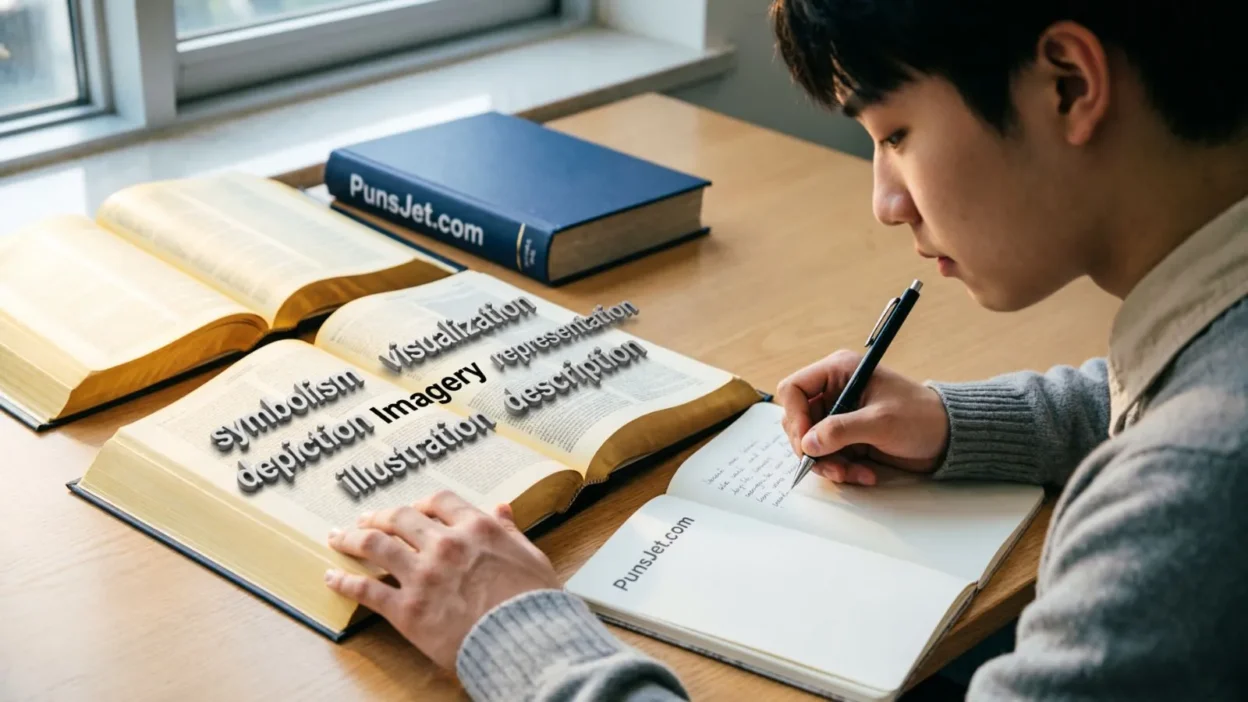
Imagery plays an important role in communication, writing, literature, and visual storytelling.
If you’re a student, ESL learner, writer, or content creator, understanding imagery synonyms can help you express ideas more clearly and creatively.
Using the right synonym allows you to match the tone, context, and purpose of your writing.
Some alternatives sound artistic, while others fit academic, professional, or everyday situations.
In this guide, you’ll learn the meaning of imagery, discover useful imagery synonyms, see practical examples, and understand when each word works best.
What Does Imagery Mean?
Imagery refers to language, descriptions, pictures, or mental representations that create vivid impressions in a reader’s or listener’s mind.
In literature, imagery helps readers visualize scenes, hear sounds, feel textures, or experience emotions. In everyday communication, imagery can also mean visual representations, pictures, symbols, or mental images.
Simple Definition
Imagery = words, pictures, or descriptions that help people imagine something clearly.
Example
“The golden sunlight reflected on the calm lake.”
This sentence creates a visual image in the reader’s mind, making it an example of imagery.
30 Imagery Synonyms With Meanings and Examples
1. Image
Meaning: A picture or visual representation.
Example: The image on the screen was incredibly clear.
Best Usage Context: Photography, design, visual media.
2. Picture
Meaning: A visual representation of something.
Example: She showed me a picture of her vacation.
Best Usage Context: Everyday conversations.
3. Illustration
Meaning: A drawing or visual explanation.
Example: The book contained colorful illustrations.
Best Usage Context: Education, publishing.
4. Visualization
Meaning: The act of creating a mental image.
Example: Visualization helps athletes prepare for competitions.
Best Usage Context: Psychology, self-improvement.
5. Representation
Meaning: Something that stands for or depicts another thing.
Example: The sculpture is a representation of freedom.
Best Usage Context: Academic and formal writing.
6. Depiction
Meaning: A detailed portrayal of something.
Example: The movie’s depiction of history was impressive.
Best Usage Context: Literature, film reviews.
7. Portrayal
Meaning: The way something is presented or described.
Example: His portrayal of the character felt realistic.
Best Usage Context: Acting, storytelling.
8. Vision
Meaning: A mental image or idea of the future.
Example: The entrepreneur had a clear vision for the company.
Best Usage Context: Business and creativity.
9. Impression
Meaning: An effect or image left in the mind.
Example: The painting created a lasting impression.
Best Usage Context: Art and personal experiences.
10. Scene
Meaning: A visual setting or situation.
Example: The mountain scene looked breathtaking.
Best Usage Context: Literature and photography.
11. View
Meaning: What can be seen from a particular place.
Example: The hotel offered a beautiful ocean view.
Best Usage Context: Travel and descriptions.
12. Snapshot
Meaning: A quick visual representation.
Example: The report provides a snapshot of market trends.
Best Usage Context: Business and photography.
13. Graphic
Meaning: A visual design element.
Example: The graphic explained the process clearly.
Best Usage Context: Marketing and design.
14. Sketch
Meaning: A rough drawing or outline.
Example: The artist completed a quick sketch.
Best Usage Context: Art and planning.
15. Drawing
Meaning: An image created using lines and shapes.
Example: Her drawing won first prize.
Best Usage Context: Art education.
16. Symbol
Meaning: An object or image representing an idea.
Example: The dove is a symbol of peace.
Best Usage Context: Literature and culture.
17. Icon
Meaning: A simple visual symbol.
Example: Click the icon to open the application.
Best Usage Context: Technology and design.
18. Portrait
Meaning: A visual representation of a person.
Example: The portrait hung in the gallery.
Best Usage Context: Art and photography.
19. Reflection
Meaning: A mirrored image or thoughtful representation.
Example: The water showed a reflection of the trees.
Best Usage Context: Nature and symbolism.
20. Mental Image
Meaning: A picture formed in the mind.
Example: I have a clear mental image of the place.
Best Usage Context: Psychology and storytelling.
21. Visualization Image
Meaning: A created image for understanding concepts.
Example: The visualization image simplified the data.
Best Usage Context: Education and analytics.
22. Rendering
Meaning: A detailed visual interpretation.
Example: The architect shared a rendering of the building.
Best Usage Context: Architecture and design.
23. Diagram
Meaning: A visual explanation of information.
Example: The diagram showed how the machine works.
Best Usage Context: Technical writing.
24. Map
Meaning: A visual guide to locations or concepts.
Example: The map helped us find the route.
Best Usage Context: Geography and planning.
25. Figure
Meaning: An illustration or visual element.
Example: Figure 2 explains the research findings.
Best Usage Context: Academic writing.
26. Outline
Meaning: A simplified visual structure.
Example: The outline showed the project’s framework.
Best Usage Context: Planning and education.
27. Conceptualization
Meaning: The process of forming ideas mentally.
Example: The conceptualization stage took several weeks.
Best Usage Context: Research and creativity.
28. Visualization Graphic
Meaning: A graphic used to present information visually.
Example: The visualization graphic highlighted trends.
Best Usage Context: Data analysis.
29. Tableau
Meaning: A vivid visual scene or arrangement.
Example: The stage created a dramatic tableau.
Best Usage Context: Theater and art.
30. Illustration Image
Meaning: An image designed to explain something.
Example: The illustration image clarified the instructions.
Best Usage Context: Educational materials.
Quick Comparison Table: When to Use Different Imagery Synonyms
| Synonym | Best For | Tone |
|---|---|---|
| Image | General visuals | Neutral |
| Picture | Everyday conversation | Casual |
| Illustration | Books and learning | Educational |
| Depiction | Detailed descriptions | Formal |
| Portrayal | Characters and stories | Literary |
| Vision | Ideas and goals | Inspirational |
| Symbol | Hidden meanings | Analytical |
| Diagram | Technical explanations | Professional |
| Snapshot | Quick overview | Informal |
| Rendering | Design concepts | Professional |
How to Choose the Right Imagery Synonym
Choosing the best imagery synonym depends on your purpose and audience.
For Creative Writing
Use:
- Depiction
- Portrayal
- Scene
- Tableau
- Vision
These words create vivid and artistic descriptions.
For Academic Writing
Use:
- Representation
- Illustration
- Figure
- Diagram
- Conceptualization
These sound more professional and precise.
For Everyday Conversations
Use:
- Image
- Picture
- View
- Snapshot
These are simple and easy for most people to understand.
For Design and Visual Media
Use:
- Graphic
- Rendering
- Icon
- Visualization
These fit modern digital and creative industries.
For Mental or Psychological Contexts
Use:
- Mental Image
- Visualization
- Vision
- Impression
These focus on ideas formed in the mind.
Common Mistakes When Using Imagery Synonyms
Using “Picture” in Formal Writing
While understandable, “representation” or “illustration” may sound more professional.
Confusing “Vision” and “Image”
A vision often refers to a future idea, while an image is usually something visual.
Using “Diagram” for Artistic Content
Diagrams explain information, while illustrations or depictions are better for artistic subjects.
Why Learning Imagery Synonyms Matters
Expanding your vocabulary makes your writing more engaging and precise.
Benefits include:
- Better essays and assignments
- Stronger creative writing
- Improved communication skills
- More varied vocabulary
- Enhanced SEO content creation
Writers who understand imagery synonyms can avoid repetition and communicate ideas more effectively.
Conclusion
Understanding imagery synonyms helps you choose the perfect word for different situations.
While image, picture, and illustration are common alternatives, words like depiction, portrayal, vision, and representation provide more specific meanings and tones.
By learning these 30 imagery synonyms and their usage contexts, you can improve your writing, expand your vocabulary, and communicate ideas more clearly.
If you’re creating academic content, storytelling, blog posts, or marketing materials, selecting the right synonym will make your message stronger and more engaging.

Donald Andrew is the creative mind behind PunsJet.com, where he shares clever wordplay and humorous puns for readers around the world. With a passion for language and comedy, Donald enjoys crafting witty jokes that bring smiles to everyday conversations. His goal is to make humor simple, fun, and easy to share.