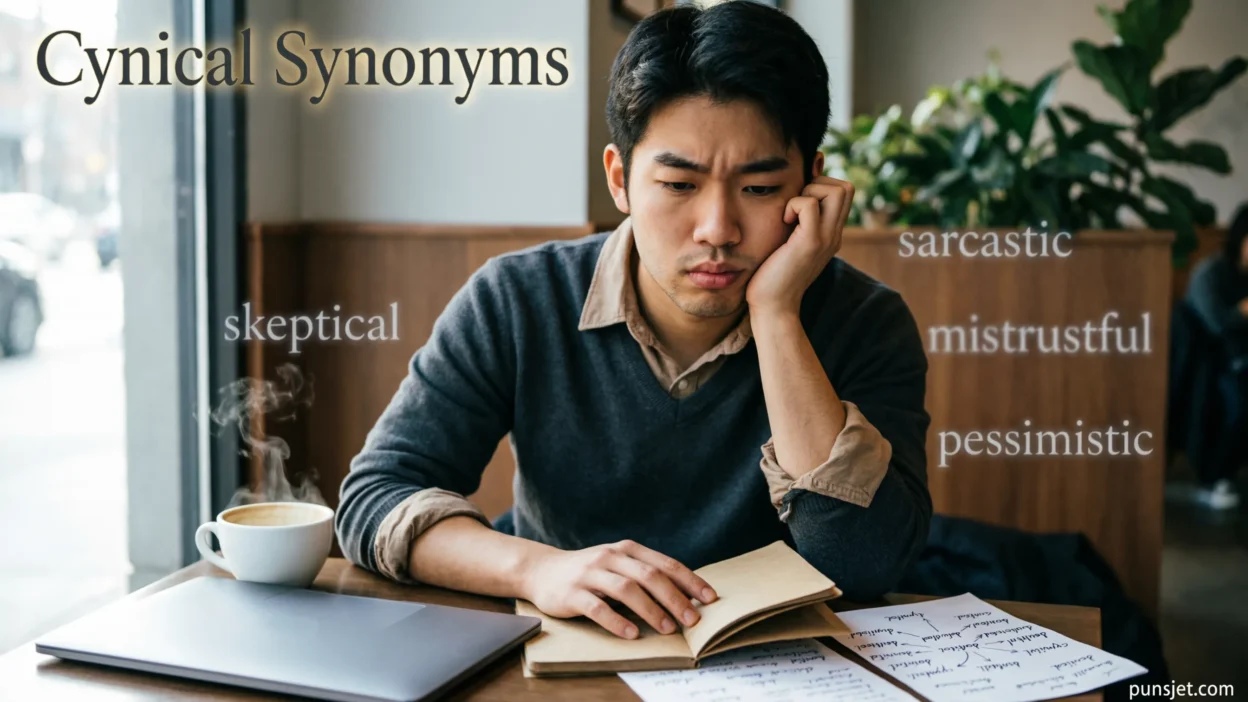
Words shape how we express emotions, opinions, and attitudes. One interesting word often used in conversations, writing, and storytelling is “cynical.”
Understanding cynical synonyms can help students, writers, and ESL learners communicate more clearly and naturally.
A cynical person usually doubts the honesty or goodness of others. They may believe people are motivated mainly by selfish reasons.
However, not every situation calls for the exact word “cynical.” Sometimes you may want a softer, stronger, more formal, or more emotional alternative.
In this guide, you’ll learn the meaning of “cynical,” explore 30 useful cynical synonyms, understand their tones, and see how to use them correctly in real sentences.
This article is written in simple English so beginners and advanced learners can both enjoy it.
What Does “Cynical” Mean?
The word cynical describes someone who distrusts people’s intentions or believes people act mainly for personal gain.
Simple Definition:
A cynical person expects selfishness, dishonesty, or bad motives from others.
Tone of the Word:
“Cynical” often has a negative or critical tone. It can describe attitudes, thoughts, humor, or opinions.
Example:
- After being lied to many times, Jake became cynical about relationships.
Common Usage Contexts:
- Personal relationships
- Politics
- Media and advertising
- Social commentary
- Literature and storytelling
30 Best Cynical Synonyms
1. Skeptical
Meaning: Doubting whether something is true.
Example: She was skeptical about the company’s promises.
Best Usage Context: Mild doubt or questioning attitude.
2. Distrustful
Meaning: Not trusting people easily.
Example: The scam made him distrustful of online sellers.
Best Usage Context: Personal trust issues.
3. Suspicious
Meaning: Believing something may be wrong or dishonest.
Example: The manager seemed suspicious of the sudden changes.
Best Usage Context: Possible dishonesty or hidden motives.
4. Pessimistic
Meaning: Expecting bad results or negative outcomes.
Example: He felt pessimistic about the future economy.
Best Usage Context: Negative outlook on life or events.
5. Doubtful
Meaning: Unsure or unconvinced.
Example: I’m doubtful that the plan will succeed.
Best Usage Context: Everyday uncertainty.
6. Sarcastic
Meaning: Using mocking or ironic language.
Example: Her sarcastic comment upset the group.
Best Usage Context: Humor with criticism.
7. Mocking
Meaning: Making fun of someone or something.
Example: The crowd gave a mocking laugh.
Best Usage Context: Ridicule or teasing.
8. Bitter
Meaning: Angry or hurt because of past experiences.
Example: He sounded bitter after losing the promotion.
Best Usage Context: Emotional disappointment.
9. Hardened
Meaning: Emotionally tough because of difficult experiences.
Example: Years of struggle made her hardened.
Best Usage Context: Emotional toughness.
10. Jaded
Meaning: Tired or bored after too much experience.
Example: The actor became jaded by fame.
Best Usage Context: Loss of excitement or innocence.
11. Negative
Meaning: Focusing more on bad aspects.
Example: His negative attitude affected the team.
Best Usage Context: General criticism or pessimism.
12. Critical
Meaning: Quick to find faults.
Example: She was highly critical of the new policy.
Best Usage Context: Analysis or judgment.
13. Disbelieving
Meaning: Unable or unwilling to believe something.
Example: He gave a disbelieving stare.
Best Usage Context: Shock or doubt.
14. Doubting
Meaning: Feeling uncertain or unconvinced.
Example: The audience remained doubting despite the explanation.
Best Usage Context: Hesitation or uncertainty.
15. Mistrustful
Meaning: Having little trust in others.
Example: The witness became mistrustful of officials.
Best Usage Context: Serious trust concerns.
16. Ironical
Meaning: Expressing meaning through irony.
Example: Her ironical smile confused everyone.
Best Usage Context: Literary or humorous tone.
17. Snarky
Meaning: Rudely sarcastic.
Example: He made a snarky remark online.
Best Usage Context: Informal criticism.
18. World-Weary
Meaning: Tired of life because of experience.
Example: The detective had a world-weary expression.
Best Usage Context: Literature and storytelling.
19. Disillusioned
Meaning: Disappointed after losing beliefs or hopes.
Example: Many voters felt disillusioned after the election.
Best Usage Context: Lost trust or hope.
20. Realistic
Meaning: Seeing situations as they truly are.
Example: She gave a realistic opinion about the risks.
Best Usage Context: Practical thinking.
21. Unbelieving
Meaning: Not accepting something as true.
Example: He looked unbelieving after hearing the news.
Best Usage Context: Surprise and doubt.
22. Gloomy
Meaning: Feeling dark or hopeless.
Example: The report gave a gloomy prediction.
Best Usage Context: Sad or depressing outlook.
23. Dry
Meaning: Showing humor without emotion.
Example: His dry humor sounded cynical at times.
Best Usage Context: Subtle humor.
24. Cold
Meaning: Emotionally distant or unfeeling.
Example: Her cold response shocked him.
Best Usage Context: Emotional detachment.
25. Detached
Meaning: Emotionally uninvolved.
Example: The journalist remained detached during interviews.
Best Usage Context: Professional or emotional distance.
26. Grim
Meaning: Serious and lacking hope.
Example: The future looked grim to investors.
Best Usage Context: Dark situations.
27. Caustic
Meaning: Sharp and hurtful in speech.
Example: The critic wrote a caustic review.
Best Usage Context: Harsh criticism.
28. Sardonic
Meaning: Humorously mocking in a dark way.
Example: He gave a sardonic smile.
Best Usage Context: Intelligent dark humor.
29. Blunt
Meaning: Very direct and sometimes rude.
Example: She gave a blunt opinion about the idea.
Best Usage Context: Honest but harsh communication.
30. Misanthropic
Meaning: Disliking people in general.
Example: The novel’s main character was deeply misanthropic.
Best Usage Context: Strong hatred or distrust of humanity.
Quick Comparison Table of Cynical Synonyms
| Synonym | Tone | Best For |
|---|---|---|
| Skeptical | Neutral | Doubt and questioning |
| Pessimistic | Negative | Expecting bad outcomes |
| Sarcastic | Humorous | Mocking humor |
| Jaded | Tired | Loss of excitement |
| Bitter | Emotional | Hurt feelings |
| Distrustful | Serious | Lack of trust |
| Sardonic | Intelligent | Dark humor |
| Snarky | Informal | Online comments |
| Realistic | Neutral | Practical thinking |
| Misanthropic | Strong | Hatred of people |
How to Choose the Right Cynical Synonym
Different synonyms work better in different situations. Here’s a simple guide.
For Mild Doubt
Use:
- Skeptical
- Doubtful
- Suspicious
These words are softer and common in daily conversation.
Example:
- I’m skeptical about the advertisement.
For Negative Thinking
Use:
- Pessimistic
- Gloomy
- Grim
These focus more on expecting bad outcomes.
Example:
- He sounded pessimistic about the project.
For Humor or Mockery
Use:
- Sarcastic
- Snarky
- Sardonic
These work well for jokes, online comments, or witty dialogue.
Example:
- Her sardonic reply made everyone laugh nervously.
For Emotional Hurt or Disappointment
Use:
- Bitter
- Disillusioned
- Jaded
These suggest emotional experiences shaped the person’s attitude.
Example:
- Years of failure left him bitter.
For Strong Distrust
Use:
- Distrustful
- Mistrustful
- Misanthropic
These are stronger and more serious.
Example:
- The character became mistrustful after betrayal.
Common Mistakes When Using Cynical Synonyms
Confusing “Skeptical” and “Cynical”
- Skeptical means questioning.
- Cynical means expecting selfishness or dishonesty.
Example:
- She was skeptical of the facts.
- He was cynical about people’s motives.
Using “Sarcastic” as a Personality Trait
“Sarcastic” describes speech style more than worldview.
Better Usage:
- She made a sarcastic comment.
Not: - She lives a sarcastic life.
Overusing Strong Words
Words like “misanthropic” are very intense and should be used carefully.
Why Learning Cynical Synonyms Matters
Expanding your vocabulary improves:
- Writing quality
- Speaking confidence
- Reading comprehension
- Emotional expression
Writers can create more realistic characters, while ESL learners can better understand movies, books, and conversations.
Using the right synonym also helps avoid repetition and makes communication sound more natural.
Conclusion
Learning cynical synonyms can greatly improve your vocabulary and communication skills.
While “cynical” describes distrust or negative expectations about people, many related words express different shades of meaning.
Some synonyms are soft and conversational, like “skeptical,” while others are stronger and more emotional, like “misanthropic” or “bitter.”
Understanding these differences helps you choose the right word for every situation.
Whether you are a student, writer, blogger, or ESL learner, mastering these synonyms will make your English more expressive, accurate, and engaging.

Donald Andrew is the creative mind behind PunsJet.com, where he shares clever wordplay and humorous puns for readers around the world. With a passion for language and comedy, Donald enjoys crafting witty jokes that bring smiles to everyday conversations. His goal is to make humor simple, fun, and easy to share.