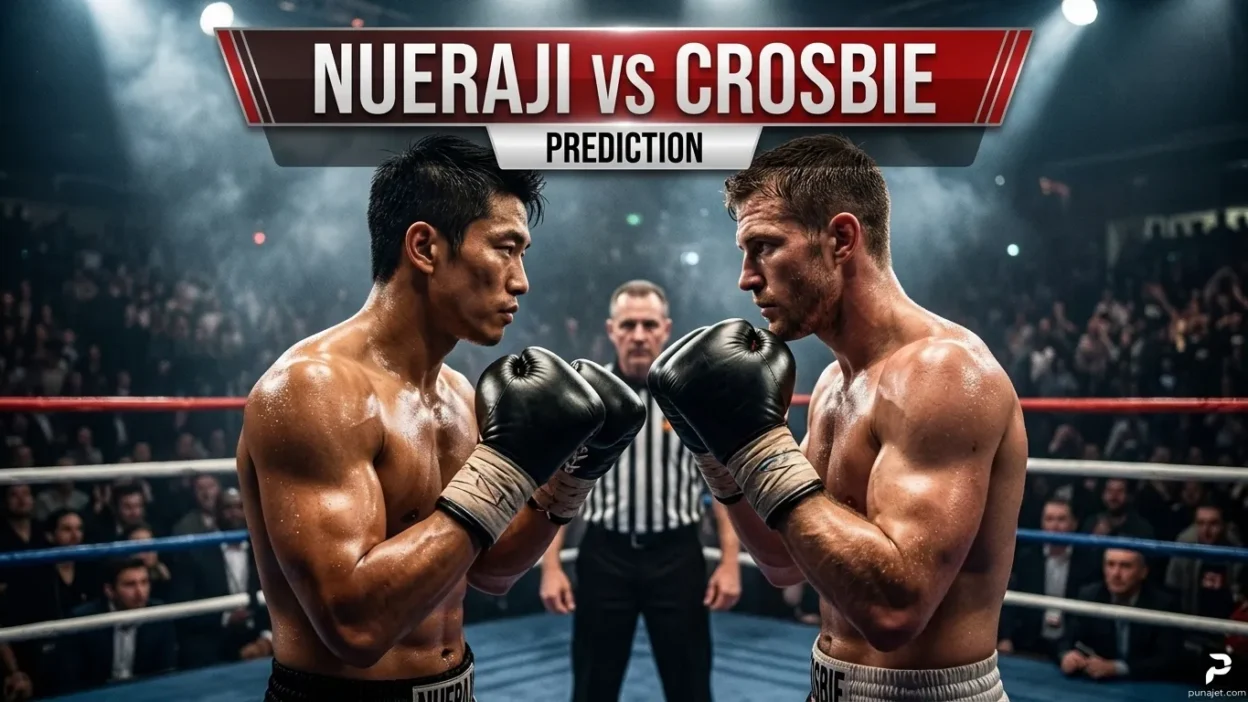
The Nueraji vs Crosbie prediction centered on a welterweight mixed martial arts (MMA) fight between Taiyilake Nueraji and Kiefer Crosbie at UFC Fight Night in Shanghai on August 23, 2025. Before the fight, Nueraji looked like the stronger pick because of his knockout power, longer reach, and impressive finishing record. Crosbie brought professional experience and striking skills, but he faced a difficult challenge against the younger fighter.
The original prediction favored Nueraji to win, with a first-round finish considered a realistic possibility. That forecast proved correct: Nueraji defeated Crosbie by technical knockout (TKO) at 3:33 of the first round. However, the result came with controversy because Nueraji landed an illegal knee on a grounded Crosbie before the finish. This detail matters when reviewing the matchup, because a prediction should consider both the sporting result and the circumstances surrounding it.
Quick Answer
Taiyilake Nueraji was the predicted winner against Kiefer Crosbie, and he won by first-round TKO at 3:33. Nueraji entered the fight with greater finishing momentum, a height and reach advantage, and strong early-round power. Crosbie’s experience offered a possible path to victory, but Nueraji’s aggressive offense ultimately decided the contest.
Why Do People Search for Nueraji vs Crosbie Prediction?
Fans search for fight predictions to understand which fighter has the better chance of winning and what might decide the matchup. This fight attracted attention because the two welterweights had different levels of experience in the UFC and different physical advantages.
Several factors shaped the pre-fight discussion:
- Recent form: Nueraji had built momentum with a series of finishes.
- Physical advantages: Nueraji was taller and had a longer reach.
- UFC experience: Crosbie had already competed in the promotion, while Nueraji was making his UFC debut.
- Finishing ability: Nueraji had a strong record of ending fights before the final bell.
- Fight strategy: Crosbie needed to manage distance and avoid being overwhelmed by early pressure.
These factors helped explain why Nueraji was favored before the contest.
First Fighter: Taiyilake Nueraji
Fighting style: Aggressive striker with finishing power
Taiyilake Nueraji entered the matchup as a promising Chinese welterweight fighter. Before facing Crosbie, he had an 11–1 professional record, with 11 wins by knockout or technical knockout and one by submission.
What Were Nueraji’s Main Strengths?
1. Powerful striking
Nueraji had shown that he could finish opponents with punches and other strikes. His power made him dangerous whenever he found a clear opening.
2. Longer reach
At approximately 6 feet 2 inches tall, with a 75-inch reach, Nueraji had a physical advantage over Crosbie. That extra reach could help him land punches without immediately entering his opponent’s preferred striking range.
3. Strong early-round performance
Nueraji had recorded numerous first-round finishes before this matchup. His ability to start quickly made an early stoppage a reasonable prediction.
4. Offensive pressure
Nueraji could force opponents to defend rather than follow their own game plans. Consistent pressure can create openings for powerful strikes and follow-up attacks.
What Were Nueraji’s Potential Weaknesses?
Despite his impressive finishing record, Nueraji was still relatively inexperienced at the UFC level before this contest. A strong record outside the promotion does not automatically guarantee success against established UFC opponents.
His defensive skills, ability to manage difficult moments, and performance against different styles were important questions entering his debut.
Second Fighter: Kiefer Crosbie
Fighting style: Experienced professional striker
Kiefer Crosbie is an Irish mixed martial artist who competed in the welterweight division. He entered the fight with a professional record of approximately 10 wins and 5 losses and experience competing in the UFC.
Crosbie’s challenge was to use his experience to prevent Nueraji from controlling the pace.
What Were Crosbie’s Main Strengths?
1. Professional experience
Crosbie had already competed at the UFC level. That experience could help him manage the pressure of fighting on a major event card.
2. Striking experience
Crosbie had experience with boxing-style exchanges and standing attacks. If he could maintain a useful distance, he had opportunities to counter Nueraji’s forward movement.
3. Toughness and persistence
Experienced fighters often need to adjust when an opponent starts aggressively. Crosbie’s best chance was to stay composed, defend carefully, and avoid giving Nueraji easy openings.
4. Opportunity to change the fight’s pace
Crosbie needed to interrupt Nueraji’s rhythm rather than engage in uncontrolled exchanges. Better timing, defensive movement, and well-chosen counters could have helped him create opportunities.
What Were Crosbie’s Main Concerns?
Before the fight, Crosbie had yet to secure a UFC victory. His previous UFC appearances had also ended in submission losses, making it important for him to show improved defense and adaptability.
The height and reach difference presented another challenge. If Nueraji controlled the distance and landed clean strikes, Crosbie could struggle to establish his own offense.
Nueraji vs Crosbie Comparison Table
| Category | Taiyilake Nueraji | Kiefer Crosbie |
|---|---|---|
| Nationality | Chinese | Irish |
| Division | Welterweight | Welterweight |
| Pre-fight record | 11–1 | 10–5 |
| Height | 6 ft 2 in | 5 ft 11 in |
| Reach | 75 inches | 70 inches |
| UFC status before fight | Making UFC debut | Seeking first UFC win |
| Main strength | Power and finishing ability | Experience and striking |
| Key advantage | Youth, reach, and momentum | More UFC experience |
| Main concern | UFC-level experience | Defending against early pressure |
| Pre-fight prediction | Favored to win | Underdog |
Records and measurements reflect the pre-fight matchup information; professional records can change after subsequent bouts.
When Was Nueraji the Better Pick, and When Could Crosbie Have Won?
A good prediction considers the conditions that favor each fighter instead of assuming one competitor must win.
Why Nueraji Was the Better Pick
Nueraji had several advantages that supported the pre-fight prediction:
- His recent record showed strong finishing ability.
- His longer reach offered opportunities to land strikes from a distance.
- His aggressive approach could put Crosbie under immediate pressure.
- His history of first-round finishes supported the possibility of an early stoppage.
- Crosbie’s previous UFC results raised questions about his ability to handle the matchup.
Together, these factors made Nueraji a reasonable favorite.
How Crosbie Could Have Pulled Off an Upset
Crosbie needed to make the fight more difficult and avoid giving Nueraji an easy opportunity to finish.
His potential route to victory included:
- Keeping a safe distance and avoiding predictable exchanges.
- Using defensive movement to reduce the number of clean strikes he absorbed.
- Countering when Nueraji committed too heavily to an attack.
- Managing his energy if the fight moved into later rounds.
- Taking advantage of mistakes rather than trading powerful strikes unnecessarily.
These were possible paths before the fight, not guarantees of how it would unfold.
10 Key Examples That Explain the Prediction
The following examples show how analysts could evaluate this matchup before fight night.
1. Longer reach: Nueraji’s five-inch reach advantage could help him land straight punches from farther away.
2. Knockout record: His history of knockout victories supported the possibility of a finish rather than a long decision.
3. Early pressure: If Nueraji attacked quickly, Crosbie might have had less time to settle into his preferred rhythm.
4. UFC experience: Crosbie had experience in the promotion, but that alone could not guarantee that he would handle Nueraji’s power.
5. Defensive discipline: Crosbie’s ability to avoid clean strikes was an important factor in assessing his chances.
6. Distance management: Nueraji could use his reach to make it harder for Crosbie to enter striking range safely.
7. Counterattacking: Crosbie’s opportunity depended partly on recognizing openings when Nueraji attacked.
8. Fight duration: Nueraji’s previous finishes made an early ending plausible, although no prediction could guarantee a specific round.
9. Unexpected incidents: An illegal strike or an officiating decision could affect the course of a fight independently of the fighters’ original strategies.
10. Actual outcome: Nueraji won by TKO at 3:33 of the first round, matching the prediction of an early victory. The illegal knee earlier in the round remains an important part of the result’s context.
Common Mistakes When Predicting Nueraji vs Crosbie
Fight predictions become less reliable when people focus on one statistic and ignore the wider picture.
Mistake 1: Looking Only at Win-Loss Records
A fighter’s record does not explain everything. The quality of opponents, methods of victory, and performance against similar styles also matter.
Mistake 2: Assuming Experience Guarantees Victory
Crosbie had UFC experience, but Nueraji’s physical advantages and finishing ability created a difficult matchup.
Mistake 3: Treating a Prediction as a Certainty
Even a heavily favored fighter can lose. Predictions describe the most likely outcome based on available evidence; they do not guarantee the future.
Mistake 4: Ignoring the Rules
An illegal strike can change the circumstances of a contest. An accurate fight report should acknowledge significant incidents rather than discuss only the final result.
Mistake 5: Using the Result as the Only Proof
A correct prediction does not necessarily mean every part of the analysis was correct. Good analysis explains why the pick made sense before the fight started.
Memory Trick: How to Remember the Nueraji vs Crosbie Pick
Use this simple phrase:
“Nueraji had the reach and finishing power; Crosbie had the UFC experience.”
This summarizes the main pre-fight comparison.
- Remember Nueraji for his aggressive offense, physical advantages, and record of finishes.
- Remember Crosbie for his professional experience and the challenge of facing a powerful opponent.
The trick is not to memorize the names alone. It is to remember the reasons behind the prediction.
American vs British English
There is no important American-versus-British spelling difference between the fighters’ names or the main terms used in this matchup.
However, some sports terminology and reporting preferences vary.
| Term | Common usage | Meaning |
|---|---|---|
| Knockout (KO) | American and British English | A finish in which a fighter is knocked out under the applicable rules |
| Technical knockout (TKO) | American and British English | A referee or official stops the fight because a fighter cannot safely continue |
| Favorite | Common in American English | The fighter considered more likely to win |
| Favourite | Common in British English | The same meaning, with British spelling |
| Defense | American English | Preventing an opponent’s attacks from succeeding |
| Defence | British English | The same meaning, with British spelling |
Both favorite and favourite are correct. The preferred spelling depends on the variety of English being used.
Similar Terms to Know
Understanding these terms makes MMA predictions easier to follow.
- Prediction: An informed estimate of what may happen.
- Favorite: The competitor considered more likely to win.
- Underdog: The competitor considered less likely to win.
- KO: Knockout, a type of fight-ending result.
- TKO: Technical knockout, when the contest is stopped because a fighter cannot safely continue.
- Submission: A finish in which a fighter forces an opponent to submit or the referee intervenes under the rules.
- Decision: A result determined by the judges after the scheduled fight time ends.
- Reach: The distance from a fighter’s shoulder area to the end of the extended arm, commonly used to compare striking range.
- Fight analysis: An examination of skills, records, strategies, and other factors that could influence a contest.
- Upset: A victory by a fighter who was expected to lose.
FAQs:
1. Who was predicted to win Nueraji vs Crosbie?
Taiyilake Nueraji was favored before the fight. His knockout record, longer reach, and recent finishing performances supported the prediction.
2. Who won Nueraji vs Crosbie?
Taiyilake Nueraji defeated Kiefer Crosbie by technical knockout at 3:33 of the first round at UFC Fight Night in Shanghai on August 23, 2025.
3. How did Nueraji beat Crosbie?
Nueraji finished Crosbie with strikes in the first round. The contest also included an illegal knee to a grounded Crosbie, for which Nueraji received a two-point deduction.
4. Why was Nueraji favored over Crosbie?
Nueraji had a strong finishing record, a five-inch reach advantage, and a history of early stoppages. Crosbie had more UFC experience, but his previous promotional results were a concern.
5. What was the predicted method of victory?
An early knockout or technical knockout was a leading possibility in the pre-fight analysis. Nueraji ultimately won by first-round TKO.
6. Was Nueraji vs Crosbie a close fight?
Nueraji secured the finish in the first round, so the fight did not reach the later rounds. However, the illegal knee and the referee’s penalty added controversy to the contest.
7. Can fight predictions guarantee the winner?
No. Fight predictions use available records, styles, physical attributes, and performance trends to estimate likely outcomes. Unexpected events, mistakes, and changing circumstances can affect any fight.
Remember This
- Predicted winner: Taiyilake Nueraji.
- Opponent: Kiefer Crosbie.
- Event: UFC Fight Night in Shanghai.
- Date: August 23, 2025.
- Actual result: Nueraji won by first-round TKO at 3:33.
- Main reason for the pick: Nueraji’s finishing power, reach advantage, and early-round threat.
- Important context: An illegal knee resulted in a two-point deduction.
Conclusion
The Nueraji vs Crosbie prediction favored Taiyilake Nueraji because he had the stronger finishing record, a physical advantage in reach, and the ability to put opponents under immediate pressure. Crosbie’s professional experience gave him a potential route to an upset, but he faced a challenging matchup against Nueraji’s aggressive style.
The prediction proved correct when Nueraji won by first-round TKO. Still, the illegal knee and resulting penalty are essential details when describing the fight accurately. The main lesson is that useful MMA predictions should consider records, fighting styles, physical advantages, and the possibility of unexpected events rather than relying on a single statistic.

Emily Margaret is a writer and humor enthusiast at PunsJet.com. She enjoys creating clever puns and lighthearted content that entertains readers and adds a spark of humor to everyday life. With a love for wordplay and creativity, Emily aims to share fun, relatable jokes that make people smile and laugh.