
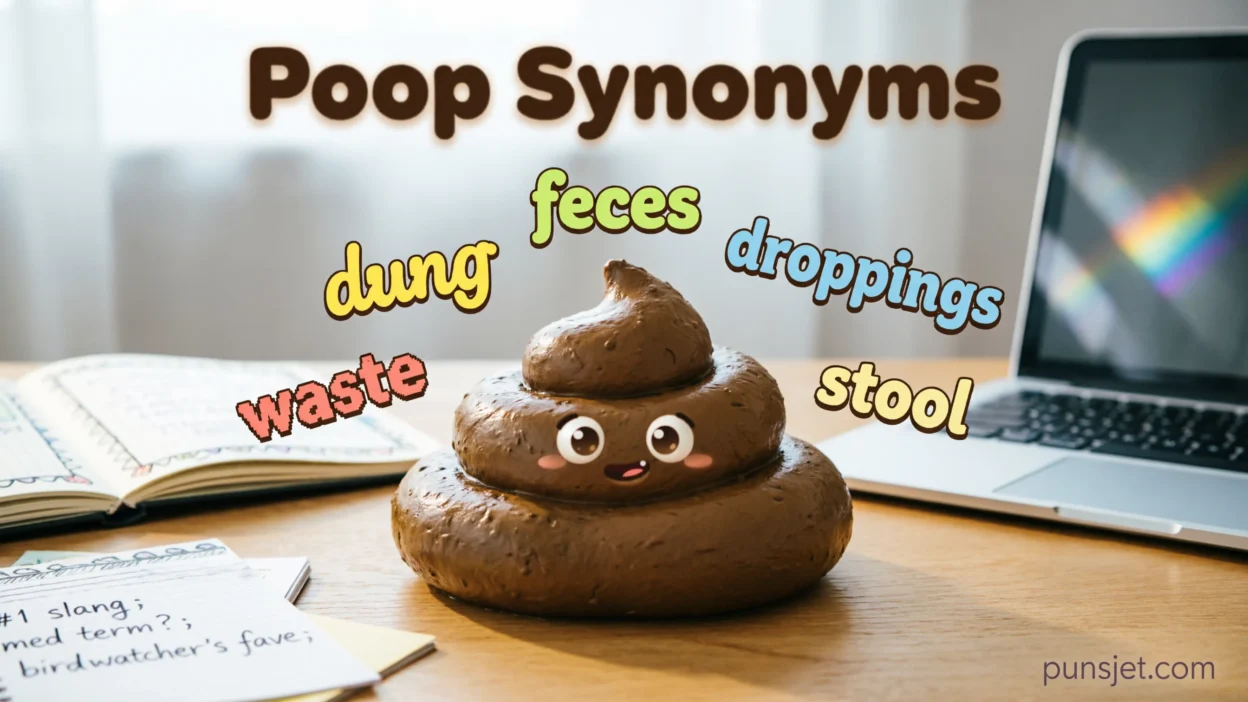
When people search for poop synonyms, they usually want better, cleaner, funnier, or more professional ways to talk about poop.Some words are casual and funny, while others are medical, polite, or slang-based. Knowing the right synonym can help students, ESL learners, writers, and content creators communicate more naturally and clearly.
The English language has many alternatives for the word “poop.” You may hear formal words in hospitals, playful words in conversations, and slang terms online or in comedy. Choosing the correct synonym depends on tone, audience, and situation.This guide explains the meaning of poop synonyms in simple English. You’ll learn 30 useful alternatives with meanings, example sentences, and the best situations for using them.
What Does “Poop” Mean?

The word poop refers to solid waste released from the body after digestion. It is a very common informal English word.
People use poop-related synonyms for different reasons:
- To sound polite
- To sound scientific or medical
- To make jokes
- To avoid repeating the same word
- To match formal or informal situations
For example:
- A doctor may say “stool.”
- A child may say “poopy.”
- A comedian may say “crap.”
- A writer may use “droppings” for animals.
Understanding these differences improves vocabulary and communication skills.
Best Poop Synonyms
1. Stool
Meaning: Medical or formal word for poop.
Example: The doctor asked for a stool sample.
Best Usage Context: Hospitals, healthcare, medical writing.
2. Feces
Meaning: Scientific term for solid body waste.
Example: The lab tested the feces for bacteria.
Best Usage Context: Scientific and academic writing.
3. Excrement
Meaning: Formal term for waste released from the body.
Example: Animal excrement covered the path.
Best Usage Context: Formal descriptions and biology topics.
4. Waste
Meaning: General term for unwanted body material.
Example: The body removes waste naturally.
Best Usage Context: Health and educational content.
5. Droppings
Meaning: Waste from birds or animals.
Example: Bird droppings were on the car.
Best Usage Context: Animal-related discussions.
6. Manure
Meaning: Animal waste used as fertilizer.
Example: Farmers spread manure on the fields.
Best Usage Context: Agriculture and farming.
7. Dung
Meaning: Animal feces, especially from farm animals.
Example: The barn smelled of dung.
Best Usage Context: Rural or farming language.
8. Crap
Meaning: Informal slang word for poop.
Example: The dog left crap in the yard.
Best Usage Context: Casual conversations.
9. Turd
Meaning: A rude slang term for a piece of poop.
Example: Someone stepped on a turd.
Best Usage Context: Humor and slang.
10. Number Two
Meaning: Polite indirect expression for poop.
Example: The child needed to do number two.
Best Usage Context: Talking with children.
11. BM
Meaning: Short form of bowel movement.
Example: The patient had a normal BM today.
Best Usage Context: Medical notes and healthcare.
12. Bowel Movement
Meaning: Formal phrase for passing poop.
Example: Drinking water helps bowel movements.
Best Usage Context: Health conversations.
13. Solid Waste
Meaning: Formal phrase for body waste.
Example: The system removes solid waste efficiently.
Best Usage Context: Scientific and technical writing.
14. Mess
Meaning: Informal word for poop, especially from pets or babies.
Example: The puppy made a mess on the floor.
Best Usage Context: Family conversations.
15. Poopy
Meaning: Child-friendly version of poop.
Example: The diaper is poopy.
Best Usage Context: Speaking with young children.
16. Scat
Meaning: Animal droppings, especially in wildlife studies.
Example: Researchers studied bear scat.
Best Usage Context: Wildlife and biology.
17. Guano
Meaning: Bird or bat droppings.
Example: Guano collected inside the cave.
Best Usage Context: Nature and science topics.
18. Filth
Meaning: Dirty or disgusting waste material.
Example: The alley was covered in filth.
Best Usage Context: Descriptive writing.
19. Refuse
Meaning: General waste or garbage.
Example: The city removed household refuse.
Best Usage Context: Formal waste-management topics.
20. Sewage
Meaning: Waste carried through drains and pipes.
Example: The sewage system needed repairs.
Best Usage Context: Plumbing and sanitation.
21. Poo
Meaning: Common British and informal version of poop.
Example: The toddler laughed at the word poo.
Best Usage Context: Casual everyday speech.
22. Doo-Doo
Meaning: Playful child-friendly term for poop.
Example: The cartoon joked about doo-doo.
Best Usage Context: Humor and kids’ language.
23. Defecation
Meaning: Formal medical term for passing poop.
Example: Fiber helps regular defecation.
Best Usage Context: Medical and scientific writing.
24. Foul Matter
Meaning: Dirty or unpleasant waste material.
Example: Workers cleaned the foul matter.
Best Usage Context: Formal descriptive writing.
25. Organic Waste
Meaning: Natural waste from living things.
Example: Organic waste can become compost.
Best Usage Context: Environmental discussions.
26. Night Soil
Meaning: Old-fashioned term for human waste.
Example: Night soil was removed from villages long ago.
Best Usage Context: Historical writing.
27. Sludge
Meaning: Thick waste material, sometimes including sewage.
Example: The pipes were blocked with sludge.
Best Usage Context: Industrial and sanitation topics.
28. Residue
Meaning: Material left behind after a process.
Example: Residue remained after cleaning.
Best Usage Context: Technical and scientific discussions.
29. Offal
Meaning: Waste parts from animal processing.
Example: The factory disposed of offal carefully.
Best Usage Context: Food industry and farming.
30. Dirt
Meaning: Informal word for something dirty or messy.
Example: The child tracked dirt into the house.
Best Usage Context: Casual speech.
Quick Comparison Table for Poop Synonyms
| Synonym | Tone | Best For |
|---|---|---|
| Stool | Formal | Medical situations |
| Feces | Scientific | Academic writing |
| Crap | Informal | Casual conversations |
| Number Two | Polite | Children |
| Droppings | Neutral | Animals |
| Dung | Rural | Farming |
| BM | Medical shorthand | Healthcare |
| Poo | Casual | Everyday British English |
| Turd | Rude slang | Humor |
| Defecation | Very formal | Scientific language |
How to Choose the Right Poop Synonym
Choosing the right synonym depends on tone, audience, and purpose.
Formal and Medical Contexts
Use these words in healthcare, science, or academic writing:
- Stool
- Feces
- Defecation
- Bowel movement
- BM
These sound professional and respectful.
Casual Everyday Conversations
Use these for relaxed or friendly speech:
- Poop
- Poo
- Crap
- Mess
These are common in daily life.
Child-Friendly Terms
Use these when speaking with children:
- Poopy
- Number two
- Doo-doo
These sound softer and less serious.
Animal and Farming Terms
Use these for wildlife or agriculture:
- Dung
- Manure
- Droppings
- Scat
- Guano
These specifically relate to animals.
Slang and Humor
Use carefully in jokes or informal content:
- Turd
- Crap
These can sound rude in professional settings.
Common Mistakes When Using Poop Synonyms
Using Slang in Formal Writing
Words like “crap” or “turd” should not appear in school essays or professional documents.
Incorrect:
- The patient had weird crap issues.
Correct:
- The patient experienced bowel movement issues.
Mixing Animal and Human Terms
Some synonyms work better for animals than humans.
For example:
- “Dung” usually refers to animals.
- “Stool” is commonly used for humans.
Using Scientific Terms Casually
Words like “feces” can sound too formal in friendly conversations.
Example:
- Casual: “The dog pooped on the lawn.”
- Scientific: “The canine feces contained parasites.”
Why Learning Poop Synonyms Is Useful
Learning poop synonyms improves:
- Vocabulary variety
- Writing flexibility
- ESL communication skills
- Understanding of tone
- Creative writing ability
Writers and content creators especially benefit from knowing which words sound funny, formal, polite, or scientific.
Conclusion
Understanding poop synonyms helps you communicate more naturally in English.Some synonyms are formal and medical, while others are playful, casual, or slang-based. The best choice depends on your audience and situation.
Words like stool, feces, and bowel movement work well in professional settings.Casual conversations often use poop, poo, or crap. For children, softer terms like number two and doo-doo are more appropriate.
By learning these synonyms, students, ESL learners, writers, and content creators can improve vocabulary, avoid repetition, and choose words with the right tone and meaning.