
Aid and aide sound exactly the same when we say them aloud, but they do not have the same meaning. This can make them confusing, especially for students, English learners, and anyone who is still building confidence with English vocabulary.
The good news is that the difference is simple once you remember what each word means.
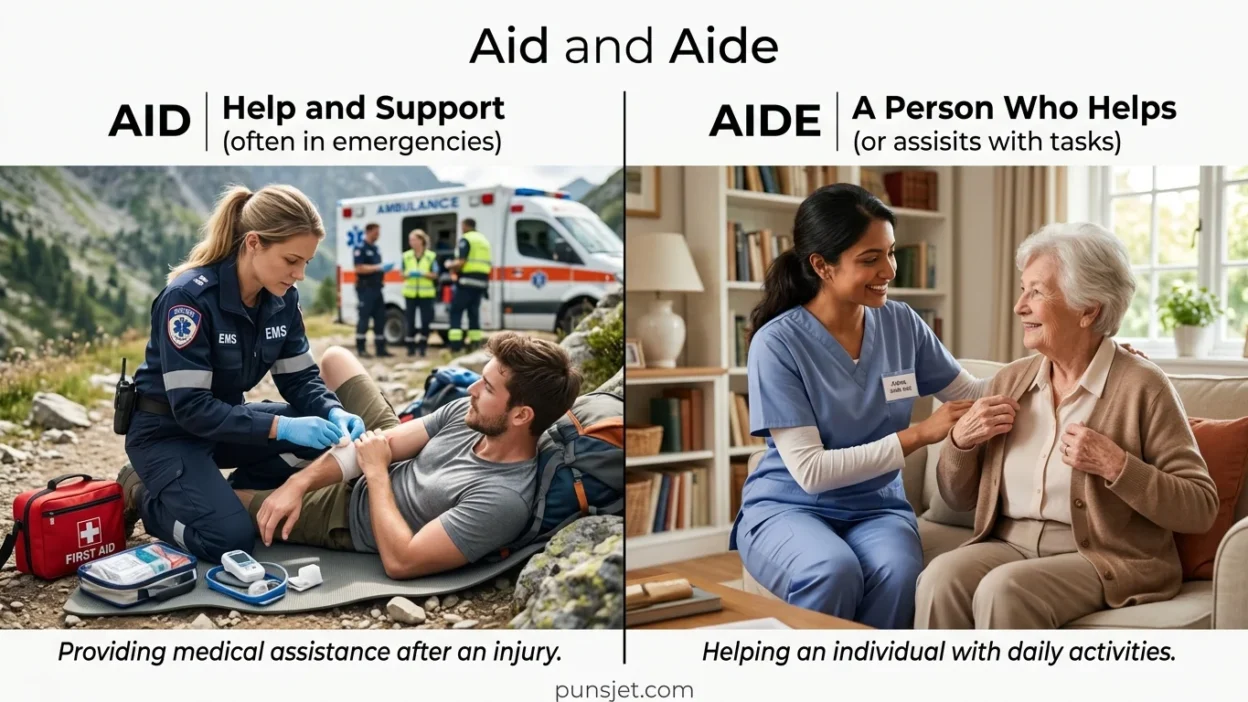
Aid is connected with help or assistance. It can be used as a noun or a verb.Aide is a person who helps another person, especially someone who has an important job or position.
For example:
- The charity provided aid to families after the storm.
- The president’s aide prepared the meeting notes.
Both words are pronounced like “aid,” but their meanings and uses are different.
Quick Answer: Aid vs. Aide
Here is the easiest way to remember the difference:
- Aid = help or assistance.
- Aid can also mean to help.
- Aide = a person who helps someone.
- Aid can be used as a noun or verb.
- Aide is usually a noun.
- Aid is common in phrases such as medical aid, financial aid, and first aid.
- Aide is common when talking about a person’s job, such as a political aide or teacher’s aide.
Easy memory trick
Think of the extra e in aide as standing for employee.
Aide = a person who helps.
A Simple Background of the Words
The words aid and aide are related in meaning because both are connected with helping.
Aid comes from an old French word connected with helping or assistance. English has used aid for many years to describe help given to a person, group, or cause.
Aide came into English later as a word for a person who provides help. It is closely related to the French word aide, which means help or helper depending on its use.
Over time, English developed a useful difference between the two spellings:
- aid usually refers to help itself
- aide usually refers to the person who gives help
They kept the same pronunciation, which is why they are called homophones.
What Does “Aid” Mean?
Aid means help, support, or assistance.
It can be a thing that helps someone, money given to someone, medical treatment, or any other form of useful support.
Aid as a noun
When aid is a noun, it means help.
Examples:
- The victims received emergency aid.
- The country sent food and medical aid.
- Students can apply for financial aid.
- The injured man needed first aid.
- The organization provides aid to poor families.
In these examples, aid means some kind of help or support.
Aid as a verb
Aid can also be a verb. As a verb, it means to help.
Examples:
- The medicine may aid recovery.
- The teacher aided the students with their project.
- These tools can aid workers in their daily tasks.
A simple replacement test can help:
If you can replace the word with help, you probably need aid.
The program will aid students.
This means:
The program will help students.
What Does “Aide” Mean?
Aide is a noun that means a person whose job is to help someone.
An aide often works for a person in an important position, a teacher, a doctor, a government official, or another professional.
Examples:
- The senator spoke with an aide before the meeting.
- The teacher’s aide helped the children.
- The manager asked his aide to organize the schedule.
- A hospital aide helped the patients.
- The mayor’s aide answered questions from reporters.
Notice that aide always points to a person.
Aide does not mean help itself
This is one of the most important things to remember.
You would not normally say:
The family received an aide.
If you mean help, use aid:
The family received aid.
If you mean a person who provides help, use aide:
The family was assisted by an aide.
Aid vs. Aide: Comparison Table
| Word | Meaning | Part of Speech | Example |
|---|---|---|---|
| aid | help or assistance | Noun | The victims received aid. |
| aid | to help | Verb | The treatment may aid recovery. |
| aide | a person who helps | Noun | The senator’s aide attended the meeting. |
| aid | support or resources | Noun | The school provides financial aid. |
| aide | a worker or assistant | Noun | The teacher’s aide helped the class. |
The main difference
Aid = help.
Aide = helper.
That one idea will solve most aid vs. aide questions.
Which One Should You Use and When?
Choosing between these words becomes easy when you ask one question:
Are you talking about help or a person?
If you are talking about help, use aid.
- financial aid
- medical aid
- emergency aid
- first aid
- humanitarian aid
- legal aid
If you are talking about a person who helps, use aide.
- teacher’s aide
- political aide
- presidential aide
- classroom aide
- congressional aide
Use “aid” as a verb when you mean “help”
For example:
Exercise can aid your health.
You could also say:
Exercise can help your health.
Because aid can replace help, it is the correct word.
Common Mistakes With Aid and Aide
Because the two words sound the same, spelling mistakes are very common.
Mistake 1: Using “aide” for help
Incorrect:
The organization provided food and aide.
Correct:
The organization provided food and aid.
The sentence is talking about help, not a person.
Mistake 2: Using “aid” for a helper
Incorrect:
The teacher’s aid helped the students.
Correct:
The teacher’s aide helped the students.
Here, the sentence is talking about a person whose job is to help the teacher.
Mistake 3: Forgetting that “aid” can be a verb
Some learners think aid can only be a noun.
But this is also correct:
The new system will aid workers.
Here, aid means help.
Mistake 4: Choosing based only on pronunciation
Both words sound the same, so listening alone will not tell you which spelling to use.
You need to look at the meaning.
Ask yourself:
“Am I talking about help, or am I talking about a helper?”
- Help → aid
- Helper → aide
Everyday Real-Life Examples
These words appear in many ordinary situations.
In emails
You might write:
I am writing to ask about financial aid for next semester.
Here, aid means financial help.
You might also read:
The director’s aide will contact you tomorrow.
Here, aide means a person who works as an assistant.
In the news
News reports often use both words.
For example:
The government sent emergency aid to the affected area.
This means the government sent help.
Another example:
The president’s aide spoke to reporters.
This means a person who works for the president spoke to reporters.
On social media
You might see a post saying:
Thanks to everyone who offered aid after the accident.
Or:
Her aide helped arrange the event.
The first sentence refers to help. The second refers to a person.
In school
Students often see the word aid in:
financial aid
This means money or other support that helps students pay for education.
Students may also hear:
teacher’s aide
This means a person who helps a teacher in a classroom.
In emergencies
One of the most familiar phrases is:
first aid
First aid means basic medical help given to someone who is injured or suddenly becomes ill.
Another common phrase is:
emergency aid
Again, aid means help.
A Simple Learning Trick for Students
If you are learning English, do not try to memorize many complicated rules. Remember these two short sentences:
Aid is help.
An aide is a helper.
Now test yourself.
1. The hospital provided medical _____.
The answer is aid because medical help is being provided.
2. The teacher’s _____ handed out the papers.
The answer is aide because a person is handing out the papers.
3. The medicine may _____ the healing process.
The answer is aid because it means “help.”
4. The politician’s _____ arranged the meeting.
The answer is aide because it refers to a person.
More Useful Examples
Here are some quick examples to make the difference clearer:
Aid
- The family needed financial aid.
- The country received foreign aid.
- The nurse gave first aid.
- The organization sent food aid.
- This information may aid your research.
- The program is designed to aid young learners.
Aide
- The senator’s aide arrived early.
- A teacher’s aide helped the children.
- The doctor’s aide prepared the room.
- His personal aide organized his schedule.
- The government official met with an aide.
FAQ:
1. What is the difference between aid and aide?
Aid means help or assistance. Aide means a person who helps someone.
Aid = help.
Aide = helper.
2. Are aid and aide pronounced the same?
Yes. In standard English, aid and aide are pronounced the same way.
Their spelling and meaning are different.
3. Is aid a noun or a verb?
Aid can be both a noun and a verb.
As a noun, it means help:
The family received aid.
As a verb, it means to help:
The medicine may aid recovery.
4. Is aide a noun or a verb?
Aide is normally used as a noun. It means a person who helps someone as part of a job or role.
Example:
The politician’s aide arranged the meeting.
5. Is “financial aide” correct?
Usually, no.
The correct phrase is:
financial aid
It means financial help or support.
Aide would mean a person, so financial aide would suggest a person rather than financial assistance.
6. Is “teacher’s aide” correct?
Yes.
A teacher’s aide is a person who helps a teacher, often in a classroom.
Example:
The teacher’s aide helped the students complete the activity.
7. Is “first aide” correct?
No.
The correct phrase is:
First aid means basic medical help given during an injury or emergency.
8. What is the easiest way to remember aid and aide?
Remember:
Aid = help.
Aide = helper.
If you are talking about assistance, choose aid. If you are talking about a person whose job is to help, choose aide.
Conclusion
The difference between aid and aide is simple once you focus on their meanings.
Aid means help, support, or assistance. It can also be a verb meaning to help.
Aide means a person who helps, especially someone working as an assistant.
Remember this quick rule:
So you receive financial aid, give first aid, or provide emergency aid. But a teacher can have an aide, and a politician can have an aide.
Although the two words sound exactly the same, their meanings are different. Once you connect aid with “help” and aide with “helper,” choosing the correct word becomes much easier.

Emily Margaret is a writer and humor enthusiast at PunsJet.com. She enjoys creating clever puns and lighthearted content that entertains readers and adds a spark of humor to everyday life. With a love for wordplay and creativity, Emily aims to share fun, relatable jokes that make people smile and laugh.