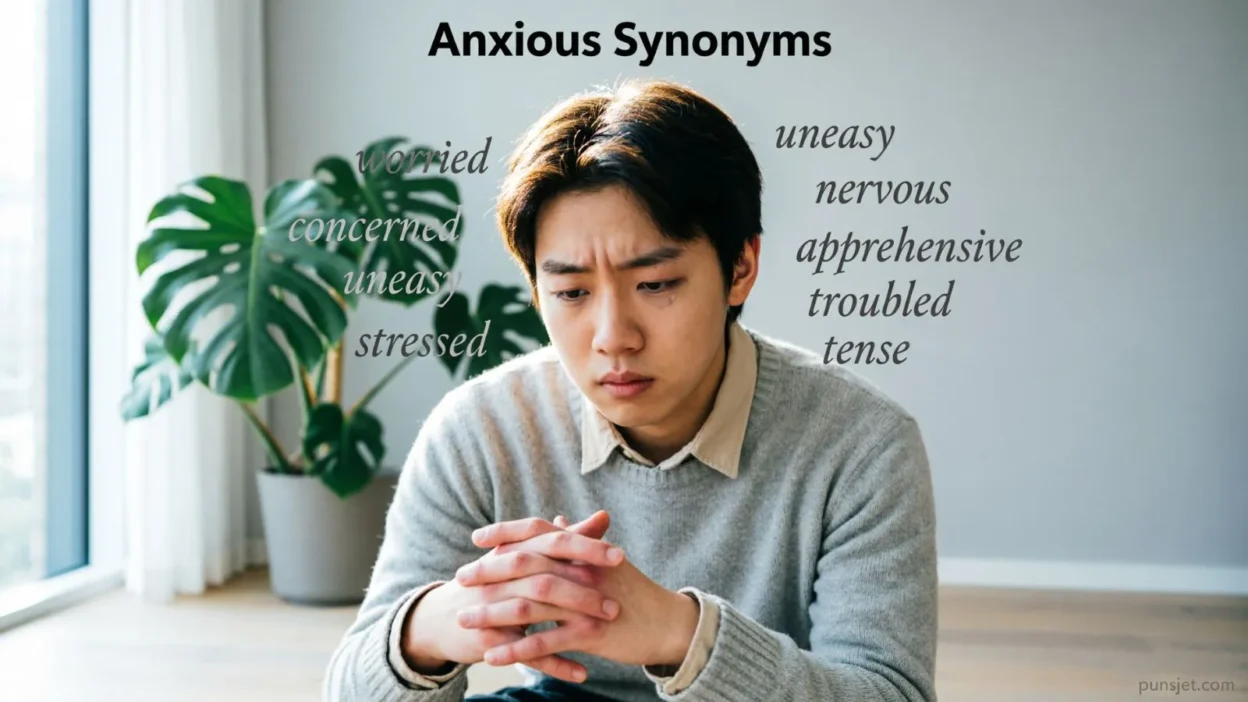
Have you ever wanted a better word than anxious when writing an essay, story, email, or social media post?
Learning anxious synonyms can help you express emotions more accurately and make your writing more engaging.
The word anxious is commonly used to describe feelings of worry, nervousness, concern, or uneasiness about a situation.
However, depending on the context, there are many other words that may fit better. Some synonyms suggest fear, while others express excitement, stress, or anticipation.
In this guide, you’ll learn the meaning of anxious, discover useful anxious synonyms, understand when to use each one, and find practical examples that improve your vocabulary and writing skills.
What Does “Anxious” Mean?
Anxious means feeling worried, nervous, uneasy, or concerned about something that may happen.
Simple Definition
A person is anxious when they feel uncertain, stressed, or nervous about an upcoming event, decision, or outcome.
Examples
- She felt anxious before her job interview.
- The students were anxious about the exam results.
- I became anxious when I couldn’t reach my family.
30 Anxious Synonyms
1. Worried
Meaning: Feeling concerned about a problem.
Example Sentence: I am worried about tomorrow’s presentation.
Best Usage Context: Everyday concerns and common situations.
2. Nervous
Meaning: Feeling tense or uneasy.
Example Sentence: He felt nervous before speaking on stage.
Best Usage Context: Public speaking, interviews, performances.
3. Concerned
Meaning: Caring about a possible problem.
Example Sentence: Parents were concerned about their child’s health.
Best Usage Context: Formal and professional situations.
4. Uneasy
Meaning: Slightly uncomfortable or worried.
Example Sentence: She felt uneasy walking alone at night.
Best Usage Context: Mild discomfort or uncertainty.
5. Apprehensive
Meaning: Expecting something unpleasant.
Example Sentence: He was apprehensive about the surgery.
Best Usage Context: Formal writing and serious situations.
6. Tense
Meaning: Physically or mentally stressed.
Example Sentence: The atmosphere became tense before the announcement.
Best Usage Context: Stressful environments.
7. Stressed
Meaning: Under pressure or strain.
Example Sentence: Many workers feel stressed during busy seasons.
Best Usage Context: Work and study-related situations.
8. Distressed
Meaning: Extremely upset or troubled.
Example Sentence: She appeared distressed after hearing the news.
Best Usage Context: Emotional or serious events.
9. Troubled
Meaning: Deeply worried or bothered.
Example Sentence: He looked troubled throughout the meeting.
Best Usage Context: Personal and emotional concerns.
10. Agitated
Meaning: Nervous and unable to stay calm.
Example Sentence: The customer became agitated while waiting.
Best Usage Context: Visible emotional tension.
11. Restless
Meaning: Unable to relax or remain still.
Example Sentence: I felt restless before the final exam.
Best Usage Context: Anticipation and nervous energy.
12. Fretful
Meaning: Frequently worried.
Example Sentence: She became fretful about every small detail.
Best Usage Context: Ongoing worry.
13. Fearful
Meaning: Afraid something bad may happen.
Example Sentence: Residents were fearful during the storm.
Best Usage Context: Situations involving danger.
14. Alarmed
Meaning: Suddenly worried or frightened.
Example Sentence: The community was alarmed by the warning.
Best Usage Context: Unexpected concerns.
15. Panicked
Meaning: Extremely anxious and afraid.
Example Sentence: He panicked when he lost his passport.
Best Usage Context: Emergency situations.
16. Overwhelmed
Meaning: Feeling unable to cope.
Example Sentence: She felt overwhelmed by her responsibilities.
Best Usage Context: Heavy workloads and emotional stress.
17. Jittery
Meaning: Shaky and nervous.
Example Sentence: I felt jittery before the competition.
Best Usage Context: Informal conversations.
18. On Edge
Meaning: Easily upset or nervous.
Example Sentence: Everyone was on edge before the results.
Best Usage Context: Casual speaking and writing.
19. Edgy
Meaning: Irritable due to anxiety.
Example Sentence: He became edgy during the long wait.
Best Usage Context: Informal communication.
20. Perturbed
Meaning: Disturbed or worried.
Example Sentence: She seemed perturbed by the unexpected delay.
Best Usage Context: Formal writing.
21. Distraught
Meaning: Extremely worried and upset.
Example Sentence: The family was distraught after the incident.
Best Usage Context: Strong emotional situations.
22. Insecure
Meaning: Lacking confidence or certainty.
Example Sentence: He felt insecure about his abilities.
Best Usage Context: Personal emotions.
23. Doubtful
Meaning: Unsure about something.
Example Sentence: She was doubtful about the plan’s success.
Best Usage Context: Decision-making situations.
24. Suspicious
Meaning: Concerned that something may be wrong.
Example Sentence: He became suspicious of the unusual behavior.
Best Usage Context: Trust-related situations.
25. Antsy
Meaning: Impatient and nervous.
Example Sentence: The children grew antsy during the delay.
Best Usage Context: Informal speech.
26. Anxious-Minded
Meaning: Naturally inclined to worry.
Example Sentence: She is an anxious-minded person.
Best Usage Context: Personality descriptions.
27. Hesitant
Meaning: Unsure and cautious.
Example Sentence: He was hesitant to accept the offer.
Best Usage Context: Decision-making.
28. Concern-ridden
Meaning: Filled with worry.
Example Sentence: She spent a concern-ridden night waiting.
Best Usage Context: Descriptive writing.
29. Troubled-Hearted
Meaning: Emotionally worried.
Example Sentence: The troubled-hearted mother waited patiently.
Best Usage Context: Literary writing.
30. Wary
Meaning: Careful because of possible danger.
Example Sentence: Travelers were wary of scams.
Best Usage Context: Cautious situations.
Quick Comparison Table
| Synonym | Strength | Best For |
|---|---|---|
| Worried | Mild | Everyday concerns |
| Nervous | Mild-Medium | Presentations, interviews |
| Concerned | Mild | Formal situations |
| Apprehensive | Medium | Future uncertainty |
| Stressed | Medium | Work and studies |
| Agitated | Medium-High | Visible tension |
| Fearful | High | Potential danger |
| Panicked | Very High | Emergencies |
| Distraught | Extreme | Emotional distress |
| Wary | Mild | Cautious behavior |
How to Choose the Right Anxious Synonym
Choosing the correct synonym depends on the emotion you want to express.
For Everyday Worry
Use:
- Worried
- Concerned
- Uneasy
- Doubtful
For Nervousness Before Events
Use:
- Nervous
- Jittery
- Restless
- Antsy
For Serious Fear
Use:
- Fearful
- Alarmed
- Panicked
- Distraught
For Stress and Pressure
Use:
- Stressed
- Tense
- Agitated
- Overwhelmed
For Formal Writing
Use:
- Apprehensive
- Perturbed
- Concerned
- Hesitant
Common Mistakes When Using Anxious Synonyms
Using “Panicked” for Minor Worries
Incorrect:
- I was panicked about choosing lunch.
Better:
- I was worried about choosing lunch.
Using “Concerned” for Extreme Fear
Incorrect:
- The victims were merely concerned during the disaster.
Better:
- The victims were fearful or panicked during the disaster.
Why Learning Anxious Synonyms Matters
Expanding your vocabulary helps you:
- Write more naturally.
- Avoid repeating the same word.
- Improve essays and assignments.
- Create stronger stories and content.
- Communicate emotions more accurately.
Writers, students, and ESL learners especially benefit from understanding subtle differences between similar words.
Conclusion
Learning anxious synonyms can significantly improve your communication skills.
While “anxious” is a useful word, alternatives such as worried, nervous, apprehensive, stressed, fearful, and panicked provide more precise ways to express different levels of concern and uneasiness.
The best synonym depends on the situation, tone, and intensity of the emotion.
By understanding these differences and practicing them in everyday writing, you can build a stronger vocabulary and communicate with greater clarity and confidence.

Joshua Paul is a creative writer and contributor at PunsJet.com who enjoys crafting witty puns and clever wordplay. With a strong sense of humor and a love for language, he creates entertaining content that readers can easily share and enjoy. Joshua’s goal is to spread laughter through fun and memorable jokes.