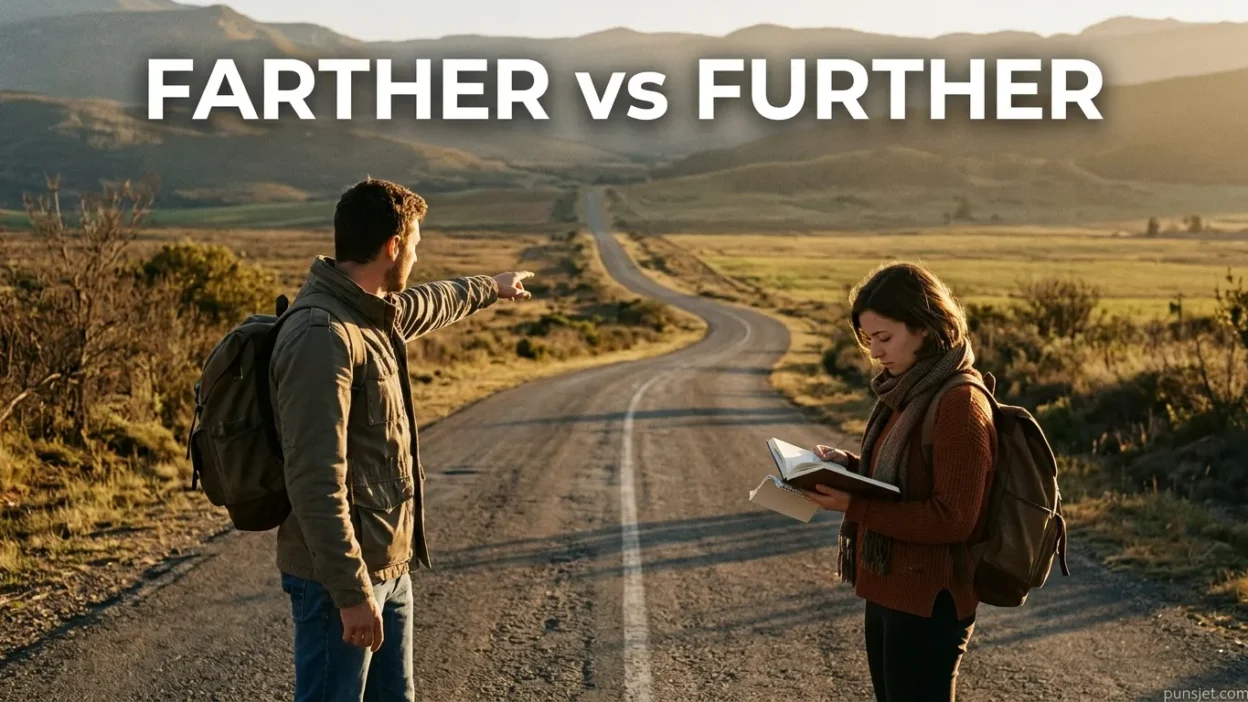
Have you ever wondered if to use farther or further when talking about distance, progress, or something beyond a certain point? These two English words look and sound similar, so it is easy to mix them up. However, they have slightly different meanings and uses. Understanding the difference can help you write more clearly and speak with confidence.
The main difference between farther and further is that farther usually refers to physical distance, while further generally refers to figurative distance, additional information, or a greater degree of something. For example, you might say, “The school is farther from my house than the library.” However, you would say, “We need to discuss this matter further.” Although this distinction is useful, further can also refer to physical distance, and both words sometimes overlap. Let’s explore their meanings, examples, grammar rules, and common mistakes.
Quick Answer: Farther vs Further
Farther usually describes measurable physical distance between two places or objects. Further generally means additional, more, or to a greater extent. For example, “We walked farther down the road” describes physical distance, while “Let’s discuss this further” means continuing a discussion in greater detail.
Why Do People Confuse Farther and Further?
People often confuse farther and further because both words can describe something beyond a starting point or existing limit.
They also share similar pronunciation and can sometimes be used interchangeably when discussing physical distance.
Here are three main reasons for the confusion:
- Similar meanings: Both words can suggest going beyond a particular point.
- Similar pronunciation: They sound almost identical in everyday conversation.
- Overlapping usage: Further can describe physical distance, even though farther is traditionally preferred for measurable distance.
The easiest way to remember the difference is to connect farther with physical distance and further with additional progress or information.
What Does Farther Mean?
Farther is a comparative word that usually describes a greater physical distance between two places, people, or objects.
It is commonly used when you can measure or compare how far something is.
For example:
- My school is farther from home than yours.
- We walked farther than we planned.
- The airport is farther away than the train station.
- Can you move the chair farther from the door?
In each example, farther describes physical space or distance.
How to Use Farther in a Sentence
Use farther when comparing the physical distance between locations or objects.
Examples:
- The supermarket is farther down the street.
- She ran farther than her brother.
- We need to drive farther to reach the beach.
- Their house is farther from the city center.
Simple rule: If you are talking about measurable physical distance, farther is usually the best choice.
What Does Further Mean?
Further means additional, more, or to a greater extent. It is commonly used when discussing ideas, information, progress, development, or actions.
Unlike farther, further does not usually describe measurable physical distance.
For example:
- We need further information before making a decision.
- Let’s discuss this matter further.
- She wants to further her education.
- The company plans to further improve its services.
In these examples, further refers to additional information, continued discussion, or progress.
How to Use Further in a Sentence
Use further when you mean something additional or want to describe progress beyond an existing level.
Examples:
- Please contact me for further details.
- We need further investigation into the problem.
- He wants to further develop his skills.
- Nothing further needs to be said.
Simple rule: If you mean more, additional, or continued progress, further is generally the correct choice.
Farther vs Further: Comparison Table
The following table highlights the main differences between these two words.
| Feature | Farther | Further |
|---|---|---|
| Main meaning | Greater physical distance | Additional or more |
| Common use | Physical distance | Ideas, progress, information |
| Grammar | Comparative adjective or adverb | Adjective, adverb, or verb |
| Distance | Usually measurable | Physical or figurative |
| Example | Walk farther | Discuss further |
| Related expression | Far away | Further information |
Both words are correct English words, but choosing the right one depends on your intended meaning.
When Should You Use Farther or Further?
Choosing between farther and further becomes easier when you understand the situation.
When to Use Farther
Use farther when describing physical distance that can be measured or compared.
For example:
- The next town is farther away.
- I can throw the ball farther than you.
- We traveled farther than expected.
- The restaurant is farther from here.
In these sentences, the focus is on actual distance.
When to Use Further
Use further when talking about additional information, deeper understanding, progress, or continued activity.
For example:
- I need further explanation.
- We should investigate the issue further.
- She wants to further her career.
- Please provide further instructions.
Here, further means more or additional rather than a measurable distance.
Can Further Also Describe Physical Distance?
Yes! Further can also describe physical distance.
For example:
- We walked further along the beach.
- The village is further down the road.
- How much further is the nearest gas station?
These sentences are grammatically acceptable. In traditional usage, farther is often preferred for measurable physical distance, but further is also widely used.
12 Examples of Farther vs Further in Sentences
Examples make it easier to understand how these words work in everyday English.
Examples Using Farther
- My office is farther from the station than yours.
- We walked farther into the forest before stopping.
- The mountain looks farther away than it really is.
- She can swim farther than anyone on the team.
- The grocery store is farther down this road.
- How much farther do we need to travel?
Examples Using Further
- I need further information about the course.
- Let’s discuss the problem further tomorrow.
- He decided to further his education abroad.
- The teacher provided further examples to explain the lesson.
- We cannot move forward without further discussion.
- Please let me know if you have any further questions.
Examples Using Both Words
You can also use both words in the same context when they express different meanings.
- We traveled farther than expected and learned further details about the area.
- The school is farther away, so we need further planning before visiting.
- She walked farther to find further information about the historical site.
These examples show how context determines which word is appropriate.
Common Mistakes When Using Farther and Further
Even experienced English speakers sometimes mix up these words. Here are some common mistakes and their corrections.
Mistake 1: Using further for every type of distance
Incorrect: We walked further than five miles.
Better: We walked farther than five miles.
Why? Farther is traditionally preferred when describing measurable physical distance.
Mistake 2: Using farther for additional information
Incorrect: Please send me farther information.
Correct: Please send me further information.
Why? Further means additional in this context.
Mistake 3: Using farther in a discussion
Incorrect: We need to discuss this matter farther.
Correct: We need to discuss this matter further.
Why? Further describes continuing a discussion or exploring an idea more deeply.
Mistake 4: Thinking further can never describe physical distance
Incorrect understanding: Further is only used for ideas and information.
Correct understanding: Further can also describe physical distance, although farther is often preferred when the distance is measurable.
Easy Memory Trick to Remember Farther vs Further
Here is a simple trick to help you remember the difference:
Farther = Far (Physical Distance)
Both words begin with “far.” Think of farther as traveling farther away from your current location.
Example: We drove farther to reach the beach.
Further = Further Information (Additional Things)
Connect further with additional details, explanations, or progress.
Example: I need further information about the project.
Remember these two simple connections:
- Farther = Physical distance.
- Further = Additional or more.
This trick works in most everyday English situations.
Farther vs Further in American and British English
Farther and further are both accepted in American and British English. There is no major spelling difference between the two varieties.
However, their preferred usage can vary slightly.
American English
American English traditionally makes a clearer distinction between the words:
- Farther for physical distance.
- Further for figurative distance, additional information, or progress.
For example:
- We drove farther than expected.
- I need further details about the meeting.
British English
British English also recognizes this distinction, but further is commonly used for both physical and figurative distance.
For example:
- We walked further along the path.
- Please provide further information.
These are general usage preferences rather than strict regional rules. Both words are understood in the United States and the United Kingdom.
Similar Words Related to Farther and Further
Understanding related words can help expand your English vocabulary.
| Word | Meaning | Example |
|---|---|---|
| Far | At a great distance | My home is far away. |
| Farthest | Greatest physical distance | This is the farthest point. |
| Furthest | Greatest degree or distance | This is the furthest we can go. |
| Additional | Extra or more | We need additional time. |
| Beyond | At or past a limit | The village is beyond the river. |
| Moreover | In addition | Moreover, the plan is affordable. |
Farther vs Farthest
Farther is the comparative form, while farthest is commonly used for the greatest physical distance.
- My house is farther away than yours.
- This is the farthest place we have visited.
Further vs Furthest
Further compares additional progress or degree, while furthest describes the greatest extent or distance.
- We need to explore this topic further.
- This is the furthest we have gone in our research.
Final Verdict: Farther or Further?
Both farther and further are correct English words, but they are generally used in different situations.
Use farther when discussing physical distance, such as walking, driving, running, or traveling between places.
Use further when referring to additional information, deeper discussion, progress, or development.
Remember that further can also describe physical distance, so it is not always incorrect to use it instead of farther.
The best choice depends on what you want to communicate.
FAQs:
1. What is the main difference between farther and further?
The main difference is that farther usually describes physical distance, while further generally means additional, more, or to a greater extent. For example, “We walked farther” refers to distance, while “We need further information” means additional information.
2. Is farther or further correct for distance?
Both words can describe physical distance. However, farther is traditionally preferred when referring to measurable physical distance. Further is also widely accepted, particularly in British English.
3. Is further more formal than farther?
Further is often used in formal writing when discussing additional information, research, or progress. However, neither word is automatically more formal than the other. Both are appropriate in everyday and professional English.
4. Can I use further instead of farther?
Yes. Further can describe physical distance, and many English speakers use it this way. However, if you want to follow the traditional distinction, use farther for measurable physical distance.
5. Is it further information or farther information?
The correct expression is further information. Further means additional or more, making it the appropriate choice when requesting extra details or explanations.
6. Is it farther away or further away?
Both expressions are correct. Farther away is traditionally preferred when describing physical distance, while further away is also commonly used and understood.
7. What are the comparative and superlative forms of far?
The comparative forms are farther and further. The superlative forms are farthest and furthest. Farther and farthest usually refer to physical distance, while further and furthest can refer to additional progress or degree.
Remember This
- Farther: Use it mainly for physical distance.
- Further: Use it for additional information, progress, or deeper discussion.
- Both: Either word can describe physical distance in modern English.
- Easy trick: Farther means more physical distance; further means more of something.
Conclusion
Understanding the difference between farther and further does not have to be difficult. Although both words can describe distance, farther is traditionally used for physical measurements, while further is preferred when discussing additional information, progress, or a greater degree of something. Learning this simple distinction can help you avoid common grammar mistakes.
The next time you are unsure which word to choose, think about your sentence’s meaning. Are you talking about traveling a greater physical distance? Choose farther. Are you asking for more information or discussing something in greater detail? Choose further. With regular practice, you will find it much easier to use both words naturally and correctly.

Joshua Paul is a creative writer and contributor at PunsJet.com who enjoys crafting witty puns and clever wordplay. With a strong sense of humor and a love for language, he creates entertaining content that readers can easily share and enjoy. Joshua’s goal is to spread laughter through fun and memorable jokes.