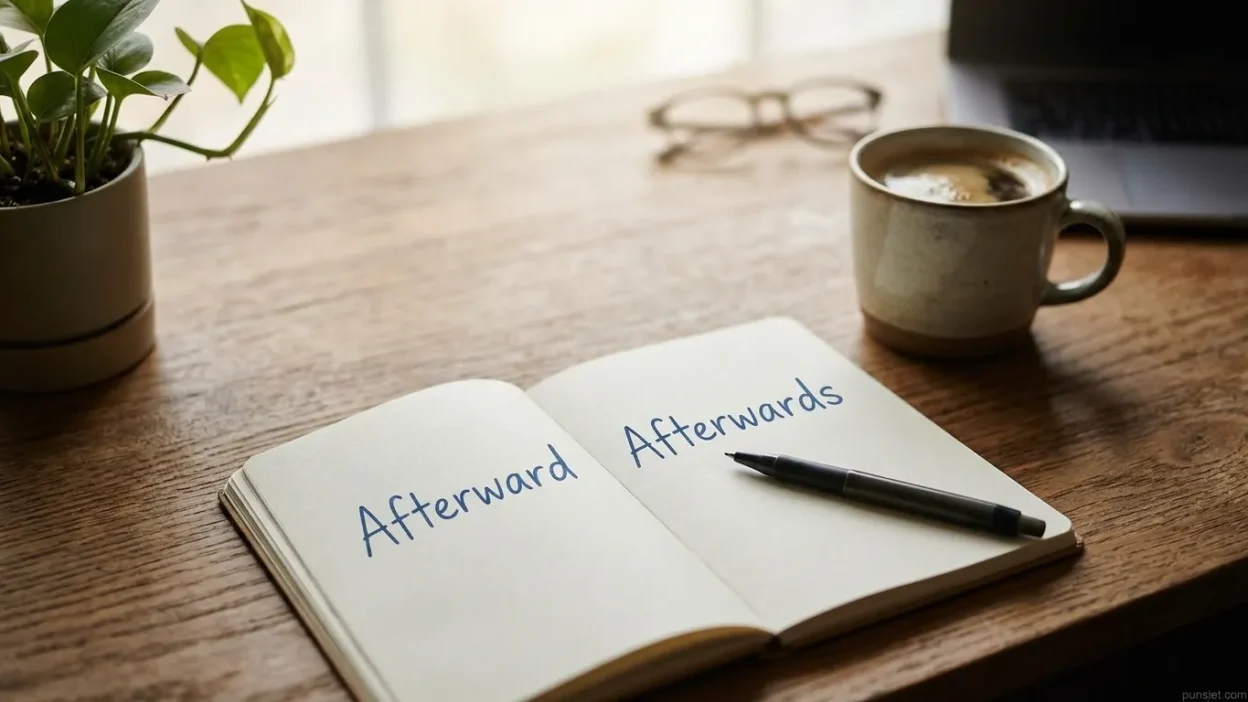
Have you ever wondered if to write afterward or afterwards? Both words are common in English, and they often confuse students, ESL learners, and even experienced writers. They look slightly different, but do they have different meanings? The good news is that both forms are correct, and they are used to describe something that happens later or after a particular event.
The main difference is regional preference. Afterward is more common in American English, while afterwards is more commonly used in British English. Both words function as adverbs and can be used in everyday conversations, emails, stories, and formal writing. Understanding this small difference will help you choose the right spelling for your audience and communicate more confidently.
Quick Answer: Afterward vs Afterwards
Afterward and afterwards mean the same thing: at a later time or after something has happened. The main difference is regional usage. American English generally prefers afterward, while British English commonly uses afterwards. Both spellings are grammatically correct, and neither changes the meaning of a sentence.
Why Do People Confuse Afterward and Afterwards?
People often confuse these words because they have almost identical spellings and meanings. The only visible difference is the letter S at the end of afterwards.
Unlike some confusing English word pairs, these two words do not have separate definitions or grammatical functions. Both are adverbs that explain when something happens.
For example:
- We went shopping afterward.
- We went shopping afterwards.
Both sentences are correct. They tell us that shopping happened after another event.
The confusion mainly comes from differences between American and British English. Writers sometimes wonder whether one spelling is more correct or whether the extra S changes the meaning. It does not.
1. Afterward: Meaning, Definition, and Usage
Afterward means at a later time or after something else has happened. It is an adverb that tells the reader when an action takes place.
This spelling is particularly common in American English.
Examples of Afterward
- We had dinner and went for a walk afterward.
- She finished her homework and watched television afterward.
- I will call you afterward.
- They discussed the problem afterward.
- He apologized for his mistake afterward.
When Should You Use Afterward?
Use afterward when you want to describe something that happens following an event, activity, or situation.
It works naturally in:
- American English writing.
- School assignments and essays.
- Emails and professional communication.
- Everyday conversations.
- Stories and personal experiences.
Example: The students attended the lecture and discussed the topic afterward.
Here, afterward tells us that the discussion happened after the lecture.
2. Afterwards: Meaning, Definition, and Usage
Afterwards also means at a later time or after something has happened. It is an adverb and has exactly the same basic meaning as afterward.
This spelling is especially common in British English.
Examples of Afterwards
- We went to the park and had lunch afterwards.
- She completed her project and submitted it afterwards.
- I met my friends and went shopping afterwards.
- They watched a movie and talked about it afterwards.
- He visited his grandparents and returned home afterwards.
When Should You Use Afterwards?
Use afterwards when you want to express that something happens later, particularly when writing in British English.
It is suitable for:
- British English writing.
- Personal letters and emails.
- Academic writing.
- Everyday conversations.
- Stories and descriptive writing.
Example: We visited the museum and went to a restaurant afterwards.
The word afterwards shows that the restaurant visit happened after the museum visit.
Afterward vs Afterwards: Comparison Table
| Feature | Afterward | Afterwards |
|---|---|---|
| Meaning | At a later time | At a later time |
| Word type | Adverb | Adverb |
| American English | More common | Less common |
| British English | Less common | More common |
| Grammar | Correct | Correct |
| Formal writing | Acceptable | Acceptable |
| Informal writing | Acceptable | Acceptable |
| Extra S | No | Yes |
Important: Neither spelling is grammatically incorrect. Your choice mainly depends on your preferred variety of English.
When to Use Afterward or Afterwards
Although both words are interchangeable in meaning, choosing one consistently can make your writing more natural.
Use Afterward in American English
If your readers are mainly from the United States, afterward is generally the better choice.
Examples:
- I will finish my work and call you afterward.
- We had a meeting and went home afterward.
- She felt much better afterward.
Use Afterwards in British English
If your readers are mainly from the United Kingdom, afterwards is a natural choice.
Examples:
- We went out for dinner afterwards.
- He completed his examination and relaxed afterwards.
- They visited their friends afterwards.
Can You Use Both in the Same Sentence?
You generally do not need to use both forms in the same sentence because they have the same meaning.
For example:
Incorrect or unnecessarily repetitive: We went shopping afterward and afterwards had dinner.
Better: We went shopping and had dinner afterwards.
12+ Examples of Afterward and Afterwards in Sentences
Here are practical examples to help you understand how both words work in everyday English.
| Afterward | Afterwards |
|---|---|
| I will speak to him afterward. | I will speak to him afterwards. |
| We had lunch afterward. | We had lunch afterwards. |
| She went home afterward. | She went home afterwards. |
| He called his mother afterward. | He called his mother afterwards. |
| They played football afterward. | They played football afterwards. |
| I felt tired afterward. | I felt tired afterwards. |
| We cleaned the room afterward. | We cleaned the room afterwards. |
| She read a book afterward. | She read a book afterwards. |
| They celebrated afterward. | They celebrated afterwards. |
| He went to sleep afterward. | He went to sleep afterwards. |
| We discussed the results afterward. | We discussed the results afterwards. |
| I apologized afterward. | I apologized afterwards. |
More Examples in Different Situations
1. In everyday conversation
- Let’s finish our work and get something to eat afterward.
- We can discuss the details afterwards.
2. In professional communication
- The manager will review the report afterward.
- Please send me the meeting notes afterwards.
3. In academic writing
- The researchers analyzed the results afterward.
- The students completed the experiment and wrote their observations afterwards.
4. In storytelling
- She opened the mysterious box and discovered a beautiful necklace afterward.
- They traveled through the mountains and reached a small village afterwards.
Common Mistakes When Using Afterward and Afterwards
Although both words are easy to understand, writers sometimes make mistakes when using them.
Mistake 1: Thinking One Spelling Is Incorrect
Some people believe that afterwards is incorrect in American English or that afterward is incorrect in British English.
Incorrect idea: Afterwards is always grammatically wrong.
Correct understanding: Both spellings are correct. They simply have different regional preferences.
Mistake 2: Using Them as Adjectives
Both words are adverbs, not adjectives.
Incorrect: We planned an afterward meeting.
Better: We planned a meeting for later.
Mistake 3: Confusing Afterwards With Afterward’s
The word afterwards should not be confused with afterward’s.
- Afterwards: At a later time.
- Afterward’s: A possessive form that would require a specific grammatical context and is rarely needed.
Mistake 4: Using Them When After Is More Natural
Sometimes, the simple word after is more suitable.
Less natural: I will call you afterward the meeting.
Correct: I will call you after the meeting.
You can also write:
I will call you afterward.
Memory Trick: How to Remember Afterward vs Afterwards
Here is an easy way to remember the difference:
- Afterward = American preference. Remember that American English generally uses the shorter spelling.
- Afterwards = British preference. Remember that British English commonly keeps the extra S.
Another simple trick is to remember that both words contain the word after. Their meaning is always connected to something happening later.
You do not need to memorize two different definitions because their meanings are the same.
American vs British English: Which Spelling Is Preferred?
The main distinction between afterward and afterwards is their popularity in different English-speaking regions.
American English
In the United States, afterward is the more common spelling.
Example: We finished the meeting and went for coffee afterward.
British English
In the United Kingdom, afterwards is more commonly preferred.
Example: We finished the meeting and went for coffee afterwards.
What About Other English-Speaking Countries?
Usage can vary in countries such as Canada, Australia, and New Zealand. Both forms are understood, although afterwards is common in British-influenced varieties of English.
If you are writing for an international audience, either spelling is acceptable. The most important thing is to remain consistent throughout your writing.
Similar Words to Afterward and Afterwards
English has several other words and expressions that communicate the idea of something happening later.
Here are some useful alternatives:
| Word or Phrase | Meaning | Example |
|---|---|---|
| Later | At a future time | I will call you later. |
| Subsequently | After something else | The company subsequently changed its policy. |
| Thereafter | From that time onward | He moved abroad and lived there thereafter. |
| Following that | After a particular event | We had lunch, following that we went home. |
| After that | At a time following something | She finished work and relaxed after that. |
| Next | Immediately or soon after | We visited the museum next. |
Afterward vs Later
Both words can refer to a future time, but later is more general.
Example: I will meet you later.
Afterward vs Subsequently
Subsequently is more formal and is often used in academic or professional writing.
Example: The company subsequently announced its decision.
Afterward vs Thereafter
Thereafter often suggests that something continues from a particular point in time.
Example: He graduated in 2020 and worked abroad thereafter.
FAQs:
1. Is afterward or afterwards correct?
Both afterward and afterwards are correct English spellings. They have the same meaning and function as adverbs. The difference is mainly regional: American English generally prefers afterward, while British English commonly uses afterwards.
2. Is afterward American or British English?
Afterward is more commonly used in American English. It is also accepted in British English, but British writers generally prefer afterwards. Both spellings are grammatically correct.
3. Is afterwards British or American English?
Afterwards is particularly common in British English. However, it is also used and understood in American English. It means at a later time or after something has happened.
4. Do afterward and afterwards mean the same thing?
Yes. Both words have exactly the same basic meaning. They describe something that happens after a particular event or at a later time. There is no meaningful difference in their definitions.
5. Can I use afterward in formal writing?
Yes. Afterward is perfectly acceptable in formal writing, including academic papers, business emails, reports, and professional documents. It is especially suitable when following American English spelling conventions.
6. Should I use afterward or afterwards in an essay?
Choose the spelling that matches your preferred English variety or your institution’s writing guidelines. Use afterward for American English and afterwards for British English. Both are acceptable in essays.
7. Is afterwards grammatically incorrect in American English?
No. Afterwards is not grammatically incorrect in American English. Although afterward is more common in the United States, American readers understand both forms without difficulty.
Remember This: Afterward or Afterwards?
Remember these simple points:
- Afterward means at a later time.
- Afterwards means at a later time.
- Both words are adverbs.
- American English generally prefers afterward.
- British English commonly prefers afterwards.
- Neither spelling is wrong.
The easiest way to choose is to consider your audience and follow one spelling consistently.
Conclusion
The difference between afterward and afterwards is mainly about regional spelling preferences, not meaning or grammar. Both words describe something that happens later or after another event. American English generally favors afterward, while British English commonly uses afterwards. You can confidently use either spelling without changing the meaning of your sentence.
If you are learning English, remember that there is no need to memorize separate definitions for these words. Simply choose the spelling that matches your audience, maintain consistency in your writing, and use the word naturally. With this simple rule, you will never need to worry about confusing afterward and afterwards again.