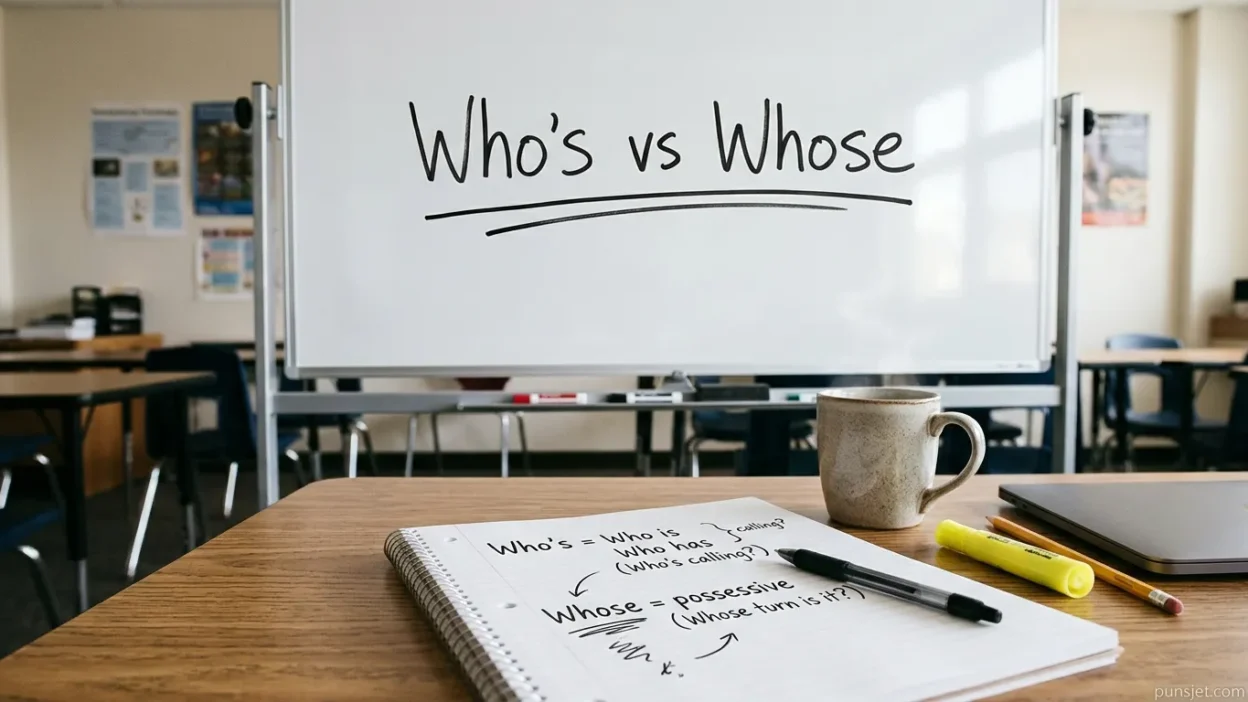
Have you ever wondered if to write who’s or whose in a sentence? These two words sound exactly the same, but they have different meanings and grammatical uses. Because of their similar pronunciation, many students, English learners, and even experienced writers sometimes mix them up. However, choosing the correct word becomes easy once you understand what each one means.
The main difference between who’s and whose is that who’s is a contraction of “who is” or “who has,” while whose shows ownership or possession. For example, “Who’s coming to the party?” means “Who is coming to the party?” On the other hand, “Whose bag is this?” asks who owns the bag. In this guide, you will learn the meanings, grammar rules, common mistakes, and practical examples of who’s vs whose so you can use both words confidently in everyday writing.
Quick Answer: Who’s vs Whose
- Who’s is a contraction of “who is” or “who has.” Example: Who’s at the door?
- Whose is a possessive word used to ask or explain who owns something. Example: Whose phone is ringing?
- Both words sound the same, but their meanings and grammatical functions are different.
- Easy trick: If you can replace the word with “who is” or “who has,” use who’s. Otherwise, use whose when showing possession.
Why Do People Confuse Who’s and Whose?
People often confuse who’s and whose because they have identical pronunciation. When speaking, there is no noticeable difference between them, so it can be difficult to remember which spelling belongs in a sentence.
Another reason is that English uses apostrophes in contractions and possessive forms differently.
For example:
- Who’s your teacher? (Who is your teacher?)
- Whose teacher is coming? (Who owns or is associated with the teacher?)
The first sentence uses a contraction, while the second uses a possessive word.
Understanding this simple grammatical difference will help you avoid mistakes in emails, school assignments, conversations, and professional writing.
1. Who’s: Meaning and Correct Usage
Who’s is a contraction of two words: “who is” or “who has.” It is commonly used in everyday conversations, informal writing, and even professional communication when contractions are appropriate.
The apostrophe replaces the missing letters in the original words.
When Does Who’s Mean Who Is?
Use who’s when you want to ask or explain who a person is or what someone is doing.
Examples:
- Who’s your best friend? (Who is your best friend?)
- Who’s waiting outside? (Who is waiting outside?)
- Who’s responsible for this project? (Who is responsible for this project?)
- Who’s coming to dinner tonight? (Who is coming to dinner tonight?)
When Does Who’s Mean Who Has?
Who’s can also replace “who has,” especially when followed by a past participle.
Examples:
- Who’s finished the assignment? (Who has finished the assignment?)
- Who’s taken my notebook? (Who has taken my notebook?)
- Who’s seen this movie before? (Who has seen this movie before?)
- Who’s been to London? (Who has been to London?)
Important grammar rule: Who’s can mean either “who is” or “who has.” Look at the words that follow it to understand its meaning.
2. Whose: Meaning and Correct Usage
Whose is a possessive form of the pronoun “who.” It is used to ask or explain who owns something or who something belongs to.
Unlike who’s, whose does not contain an apostrophe.
You can use whose before a noun or in a sentence without directly mentioning the owned object.
When Should You Use Whose?
Use whose when asking about ownership, relationships, or possession.
Examples:
- Whose book is this?
- Whose car is parked outside?
- Whose responsibility is this?
- Whose shoes are these?
In each example, whose asks about the person connected to or owning something.
Can Whose Be Used in Statements?
Yes! Whose is not limited to questions. It can also introduce a clause that provides information about a person or thing.
Examples:
- I know a girl whose father is a doctor.
- He is the student whose project won first prize.
- We visited a house whose windows were broken.
- She works for a company whose products are popular.
In these sentences, whose connects a person or thing with something associated with them.
Who’s vs Whose: Comparison Table
| Feature | Who’s | Whose |
|---|---|---|
| Meaning | Who is or who has | Belonging to whom |
| Grammar | Contraction | Possessive pronoun/determiner |
| Apostrophe | Yes | No |
| Main purpose | Shortens two words | Shows possession |
| Used in questions | Yes | Yes |
| Used in statements | Yes | Yes |
| Example | Who’s calling? | Whose phone is this? |
Remember: Who’s is about identity or action, while whose is about ownership or association.
When to Use Who’s vs Whose
Choosing between these words is easier when you understand what your sentence is trying to communicate.
Use Who’s When You Mean Who Is
If your sentence makes sense when you replace who’s with “who is,” use who’s.
- Who’s your new neighbor?
- Who’s working today?
- Who’s ready for lunch?
Use Who’s When You Mean Who Has
If replacing who’s with “who has” makes sense, use who’s.
- Who’s completed the work?
- Who’s eaten my sandwich?
- Who’s visited this place?
Use Whose When Showing Ownership
If you are asking who owns something or who something belongs to, use whose.
- Whose jacket is this?
- Whose keys are on the table?
- Whose idea was it?
Use Whose to Describe a Relationship
Whose can also describe a relationship or connection between a person and something associated with them.
- She is the woman whose son studies abroad.
- I met a writer whose books are very popular.
- He is the employee whose performance improved.
12+ Examples of Who’s and Whose in Sentences
Here are practical examples to help you understand the difference.
Examples of Who’s
- Who’s going to the shopping mall with us?
- Who’s your favorite football player?
- Who’s responsible for cleaning the classroom?
- Who’s waiting for you outside?
- Who’s bringing the food to the party?
- Who’s completed the homework?
- Who’s taken my pen?
- Who’s been using my computer?
Examples of Whose
- Whose phone is ringing?
- Whose bag is lying on the floor?
- Whose birthday is tomorrow?
- Whose car is blocking the entrance?
- Whose shoes are near the door?
- She is the teacher whose lessons are always interesting.
- I know someone whose brother lives in Canada.
- He found a wallet whose owner was difficult to identify.
These examples show that who’s refers to “who is” or “who has,” whereas whose indicates possession or association.
Common Mistakes When Using Who’s and Whose
Even though the difference is simple, these words are frequently used incorrectly.
Here are some mistakes to avoid.
Mistake 1: Using Who’s to Show Ownership
Incorrect: Who’s book is this?
Correct: Whose book is this?
Explanation: The sentence asks who owns the book, so whose is correct.
Mistake 2: Using Whose Instead of Who’s
Incorrect: Whose coming to the meeting?
Correct: Who’s coming to the meeting?
Explanation: The sentence means “Who is coming to the meeting?” Therefore, who’s is needed.
Mistake 3: Adding an Apostrophe to Whose
Incorrect: Who’s phone is ringing? (when asking about ownership)
Correct: Whose phone is ringing?
Explanation: Whose is already a possessive word and does not need an apostrophe.
Mistake 4: Assuming Every Question Needs Who’s
Incorrect: Who’s shoes are these?
Correct: Whose shoes are these?
Explanation: Questions about ownership require whose, not who’s.
Mistake 5: Forgetting the Two Meanings of Who’s
Incorrect assumption: Who’s always means who is.
Correct understanding: Who’s can mean either who is or who has.
Example: Who’s finished the test? means Who has finished the test?
Easy Memory Trick: How to Remember Who’s vs Whose
Here is a simple trick to remember the difference:
Who’s = Who is / Who has
Whose = Ownership
Whenever you are unsure, replace who’s with “who is” or “who has.”
- If the sentence still makes sense, use who’s.
- If you are asking who owns something, use whose.
For example:
- Who’s at the door? → Who is at the door? Correct.
- Whose door is this? → Asking about ownership. Correct.
Another useful trick is to remember that the apostrophe in who’s signals missing letters, not ownership.
American vs British English: Is There a Difference?
There is no spelling difference between American and British English when it comes to who’s and whose.
Both varieties use the same grammatical rules:
- Who’s is a contraction of who is or who has.
- Whose indicates possession or association.
Examples in American English:
- Who’s your new teacher?
- Whose car is parked outside?
Examples in British English:
- Who’s coming to the match?
- Whose coat is this?
The spelling and meanings remain the same in both varieties of English. Only pronunciation or accent may vary slightly.
Similar Words: Who’s, Whose, Whom, and Who
English has several words related to people that can be confusing. Understanding their differences makes sentence construction easier.
| Word | Meaning | Example |
|---|---|---|
| Who | Refers to a person as the subject | Who called you? |
| Whom | Refers to a person as the object | Whom did you invite? |
| Who’s | Who is or who has | Who’s your friend? |
| Whose | Shows possession | Whose bag is this? |
Who vs Whom: Who usually performs an action, while whom receives an action or follows certain prepositions.
Who’s vs Whose: Who’s is a contraction, while whose shows ownership or association.
Whose vs Whom: Whose indicates possession, while whom refers to a person as an object.
FAQs:
1. What is the main difference between who’s and whose?
The main difference is their meaning. Who’s is a contraction of “who is” or “who has,” while whose is used to show ownership or association. For example, “Who’s coming?” and “Whose bag is this?” are both correct.
2. Is whose a contraction of who is?
No, whose is not a contraction of who is. It is a possessive word used to ask who owns something or to describe a relationship. Who’s is the correct contraction of who is.
3. Does who’s mean who has?
Yes. Who’s can mean “who has” as well as “who is.” For example, “Who’s finished the assignment?” means “Who has finished the assignment?”
4. Is it whose or who’s birthday?
The correct phrase is whose birthday when asking who is celebrating a birthday.
Example: Whose birthday is today?
Here, whose asks about the person whose birthday it is.
5. Is it who’s or whose name?
The correct phrase is whose name when asking about the name of a person.
Example: Whose name is written on this paper?
However, who’s name is incorrect in this context because who is or who has does not fit.
6. Can whose be used for animals and things?
Yes. Whose can refer to people, animals, and sometimes things.
Examples:
- The dog whose owner lives nearby is friendly.
- We visited a building whose roof was damaged.
7. Why does whose not have an apostrophe?
Whose is already a possessive word, so it does not need an apostrophe. In contrast, who’s uses an apostrophe because it combines two words: who is or who has.
Remember This
- Who’s = Who is or Who has.
- Whose = Belonging to whom.
- Who’s always contains an apostrophe.
- Whose never needs an apostrophe.
- Both words sound the same but have different grammatical meanings.
- Use the replacement test whenever you are confused.
Conclusion
Understanding the difference between who’s and whose is an important part of improving your English grammar and writing skills. Although both words sound identical, they serve different purposes. Who’s is a contraction of “who is” or “who has,” while whose is used to show ownership or association. Once you learn these basic rules, choosing the correct word becomes much easier.
The best way to remember this difference is to practice using both words in everyday sentences. Before writing who’s, check if you can replace it with “who is” or “who has.” If you are asking about ownership, choose whose instead. With regular practice, you will be able to use both words naturally and confidently in conversations, emails, and academic writing.

Emily Margaret is a writer and humor enthusiast at PunsJet.com. She enjoys creating clever puns and lighthearted content that entertains readers and adds a spark of humor to everyday life. With a love for wordplay and creativity, Emily aims to share fun, relatable jokes that make people smile and laugh.