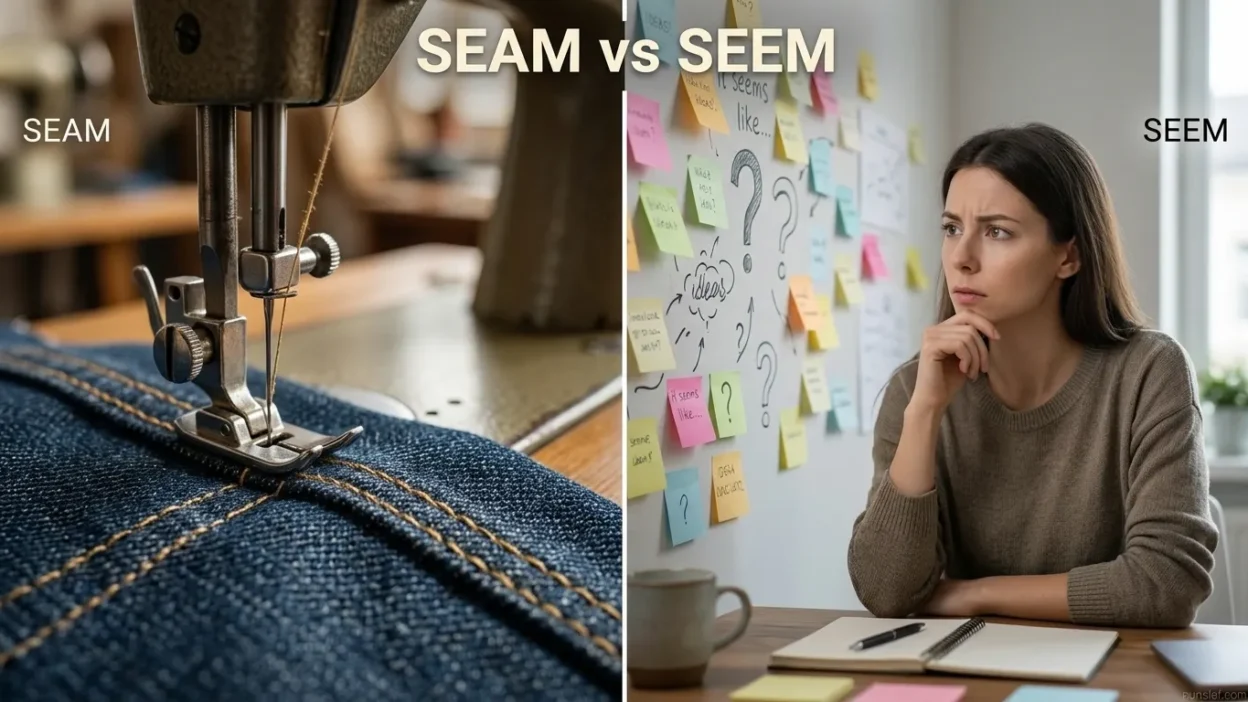
Have you ever wondered if to write seam or seem? These two words sound exactly the same, but they have completely different meanings and uses. This can make them confusing for students, English learners, and even people who use English every day. Although their pronunciation is identical, choosing the wrong spelling can change the meaning of your sentence.
The main difference between seam and seem is that seam is a noun that refers to a line where two pieces of material are joined together, while seem is a verb that means to appear or give a particular impression. For example, a tailor may sew a seam in a shirt, but someone may seem happy after receiving good news. Understanding their meanings, grammatical roles, and sentence patterns will help you use both words correctly in writing and conversation.
Quick Answer: What Is the Difference Between Seam and Seem?
Seam is a noun that means a line where two pieces of fabric, leather, or another material are sewn or joined. Seem is a verb that means to appear or give an impression. Both words sound alike, but their spellings and meanings are different. Use seam for joining lines and seem for appearances.
Why Do People Confuse Seam and Seem?
People often confuse seam and seem because they are homophones. Homophones are words that have the same pronunciation but different meanings and spellings.
Both words are pronounced /siːm/, so you cannot tell which spelling is correct simply by listening.
However, their grammatical roles and meanings are different:
- Seam: A noun related to sewing, clothing, and joined materials.
- Seem: A verb related to appearance, impressions, and opinions.
For example:
- The seam on my jacket is coming apart.
- You seem tired today.
Both sentences sound similar when spoken, but they communicate completely different ideas.
What Does Seam Mean?
Seam is a noun that describes a line where two pieces of fabric, leather, or another material are joined together, usually by sewing.
It is commonly used when talking about clothing, tailoring, shoes, bags, and other manufactured items.
A seam holds separate pieces of material together and can sometimes be visible on the outside of an object.
Examples of Seam in Sentences
- The seam on my trousers needs repairing.
- She carefully stitched the seam of her dress.
- The tailor fixed a small hole near the shoulder seam.
- This jacket has a strong double seam.
- I noticed a loose seam on my new shirt.
- The seam along the pillow cover is coming apart.
- The designer added decorative stitching to the seam.
- Please check the seams before buying the clothes.
- The worker carefully joined the two pieces along the seam.
- Water entered through a seam in the tent.
Different Uses of Seam
Although seam is most commonly associated with sewing, it can also describe a joining line or layer in other contexts.
1. Clothing and fabric
A seam joins two pieces of fabric.
Example: The seam of her wedding dress was beautifully finished.
2. Construction and manufacturing
A seam can refer to a line where two materials or parts meet.
Example: The seam between the two metal panels is clearly visible.
3. Geology
A seam can describe a narrow layer of a natural material, such as coal.
Example: Workers discovered a coal seam underground.
4. Expressions
The phrase bursting at the seams means being extremely full or crowded.
Example: The small restaurant was bursting at the seams during lunch.
What Does Seem Mean?
Seem is a verb that means to appear, look, or give a particular impression based on what someone observes or understands.
It is used when something appears to be true, even when the speaker may not know whether it is actually true.
For example:
- You seem happy today.
- This question seems difficult.
- He seems to understand the lesson.
In these examples, seem describes an impression rather than a physical joining line.
Examples of Seem in Sentences
- You seem very excited about your new job.
- This exercise seems easy at first.
- She seems happy with her results.
- They seem interested in learning English.
- It seems like a beautiful day.
- He doesn’t seem worried about the exam.
- Your explanation seems clear to me.
- The children seem tired after playing.
- This decision seems reasonable.
- Everything seems different after the holidays.
Common Grammatical Patterns With Seem
Seem is frequently used in several sentence structures.
1. Seem + adjective
Use seem before an adjective to describe an impression.
- You seem nervous.
- The food seems delicious.
- This lesson seems helpful.
2. Seem + to + verb
Use this structure when describing what someone or something appears to do.
- He seems to understand everything.
- She seems to enjoy her work.
- They seem to know the answer.
3. Seem + like + noun
Use seem like when comparing an impression with a person, thing, or situation.
- It seems like a good idea.
- He seems like a friendly person.
- This seems like an interesting book.
4. It seems that + clause
Use this structure to introduce an impression or conclusion.
- It seems that everyone is ready.
- It seems that we made a mistake.
- It seems that the weather is changing.
Seam vs Seem: Comparison Table
The following table explains the important differences between seam and seem.
| Feature | Seam | Seem |
|---|---|---|
| Meaning | A line where materials are joined | To appear or give an impression |
| Part of speech | Noun | Verb |
| Pronunciation | /siːm/ | /siːm/ |
| Main use | Sewing and joining materials | Describing appearances |
| Related words | Sewing, stitching, joint | Appear, look, suggest |
| Example | The seam is loose. | You seem happy. |
| Plural or other forms | Seams | Seems, seemed, seeming |
The easiest difference to remember: Seam is about a joining line, while seem is about how something appears.
When Should You Use Seam or Seem?
Choosing between these words becomes easier when you understand what your sentence is describing.
When to Use Seam
Use seam when discussing:
- A line where two pieces of fabric are joined.
- Stitching or sewing in clothing.
- The joining points of different materials.
- Layers or narrow bands of natural materials.
- Expressions such as bursting at the seams.
Examples:
- The seam of my shirt is damaged.
- The tailor repaired the seam.
- There is a coal seam beneath the ground.
If your sentence is about stitching, fabric, or a joining line, seam is probably the correct word.
When to Use Seem
Use seem when discussing:
- How someone or something appears.
- An impression based on observation.
- Something that looks or sounds a certain way.
- An opinion that may not be completely certain.
- A situation that appears to be true.
Examples:
- You seem confident.
- This seems like a good opportunity.
- They seem to be enjoying themselves.
If your sentence describes an appearance, impression, or possibility, seem is the correct choice.
15 Examples of Seam vs Seem in Sentences
Here are 15 practical examples to help you understand the difference.
| Seam (Joining Line) | Seem (Appearance or Impression) |
|---|---|
| The seam of my shirt is torn. | You seem happy today. |
| She repaired the seam on her skirt. | She seems interested in the project. |
| The tailor checked every seam. | The tailor seems very experienced. |
| There is a loose seam on my jacket. | There seems to be a problem. |
| The seam of this bag is strong. | This bag seems expensive. |
| I found a hole near the seam. | You seem worried about something. |
| The seam needs extra stitching. | The task seems difficult. |
| The dress has a hidden seam. | The dress seems beautiful. |
| Water entered through the tent’s seam. | It seems that rain is coming. |
| The seam of the cushion is damaged. | The cushion seems comfortable. |
| The worker repaired the seam. | The worker seems tired. |
| A coal seam was found underground. | The discovery seems important. |
| The seam runs along the sleeve. | Your explanation seems correct. |
| The seam came apart after washing. | The clothes seem too small. |
| The designer created a decorative seam. | The designer seems creative. |
These examples show that the correct spelling depends on the meaning of the sentence, not its pronunciation.
Common Mistakes When Using Seam and Seem
Even though these words are easy to understand individually, writers sometimes use them incorrectly.
Here are some common mistakes and their corrections.
Mistake 1: Using seam instead of seem
Incorrect: You seam very happy today.
Correct: You seem very happy today.
Explanation: The sentence describes someone’s appearance, so seem is correct.
Mistake 2: Using seem instead of seam
Incorrect: The seem of my trousers is damaged.
Correct: The seam of my trousers is damaged.
Explanation: The sentence refers to the stitching line on clothing, so seam is correct.
Mistake 3: Confusing seem with the noun appearance
Incorrect: The situation has a strange seem.
Correct: The situation seems strange.
Explanation: Seem is a verb, not a noun meaning appearance.
Mistake 4: Forgetting the correct verb form
Incorrect: She seem tired.
Correct: She seems tired.
Explanation: With a singular third-person subject such as he, she, or it, use seems in the present tense.
Mistake 5: Using seem when talking about stitching
Incorrect: The seem along the sleeve is coming apart.
Correct: The seam along the sleeve is coming apart.
Explanation: A joining line in fabric is called a seam.
Memory Trick: How to Remember Seam vs Seem
Here is a simple trick to remember both words.
- Seam = Sewing: Both words begin with the letter S. Think of a seam as the stitching that joins fabric.
- Seem = Appear: Remember that seem describes how something appears or looks.
You can also remember these two sentences:
- The seam on my shirt is broken.
- I seem happy today.
If you remember sewing and appearance, you will rarely confuse these words again.
Seam vs Seem in American and British English
There is no spelling difference between seam and seem in American and British English.
Both varieties use:
- Seam for a joining line or layer.
- Seem for something that appears to be true.
Their meanings and grammatical roles also remain the same in both varieties.
The pronunciation is generally the same in standard American and British English, although individual accents may affect the exact sound.
Examples:
- American English: The seam on my jacket is loose.
- British English: The seam on my jacket is loose.
Both sentences are correct.
Similar Words to Seam and Seem
Understanding related words can make it easier to remember the difference.
Words Related to Seam
These words are commonly associated with sewing and joining materials.
- Stitch: A loop or movement of thread used in sewing.
- Seamstress: A person who sews clothes professionally.
- Stitching: The process or pattern of sewing.
- Hem: A finished edge of clothing made by folding and sewing fabric.
- Joint: A place where two parts are connected.
Words Related to Seem
These words are connected to appearance and impressions.
- Appear: To look or seem a certain way.
- Look: To have a particular appearance.
- Sound: To give a particular impression when heard.
- Suggest: To indicate something without stating it directly.
- Feel: To give someone a particular impression or sensation.
These related words can help you understand the meaning of each word in different situations.
Final Verdict: Seam or Seem?
Both seam and seem are correct English words, but they cannot replace each other.
Use seam when referring to a line where two pieces of fabric or other materials are joined together. It is a noun commonly used in sewing, clothing, and manufacturing.
Use seem when describing how someone or something appears or what impression it gives. It is a verb commonly used in everyday conversations and writing.
Remember that both words sound alike, but their meanings are completely different. Choosing the correct spelling depends on the message you want to communicate.
FAQs:
1. What is the main difference between seam and seem?
The main difference is their meaning and grammatical role. Seam is a noun referring to a line where materials are joined, while seem is a verb meaning to appear or give an impression.
2. Are seam and seem pronounced the same?
Yes. Seam and seem are homophones because they share the same pronunciation, /siːm/. However, they have different spellings and meanings.
3. Is seem a noun or a verb?
Seem is a verb. It describes how someone or something appears. For example: “You seem happy today.”
4. What is an example of seam in a sentence?
An example is: “The seam on my jacket is coming apart.” Here, seam refers to the line where the pieces of fabric are joined together.
5. Can seem be used to describe someone’s feelings?
Yes. Seem can describe the impression someone gives about their feelings or emotional state.
Example: “She seems excited about her new job.”
6. What is the plural of seam?
The plural of seam is seams.
Example: “The tailor checked all the seams on the dresses.”
7. What are the past and present forms of seem?
The main forms are:
- Present: Seem
- Third-person singular: Seems
- Past: Seemed
- Present participle: Seeming
Example: “He seemed nervous yesterday, but he seems relaxed today.”
Remember This
- Seam = A line where two pieces of material are joined.
- Seem = To appear or give an impression.
- Both words sound the same but have different meanings.
- Seam is a noun, while seem is a verb.
- Use seam for sewing and seem for appearances.
Conclusion
Understanding the difference between seam and seem is simple once you connect each word with its meaning. Although they sound identical, seam refers to a joining line in fabric or other materials, whereas seem describes how something appears. Both words have important uses in everyday English.
The next time you write either word, think about your sentence first. If you are talking about stitching or joined materials, choose seam. If you are describing an impression or appearance, choose seem. This small spelling difference will help you communicate more clearly and avoid common English mistakes.

Joshua Paul is a creative writer and contributor at PunsJet.com who enjoys crafting witty puns and clever wordplay. With a strong sense of humor and a love for language, he creates entertaining content that readers can easily share and enjoy. Joshua’s goal is to spread laughter through fun and memorable jokes.