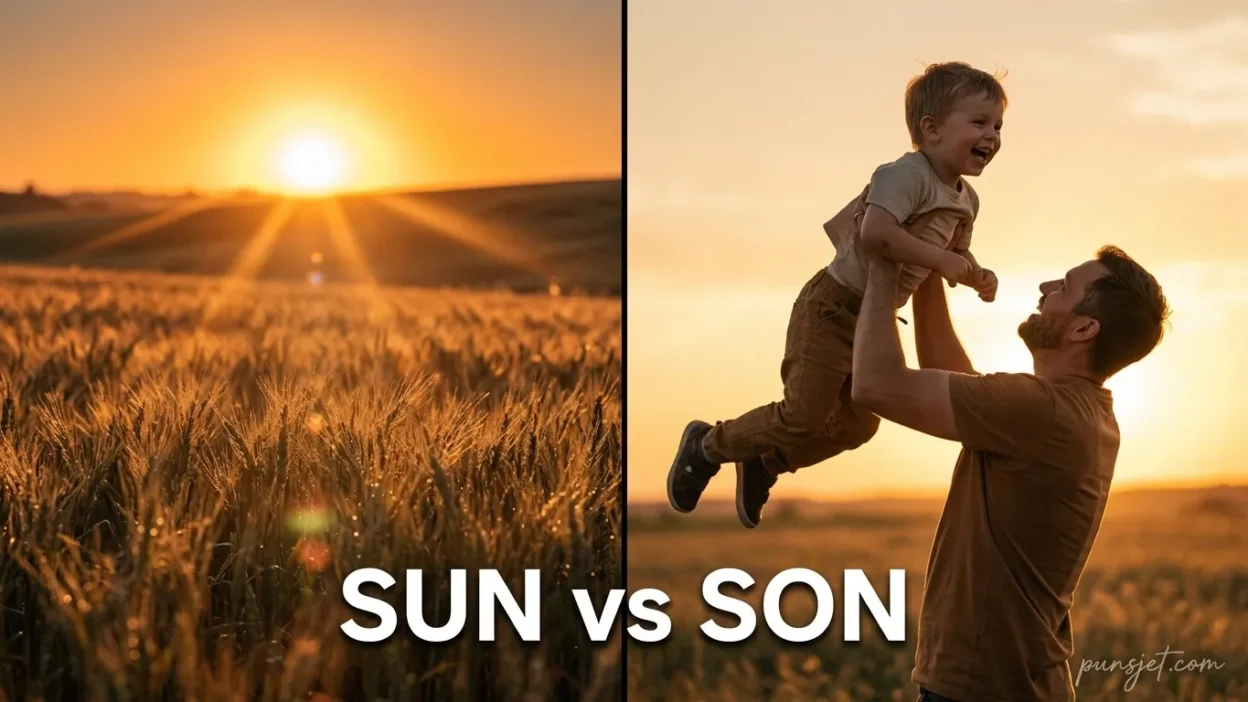
The words sun and son sound exactly the same, but they have completely different meanings. This can make them confusing for students, English learners, and anyone who wants to improve their spelling. Although both words are pronounced alike, you cannot use them in place of each other because they describe different things.
The word sun refers to the star that gives Earth light and heat. We see sunlight during the day, and the Sun plays an important role in life on our planet. The word son, on the other hand, refers to a male child in relation to his parents. For example, a mother might say, “My son loves playing football.” Understanding the difference between sun vs son is simple once you connect each word with its meaning. In this guide, you will learn how to use both words correctly, explore everyday examples, and discover an easy trick to remember their spellings.
Quick Answer: Sun vs Son
Sun is the star that gives Earth light and heat. Son means a male child in relation to his parents. Both words have the same pronunciation, but their meanings and spellings are different. Use sun when talking about sunlight or the star, and use son when talking about someone’s male child.
Why Do People Confuse Sun and Son?
People often confuse sun and son because they are homophones. Homophones are words that sound the same but have different meanings and spellings.
When you say these words aloud, they usually sound identical in English. You cannot easily tell which word someone means just by hearing it. You need to understand the sentence and its context.
For example:
- The sun is shining brightly.
- Their son is playing outside.
Both sentences sound similar when spoken, but they describe different things. The first sentence talks about the star in our solar system, while the second talks about a child.
Another reason for this confusion is that the words have only one letter that differs: u in sun and o in son. Remembering what each word means will help you choose the correct spelling.
What Does Sun Mean?
Sun is a noun that refers to the star at the center of our solar system. It provides the light and energy that Earth needs to support life. The word can also refer to the sunlight we experience during the day.
The Sun is essential for plants, animals, and people. It helps plants grow and provides warmth to our planet.
Examples of Sun in Sentences
- The sun rises in the east.
- We sat outside and enjoyed the warm sun.
- The sun is shining through the window.
- Plants need sunlight from the sun to grow.
- The children played in the sun all afternoon.
- The sun disappeared behind the clouds.
Other Uses of Sun
The word sun can also appear in expressions related to light, warmth, and sunny weather.
For example:
- Sunlight: The natural light that comes from the Sun.
- Sunshine: Direct light from the Sun.
- Sunburn: Skin damage caused by too much ultraviolet radiation, usually from the Sun.
- Sunflower: A plant known for its large flower head, commonly associated with sunny conditions.
In everyday English, the word sun is often connected with daylight, warmth, summer, and outdoor activities.
What Does Son Mean?
Son is a noun that means a male child in relation to one or both of his parents. It is used when talking about family relationships.
For example, a woman may say, “My son is ten years old.” A father may say, “My son is learning to swim.”
The word can refer to a young boy or an adult male child. A person does not stop being someone’s son when he grows up.
Examples of Son in Sentences
- Their son is learning to read.
- My son loves playing football.
- Her son lives in London.
- They are proud of their youngest son.
- His son helped him wash the car.
- The proud parents watched their son graduate.
Other Uses of Son
The word son also appears in expressions related to family and relationships.
For example:
- Only son: A family’s one male child, when referring to its sons.
- Son-in-law: The man married to someone’s daughter.
- Stepson: The son of one’s spouse from another relationship.
- Father and son: A phrase describing a relationship between a father and his male child.
The word can also appear in religious, historical, or literary expressions, such as “Son of God.” In these cases, its meaning depends on the context.
Sun vs Son: Comparison Table
| Feature | Sun | Son |
|---|---|---|
| Meaning | The star that gives Earth light and heat | A male child in relation to a parent |
| Part of speech | Noun; can also be a verb | Noun |
| Pronunciation | /sʌn/ | /sʌn/ |
| Spelling | S-U-N | S-O-N |
| Related words | Sunny, sunlight, sunshine | Son-in-law, stepson |
| Common context | Space, weather, light, warmth | Family, children, relationships |
| Example | The sun is bright today. | Their son is at school. |
The main difference is the meaning. Sun refers to a star or its light, while son refers to a male child.
When Should You Use Sun or Son?
Choosing between these words becomes easy when you consider what you want to describe.
When to Use Sun
Use sun when your sentence refers to the star in our solar system, its light, or its warmth.
Examples:
- The sun is very bright today.
- We need protection from the sun.
- The sun gives Earth energy.
- I love watching the sun set.
If your sentence is about sunlight, sunny weather, or the star in space, sun is usually the correct choice.
When to Use Son
Use son when you are talking about a male child or a family relationship.
Examples:
- My son is starting school.
- Her son is a talented musician.
- Their son called them yesterday.
- He introduced his son to his friends.
If the sentence is about someone’s child, son is the correct word.
12 Examples of Sun vs Son in Everyday English
These examples show how the two words work in common situations.
- Sun: The sun is shining brightly this morning.
- Son: My son is getting ready for school.
- Sun: We went to the beach to enjoy the sun.
- Son: Her son won the spelling competition.
- Sun: The sun sets behind the mountains.
- Son: Their son wants to become a doctor.
- Sun: Too much exposure to the sun can damage your skin.
- Son: His son helped him prepare dinner.
- Sun: The flowers need sunlight from the sun.
- Son: The proud mother hugged her son.
- Sun: We watched the sun rise early in the morning.
- Son: My neighbor’s son plays basketball every weekend.
Examples Using Both Words
You can also use both words in the same sentence.
- My son enjoys playing outside in the sun.
- The sun was shining when their son arrived home.
- Her son drew a picture of the sun for school.
- The father and son watched the sun set together.
These examples make the difference especially clear because each word has a separate role.
Common Mistakes When Using Sun and Son
Even though these words are easy to understand, spelling mistakes can happen because they sound alike.
Mistake 1: Using Son When You Mean Sun
Incorrect: The son is shining today.
Correct: The sun is shining today.
Why? The sentence describes the star that provides light, so sun is the correct spelling.
Mistake 2: Using Sun When You Mean Son
Incorrect: My sun is five years old.
Correct: My son is five years old.
Why? The sentence describes a male child, so you should use son.
Mistake 3: Choosing by Sound Alone
Incorrect: I heard the word, so I wrote “sun.”
Correct: Think about the meaning before choosing the spelling.
Why? Both words sound the same. The surrounding words and the meaning of the sentence help you decide which one to write.
Mistake 4: Forgetting the Difference in Family Expressions
Incorrect: She introduced her sun-in-law.
Correct: She introduced her son-in-law.
Why? The expression refers to the man married to someone’s daughter, so it uses son.
What Is an Easy Memory Trick for Sun vs Son?
A simple memory trick can help you remember these words without confusion.
- Sun = U for Universe. The Sun is a star in our universe.
- Son = O for Offspring. A son is a parent’s male child.
Remember that U in sun connects with the universe, while O in son connects with offspring.
You can also picture a bright yellow Sun in the sky whenever you write sun. When you think about a mother, father, or family, remember to write son.
Practicing these associations will help you spell both words correctly.
Sun vs Son in American and British English
There is no spelling difference between sun and son in American and British English. Both varieties use the same spellings and meanings.
| Word | American English | British English |
|---|---|---|
| Sun | Sun | Sun |
| Son | Son | Son |
Both words are generally pronounced the same way in American and British English, although accents can affect vowel quality.
For example:
- American English: The sun is bright. My son is happy.
- British English: The sun is bright. My son is happy.
In both varieties, context determines which word is correct. You do not need to learn separate spellings for American and British English.
Similar Words to Sun and Son
English contains many homophones that can confuse learners. Like sun and son, these words sound alike but have different meanings.
- See vs sea: See means to look at something; sea means a large body of salt water.
- Right vs write: Right can mean correct; write means to form words using letters.
- Pair vs pear: Pair means two things that belong together; pear is a type of fruit.
- Hear vs here: Hear means to notice sound; here refers to a place.
- Flower vs flour: Flower is the part of a plant that often produces seeds; flour is a powder used in cooking.
- One vs won: One is the number 1; won is the past tense of win.
- Knight vs night: Knight refers to a historical warrior or a person given an honorary title; night is the dark part of the day.
Learning these word pairs can improve your spelling, reading, and writing skills.
FAQs:
1. What is the difference between sun and son?
Sun is the star that gives Earth light and heat. Son means a male child in relation to a parent. The words sound the same but have different meanings and spellings.
2. Are sun and son homophones?
Yes. Sun and son are homophones because they have the same pronunciation but different spellings and meanings.
3. How do you spell sun and son correctly?
Spell sun as S-U-N when talking about the star or its light. Spell son as S-O-N when talking about a male child.
4. Is it my sun or my son?
The correct phrase is my son when referring to your male child. For example, “My son is learning to ride a bicycle.”
5. Is the sun shining or the son shining?
Use the sun is shining when describing the star’s light. Use son when referring to a male child. A sentence such as “My son is shining in the school play” could be used figuratively, but it does not refer to sunlight.
6. Do sun and son sound the same?
Yes. In standard English pronunciation, both words are pronounced /sʌn/. Their meanings are different even though their sounds are the same.
7. Can sun and son be used in the same sentence?
Yes. For example: “My son played in the sun after school.” Here, son refers to a child, and sun refers to the star’s light and warmth.
8. Is sun a proper noun or a common noun?
In everyday English, sun is often written with a lowercase s. When referring specifically to the star at the center of our solar system as an astronomical object, Sun is also commonly capitalized, especially in scientific and astronomical writing. The word son is a common noun unless it appears at the beginning of a sentence or in a title.
Remember This: Sun vs Son
- Sun = the star that gives Earth light and heat.
- Son = a male child in relation to a parent.
- Both words sound the same.
- Their spellings and meanings are different.
- Use the sentence’s meaning to choose the correct word.
Quick memory tip: U stands for Universe in sun, while O stands for Offspring in son.
Conclusion
The difference between sun and son is simple once you understand what each word means. Sun refers to the star that provides Earth with light and heat, while son refers to a male child. Although the words have the same pronunciation, their spellings and uses are different. Remembering their meanings will help you avoid common spelling mistakes.
To use these words correctly, look at the meaning of the whole sentence before writing. If you are talking about sunlight, warmth, or the star in space, choose sun. If you are talking about a family member or someone’s male child, choose son. With a little practice, you can easily remember the difference and use both words confidently in everyday English.