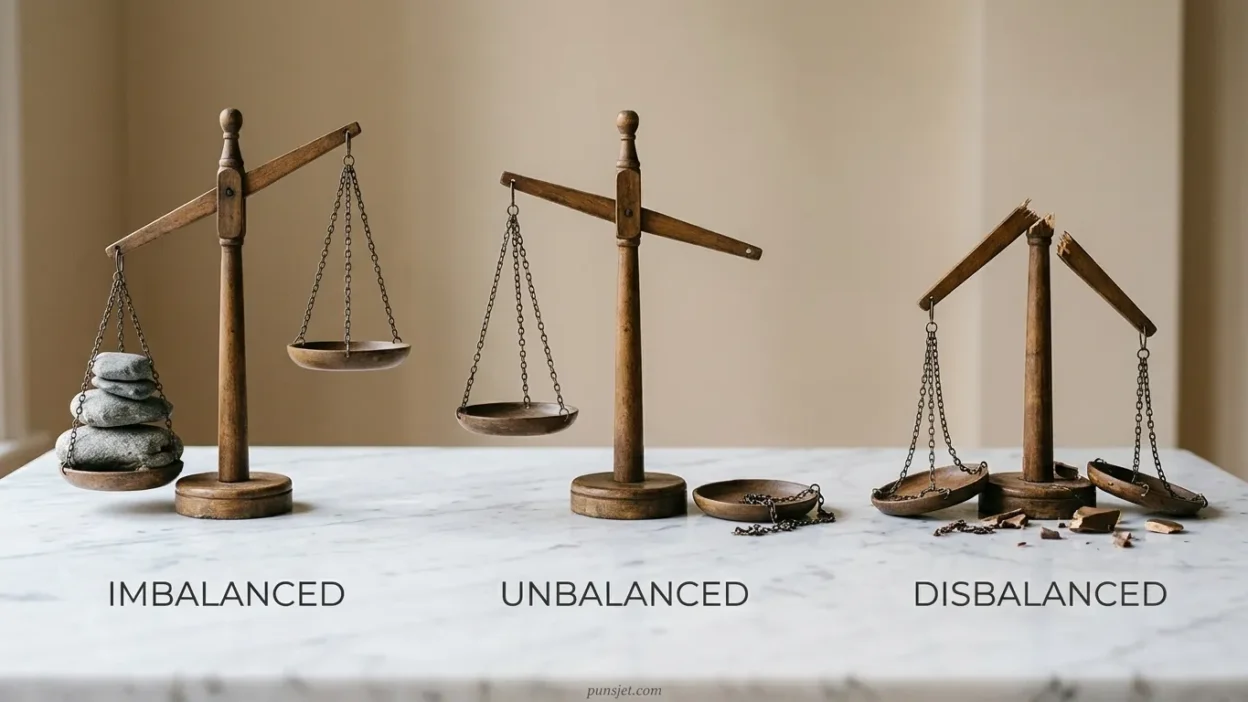
English has many words that look similar but are not always used in the same way. Imbalanced, unbalanced, and disbalanced are three such words. They all relate to something that is not balanced, equal, or stable, which makes it easy to confuse them. However, their meanings, common usage, and naturalness in everyday English are slightly different.
If you are unsure if to write imbalanced vs unbalanced vs disbalanced, the good news is that two of these words are widely accepted in modern English, while the third is much less common. Understanding when to use each one can help you write more clearly in school assignments, professional emails, conversations, and other situations. This guide explains their meanings, differences, grammar, and examples in simple English so you can choose the right word with confidence.
Quick Answer: Imbalanced vs Unbalanced vs Disbalanced
Imbalanced and unbalanced are both correct English adjectives. Imbalanced usually describes something with unequal parts or proportions, while unbalanced has a broader meaning, including physical instability, lack of fairness, and lack of emotional stability. Disbalanced is a rare word and is generally less natural than the other two.
Why Do People Confuse Imbalanced, Unbalanced, and Disbalanced?
People confuse these three words because they share the root word balanced. Their prefixes—im-, un-, and dis-—all suggest a negative or opposite meaning.
At first glance, they may seem interchangeable. However, English does not use every negative prefix in exactly the same way.
Here are the main reasons for the confusion:
- Similar meanings: All three words can suggest a lack of balance.
- Similar spelling: They share most of the same letters.
- Different contexts: Some words sound more natural in particular situations.
- Unfamiliar usage: Many English learners are unsure whether disbalanced is a standard word.
The easiest way to understand them is to look at each word separately.
1. Imbalanced: Meaning, Definition, and Usage
Imbalanced is an adjective that describes something with unequal amounts, proportions, distributions, or elements.
It is commonly used when different parts of something are not equal or properly distributed.
In simple English, imbalanced means that something does not have the right balance between its parts.
When Should You Use Imbalanced?
Use imbalanced when discussing:
- Unequal distribution of resources.
- An unhealthy diet or nutritional proportions.
- Differences between two sides or groups.
- Unequal economic conditions.
- Systems with disproportionate elements.
Examples of Imbalanced
- The company has an imbalanced distribution of employees across its departments.
- Eating an imbalanced diet may affect your health.
- The team has an imbalanced combination of experienced and inexperienced players.
- The economy is suffering from an imbalanced distribution of wealth.
- An imbalanced workload can make employees feel stressed.
- The report highlights an imbalanced relationship between supply and demand.
Simple explanation: Imbalanced is especially useful when you want to describe unequal proportions or an uneven distribution.
2. Unbalanced: Meaning, Definition, and Usage
Unbalanced is an adjective that describes something that is not properly balanced, stable, equal, or evenly distributed.
It is a widely used and natural English word. Unlike imbalanced, it has several meanings and can be used in physical, emotional, financial, and general situations.
In simple English, unbalanced means that something is not steady, equal, or in the right condition.
When Should You Use Unbalanced?
Use unbalanced when talking about:
- Something physically unstable.
- Unequal or unfair situations.
- Emotional or mental instability.
- Uneven weight distribution.
- A lack of proportion or harmony.
Examples of Unbalanced
- The table is unbalanced because one leg is shorter than the others.
- She follows an unbalanced diet that lacks essential nutrients.
- The bicycle became unbalanced when the rider turned too quickly.
- The financial system appears unbalanced.
- An unbalanced workload can reduce employee productivity.
- The artist created an intentionally unbalanced design.
- He lost his balance while walking on the narrow bridge.
The last sentence uses balance rather than unbalanced, but it illustrates the same general idea.
Simple explanation: Unbalanced is the more general choice when something lacks physical, emotional, or general stability.
3. Disbalanced: Meaning, Definition, and Usage
Disbalanced is a rare adjective that means not balanced or having lost balance.
Although it can be found in some English writing, it is not a common choice in modern everyday English.
Most speakers and writers prefer unbalanced or imbalanced because these words sound more natural and are more widely recognized.
When Should You Use Disbalanced?
You may encounter disbalanced in specialized, translated, or less common writing. However, it is usually better to choose another word.
For example:
- Less natural: The system is disbalanced.
- More natural: The system is imbalanced.
- More natural: The system is unbalanced.
Another example:
- Less natural: The distribution of resources is disbalanced.
- More natural: The distribution of resources is imbalanced.
Simple explanation: Disbalanced is understandable, but it is generally best avoided in standard everyday English.
Imbalanced vs Unbalanced vs Disbalanced: Comparison Table
The following table highlights the main differences between these three words.
| Feature | Imbalanced | Unbalanced | Disbalanced |
|---|---|---|---|
| Part of speech | Adjective | Adjective | Adjective |
| Main meaning | Unequal proportions | Lack of balance or stability | Not balanced |
| Common usage | Common | Very common | Rare |
| Naturalness | Natural | Very natural | Less natural |
| Best context | Unequal distribution | General imbalance | Rare or specialized usage |
| Everyday English | Yes | Yes | Generally avoided |
The most important difference is that imbalanced focuses more on unequal proportions, while unbalanced has a wider range of meanings. Disbalanced is much less common.
When to Use Each: Imbalanced vs Unbalanced vs Disbalanced
Choosing the right word becomes easier when you consider the situation.
Use Imbalanced for Unequal Proportions
Choose imbalanced when the parts of something are not distributed equally.
Examples:
- The country has an imbalanced economy.
- The meal contains an imbalanced amount of nutrients.
- The organization has an imbalanced workforce.
Use Unbalanced for General Instability
Choose unbalanced when something is physically unstable, emotionally unsettled, or generally lacking balance.
Examples:
- The chair is unbalanced.
- The design looks unbalanced.
- His daily routine is unbalanced.
Avoid Disbalanced in Most Everyday Writing
Although disbalanced is understandable, it is usually not the best choice for normal conversations, academic writing, or professional communication.
Instead, choose:
- Imbalanced for unequal proportions.
- Unbalanced for general lack of balance.
10+ Examples of Imbalanced vs Unbalanced vs Disbalanced in Sentences
Here are practical examples to help you understand how these words work in different situations.
| Sentence | Best Word | Reason |
|---|---|---|
| The diet lacks important nutrients. | Imbalanced | Unequal nutritional proportions |
| The chair moves because one leg is shorter. | Unbalanced | Physical instability |
| The company has unequal workloads. | Imbalanced | Unequal distribution |
| The painting looks uneven. | Unbalanced | Lack of visual harmony |
| The economy has unequal wealth distribution. | Imbalanced | Unequal proportions |
| The bicycle feels unstable. | Unbalanced | Physical instability |
| The team has too many attackers and too few defenders. | Imbalanced | Unequal team composition |
| The room arrangement looks awkward. | Unbalanced | Lack of visual balance |
| The financial system needs improvement. | Imbalanced | Unequal financial distribution |
| The machine shakes during operation. | Unbalanced | Uneven physical distribution |
| The relationship lacks equal effort. | Imbalanced | Unequal contribution |
| The design has too much weight on one side. | Unbalanced | Uneven visual arrangement |
Examples Using Disbalanced
Although it is not the preferred choice, here are examples showing how the word may appear:
- The system became disbalanced after the changes.
- The distribution was described as disbalanced in the report.
- The machine appeared disbalanced during testing.
In all three sentences, imbalanced or unbalanced would generally sound more natural.
Common Mistakes When Using These Words
Even advanced English learners sometimes choose the wrong word because the meanings overlap.
Here are some mistakes to avoid.
Mistake 1: Treating All Three Words as Equally Common
Incorrect assumption: Imbalanced, unbalanced, and disbalanced are equally popular.
Correct understanding: Imbalanced and unbalanced are standard, commonly used adjectives. Disbalanced is rare.
Mistake 2: Using Imbalanced for Every Situation
Although imbalanced is correct in many situations, it is not always the most natural option.
For example:
- Less natural: The chair is imbalanced.
- More natural: The chair is unbalanced.
Mistake 3: Assuming Disbalanced Is the Best Alternative
Some writers believe that adding dis- automatically creates a better opposite of balanced.
However, English word formation does not work that way in every situation.
Better choices are usually imbalanced or unbalanced.
Mistake 4: Confusing Imbalance With Unbalance
Both words can refer to a lack of balance, but they are not always used in the same contexts.
- Imbalance: A lack of equality or proportion.
- Unbalance: The act of making something unstable or the condition of lacking balance.
For example:
- There is an imbalance between income and expenses.
- The sudden movement may unbalance the table.
Memory Trick: How to Remember the Difference
Use this simple trick to remember all three words:
- Imbalanced = Inequality: Think of unequal parts or proportions.
- Unbalanced = Unsteady: Think of something unstable or lacking general balance.
- Disbalanced = Don’t prefer: Remember that it is rarely needed in everyday English.
A quick way to remember the difference is:
Imbalanced = Unequal.
Unbalanced = Unsteady.
Disbalanced = Rare.
This simple trick can help you select the right word when writing sentences.
American vs British English: Is There a Difference?
There is no major American-versus-British English spelling difference between imbalanced and unbalanced.
Both forms are understood and used in American and British English.
| Word | American English | British English |
|---|---|---|
| Imbalanced | Correct | Correct |
| Unbalanced | Correct | Correct |
| Disbalanced | Rare | Rare |
The choice between imbalanced and unbalanced depends more on meaning and context than on regional spelling rules.
For standard writing in either variety, it is best to avoid disbalanced unless you have a specific reason to use it.
Similar Words Related to Imbalanced and Unbalanced
Several other English words express a lack of balance, equality, or stability.
Here are some useful alternatives:
1. Uneven: Not equal or regular in size, amount, or shape.
- The road has an uneven surface.
2. Unequal: Not the same in amount, value, or size.
- The two teams have unequal resources.
3. Disproportionate: Too large or too small compared with something else.
- The punishment was disproportionate to the mistake.
4. Unstable: Not steady or likely to change or fall.
- The ladder is unstable.
5. Asymmetrical: Having two sides that are not the same.
- The building has an asymmetrical design.
6. Lopsided: Having one side that is larger, heavier, or stronger than the other.
- The team won by a lopsided score.
7. Inconsistent: Not staying the same or following a regular pattern.
- His work quality is inconsistent.
These words can sometimes replace imbalanced or unbalanced, but each has its own meaning. Always consider the context before choosing a synonym.
Final Verdict: Imbalanced vs Unbalanced vs Disbalanced
The correct choice depends on what you want to describe.
- Imbalanced: Use it for unequal proportions, distributions, or relationships.
- Unbalanced: Use it for physical instability, general lack of balance, and other situations involving a lack of stability or harmony.
- Disbalanced: Avoid it in most everyday writing because it is rare and less natural.
Both imbalanced and unbalanced are correct English words. Neither is universally better than the other.
If you are unsure which one to use, unbalanced is a good general choice, while imbalanced is especially useful when discussing unequal amounts or proportions.
FAQs:
1. Is imbalanced a real word?
Yes, imbalanced is a correct English adjective. It describes something with unequal proportions, distribution, or parts. For example, an imbalanced diet does not provide nutrients in suitable proportions.
2. Is unbalanced grammatically correct?
Yes, unbalanced is a grammatically correct and widely used adjective. It can describe physical instability, unequal arrangements, emotional instability, and situations that lack harmony or balance.
3. Is disbalanced a correct English word?
Disbalanced exists as a word, but it is rare in modern English. Although people may understand it, imbalanced or unbalanced is generally more natural and appropriate.
4. What is the difference between imbalanced and unbalanced?
Imbalanced usually describes unequal proportions or distributions, while unbalanced has a broader meaning that includes physical instability, emotional instability, and a general lack of balance.
For example, an imbalanced diet lacks nutritional balance, while an unbalanced chair may wobble.
5. Should I use imbalanced or unbalanced in academic writing?
Both words are acceptable in academic writing. Use imbalanced when discussing unequal proportions, distributions, or relationships. Use unbalanced when describing a general lack of stability, harmony, or balance.
6. What is the noun form of imbalanced and unbalanced?
The most common related noun is imbalance, which means a lack of balance, equality, or proportion.
For example:
- There is an imbalance between supply and demand.
- The report identifies a serious imbalance in the system.
Unbalance can also function as a noun, but it is much less common.
7. Is imbalanced more formal than unbalanced?
Not necessarily. Both words are appropriate in formal and informal English. However, imbalanced is often preferred when discussing technical subjects such as economics, nutrition, statistics, and resource distribution.
Remember This
- Imbalanced = Unequal proportions or distribution.
- Unbalanced = Not stable, equal, or properly balanced.
- Disbalanced = Rare and generally not recommended in everyday English.
The safest approach is to use imbalanced or unbalanced according to your intended meaning.
Conclusion
Understanding the difference between imbalanced, unbalanced, and disbalanced can make your English writing clearer and more natural. Although all three words relate to a lack of balance, they do not have the same level of common usage. Imbalanced is useful for unequal proportions, while unbalanced works in a wider range of situations involving instability or a lack of harmony.
Remember that disbalanced is rarely used in modern everyday English. When writing an email, completing an assignment, preparing a report, or having a conversation, choose imbalanced or unbalanced based on the context. With regular practice and attention to examples, you can use these words correctly and confidently.