
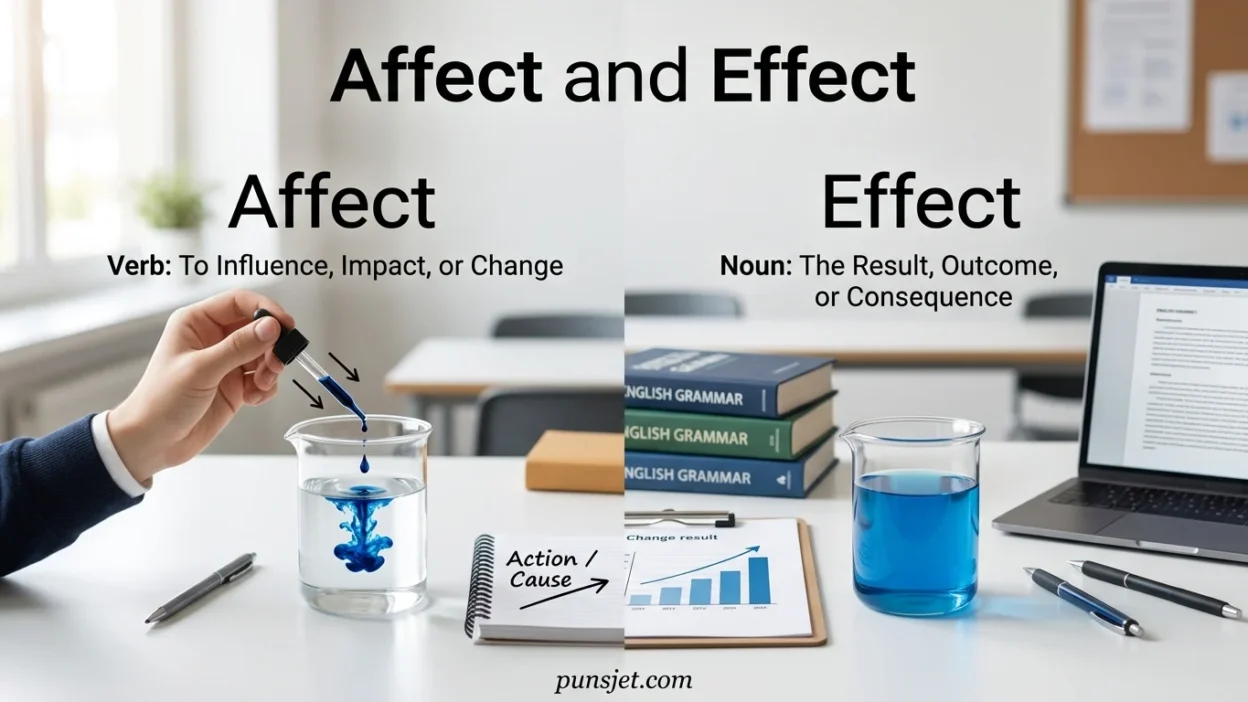
Affect and effect are two of the most confusing words in English. They look and sound similar, and both are often used when talking about how one thing changes another. Because of this, even strong English speakers sometimes use the wrong word.
The good news is that the difference is simple once you understand the basic idea.
In most everyday sentences:
- Affect is a verb. It means to change or influence something.
- Effect is a noun. It means the result or change caused by something.
For example:
The loud noise affected my sleep.
The loud noise had a bad effect on my sleep.
The first sentence focuses on the action or influence. The second focuses on the result.
There are a few less common uses, but learning these two main meanings will help you use affect and effect correctly in most situations.
Quick Answer: Affect vs. Effect
Here is the easiest way to remember the difference:
- Affect = influence or change → usually a verb
- Effect = result or outcome → usually a noun
- If something affects you, it changes or influences you.
- If something has an effect on you, it produces a result.
- Affect often answers: “What did it change?”
- Effect often answers: “What was the result?”
Simple examples
- The rain affected our plans.
- The rain had an effect on our plans.
- Lack of sleep can affect your memory.
- Lack of sleep can have a negative effect on your memory.
A useful memory trick is:
Affect = Action
Effect = End result
This trick is not perfect for every special use, but it works very well for normal English.
A Simple Background of the Words
Both affect and effect have a long history in English. They came into English through older languages, including Latin and French.
Over time, the words developed several meanings. This is one reason they can be confusing today.
The most common modern use is:
- Affect as a verb: to influence something.
- Effect as a noun: the result of something.
There are also special cases. For example, effect can sometimes be used as a verb meaning to cause something to happen, especially in formal writing. Affect can also be a noun in psychology, where it describes someone’s visible emotional state.
These special meanings are real, but beginners do not need to worry about them first. Start with the common uses.
The Difference Between Affect and Effect
What Does Affect Mean?
Affect usually works as a verb.
It means to influence, change, or have an impact on something.
Examples
- Cold weather can affect your health.
- The new rules will affect all students.
- Her words affected me deeply.
- Too much noise can affect your concentration.
- The delay affected our travel plans.
In each example, affect describes something doing something to another thing.
For example:
The rain affected the game.
The rain changed or influenced the game.
Think of Affect as an Action
Ask yourself:
“Is something influencing or changing something else?”
If the answer is yes, affect is usually the correct word.
What Does Effect Mean?
Effect usually works as a noun.
It means a result, outcome, or change caused by something.
Examples
- The medicine had a positive effect.
- The storm had a serious effect on the town.
- Lack of sleep can have a negative effect on your mood.
- The new rule had an unexpected effect.
- Exercise can have many good effects on the body.
Here, effect is the thing that happens because of another action or event.
For example:
The rain had an effect on the game.
The effect is the result of the rain.
Think of Effect as a Result
Ask yourself:
“Am I talking about the result or outcome?”
If yes, effect is usually the right choice.
Affect vs. Effect: Easy Comparison Table
| Word | Common part of speech | Simple meaning | Example |
|---|---|---|---|
| Affect | Verb | To influence or change | Noise can affect your sleep. |
| Effect | Noun | A result or outcome | Noise can have an effect on sleep. |
| Affect | Verb | To have an impact on | The news affected her mood. |
| Effect | Noun | The result of an action | The news had a strong effect on her mood. |
The easiest pattern is:
Something affects something.
Something has an effect on something.
For example:
Social media can affect your sleep.
or:
Social media can have an effect on your sleep.
Both sentences are correct, but their grammar is different.
Which One Should You Use and When?
Use affect when you need a verb that means “influence” or “change.”
Use Affect:
- The weather affected our plans.
- Stress can affect your work.
- The accident affected traffic.
- Her decision affected everyone.
Use effect when you need a noun meaning “result.”
Use Effect:
- The weather had an effect on our plans.
- Stress can have an effect on your work.
- The accident caused a major effect on traffic.
- Her decision had a strong effect on everyone.
A Quick Grammar Test
Look at the words around the blank.
If you see:
can, will, may, did, does, to
you may need a verb such as affect.
This problem can affect many people.
If you see:
an, the, this, that, its
you may need a noun such as effect.
This problem has an effect on many people.
This is not a rule for every sentence, but it is a helpful clue.
Common Mistakes with Affect and Effect
Mistake 1: Using Effect as a Verb When You Mean Influence
Incorrect:
The noise effected my sleep.
Correct:
The noise affected my sleep.
Here, the meaning is “influenced,” so affected is correct.
Mistake 2: Using Affect as a Noun
Incorrect:
The medicine had a good affect.
Correct:
The medicine had a good effect.
You are talking about a result, so use effect.
Mistake 3: Forgetting “Have an Effect”
A common structure is:
have an effect on
For example:
Exercise has a positive effect on your health.
You can also say:
Exercise affects your health positively.
Both are correct.
Mistake 4: Thinking the First Letter Gives the Answer
Some learners try to remember the words only by their spelling. This can become confusing.
Instead, remember the meanings:
Affect = influence
Effect = result
This is much more useful than trying to remember which word simply “looks right.”
Everyday Examples of Affect and Effect
In Emails
Imagine a company sends an email about a schedule change.
The new schedule will affect all employees.
Here, affect is a verb because the schedule will influence employees.
Another example:
The schedule change may have an effect on employee productivity.
Here, effect is a noun because it means the result.
In News
You may see sentences such as:
The storm affected thousands of people.
The storm influenced or changed people’s lives.
You might also read:
The storm had a major effect on local businesses.
The sentence is talking about the result of the storm.
On Social Media
Someone might write:
Too much screen time can affect your sleep.
Or:
Too much screen time can have a negative effect on your sleep.
Both express almost the same idea.
The first uses affect as a verb.
The second uses effect as a noun.
In Daily Conversation
You could say:
Does loud music affect your concentration?
Or:
Does loud music have an effect on your concentration?
Again, both can be correct.
A Simple Learning Method for Students
If you are a student or beginner, do not try to memorize every unusual meaning immediately.
Start with this two-step method.
Step 1: Ask What the Word Is Doing
If the word describes an action or influence, choose:
Affect
The bad news affected him.
If the word describes a result, choose:
Effect
The bad news had a strong effect on him.
Step 2: Replace the Word
Try replacing affect with influence.
The rain affected the match.
The rain influenced the match.
The sentence still makes sense, so affect is probably correct.
Now try replacing effect with result.
The rain had an effect on the match.
The rain had a result on the match.
The second version sounds wrong because English normally says “had an effect on,” not “had a result on.” But the meaning of effect is still “result.”
Remember This Line
Affect changes something. Effect is the change or result.
This one sentence can help you remember the difference for a long time.
FAQ:
1. What is the main difference between affect and effect?
Affect is usually a verb meaning “to influence or change.” Effect is usually a noun meaning “the result or outcome.”
The weather affected our plans.
The weather had an effect on our plans.
2. Is affect a verb?
Yes. In normal everyday English, affect is most commonly a verb.
Lack of sleep can affect your memory.
It means that lack of sleep can influence or change your memory.
3. Is effect a noun?
Yes. Effect is most commonly a noun.
The medicine had a positive effect.
Here, effect means the result produced by the medicine.
4. Can effect be a verb?
Yes. Effect can also be a verb, although this use is less common in everyday English.
As a verb, effect can mean to cause or bring about something.
For example:
The new plan will effect major changes.
This meaning is different from the usual noun effect.
For beginners, focus first on the common pattern: affect = influence and effect = result.
5. Can affect be a noun?
Yes, but this is uncommon in general conversation. In psychology and some formal contexts, affect can refer to a person’s visible emotional state.
For everyday English, it is safest to remember affect as the verb meaning “influence.”
6. What is an easy trick for remembering affect and effect?
Remember:
Affect = Action
Effect = End result
For example:
The loud noise affected my sleep.
The noise performed an action by influencing your sleep.
The loud noise had a bad effect on my sleep.
The bad sleep is the result.
7. Which is correct: “affect on” or “effect on”?
Usually, the correct phrase is:
For example:
The change had an effect on students.
With affect, you normally do not use “on” in the same way:
The change affected students.
Not:
The change affected on students.
Conclusion
The difference between affect and effect becomes much easier when you focus on their main jobs.
Affect is usually a verb. It means to influence or change something.
The weather affected our plans.
Effect is usually a noun. It means the result or outcome of something.
The weather had an effect on our plans.
When you are unsure, ask yourself:
Is this word describing an influence or action?
Use affect.
Am I talking about a result?
Use effect.
The simplest rule to remember is:
Affect = influence
Effect = result
With a little practice, these two words will stop feeling confusing. Read the sentence carefully, think about whether you need an action or a result, and choose the word that matches.