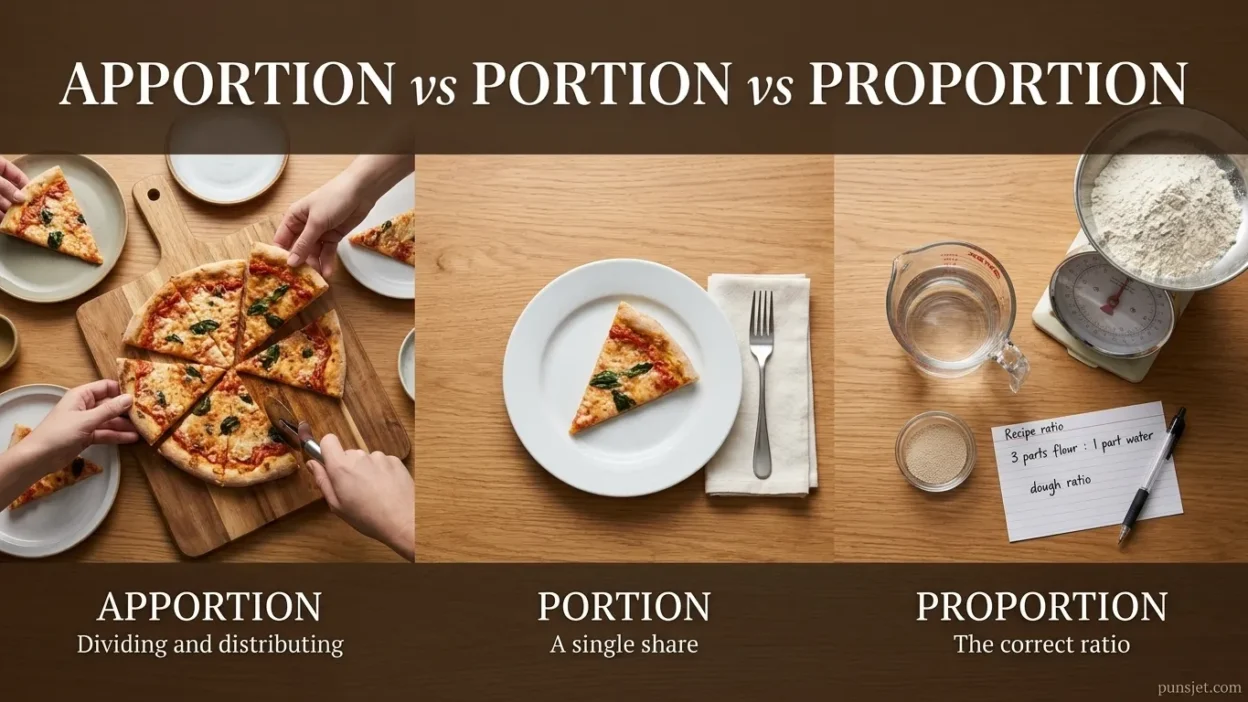
The English words apportion, portion, and proportion look and sound similar because they all relate to dividing something into parts. However, they have different meanings and grammatical uses. Knowing the difference can help you choose the correct word when talking about money, food, resources, responsibilities, quantities, or shares. Although these words are connected, they are not interchangeable.
The main difference is simple: apportion means to divide or distribute something among people or groups, portion means a part or share of something, and proportion means the relationship or relative amount of one part compared with another or with the whole. These words are common in everyday English, mathematics, business, education, and formal writing. In this guide, you will learn their meanings, grammatical roles, and correct usage through simple explanations and practical examples.
Quick Answer: Apportion vs Portion vs Proportion
- Apportion (verb): To divide and distribute something among different people or groups. Example: The manager will apportion the budget among departments.
- Portion (noun/verb): A part, share, or amount of something. It can also mean to divide something into parts. Example: She ate a small portion of rice.
- Proportion (noun): The relationship between parts or the relative amount of something compared with the whole. Example: A large proportion of students passed the exam.
Why Do People Confuse Apportion, Portion, and Proportion?
People often confuse these three words because they share the word element “portion” and are all connected to the idea of parts, shares, and division.
However, their meanings are not exactly the same.
Here are the main reasons for the confusion:
- Similar spelling: All three words contain similar letters, making them easy to mix up.
- Related meanings: Each word involves dividing something, measuring an amount, or identifying a share.
- Different grammatical roles: Apportion is primarily a verb, portion can be a noun or verb, and proportion is primarily a noun.
- Overlapping contexts: These words can appear in discussions about money, food, resources, and responsibilities.
The easiest way to understand them is to remember that apportion describes the act of distributing, portion identifies an individual part, and proportion describes a relationship between amounts.
What Does Apportion Mean?
Apportion is a verb that means to divide and distribute something among different people, groups, organizations, or purposes.
It usually suggests that something is being allocated according to a particular plan, rule, need, or requirement.
For example:
- The government will apportion funds among different regions.
- The teacher apportioned tasks among the students.
- The company decided to apportion its annual budget between departments.
- The committee will apportion responsibilities among its members.
How to Use Apportion in a Sentence
Use apportion when you want to describe the process of distributing something.
Common expressions include:
- Apportion resources
- Apportion funds
- Apportion responsibility
- Apportion expenses
- Apportion costs
- Apportion blame
- Apportion work
Example: The manager decided to apportion the available work equally among five employees.
In this sentence, apportion describes the action of distributing work among several people.
Synonyms of Apportion
Depending on the context, similar words include:
- Allocate
- Distribute
- Assign
- Divide
- Allot
- Share
What Does Portion Mean?
Portion can function as both a noun and a verb. As a noun, it means a part, share, or amount of something. As a verb, it means to divide something into separate parts or shares.
It is commonly used when discussing food, money, land, responsibilities, and other things that can be divided.
For example:
- I ate a small portion of the cake.
- Each student received a portion of the prize.
- She divided the food into equal portions.
- A large portion of the land belongs to the family.
How to Use Portion in a Sentence
Use portion when referring to an individual part or share of something.
Common expressions include:
- A small portion
- A large portion
- A portion of food
- A portion of money
- A portion of land
- Equal portions
- Divide into portions
Example: The restaurant served a generous portion of pasta.
Here, portion refers to the amount of food served to one person.
Synonyms of Portion
Depending on the context, similar words include:
- Part
- Share
- Section
- Piece
- Amount
- Serving
- Segment
What Does Proportion Mean?
Proportion is primarily a noun. It refers to the relationship between two or more amounts, quantities, or parts. It can also describe how much of something exists compared with the whole.
It is frequently used in mathematics, statistics, science, business, and everyday conversations.
For example:
- A large proportion of employees work remotely.
- The proportion of boys to girls in the class is equal.
- Only a small proportion of the budget was spent.
- The recipe requires the correct proportion of flour and water.
How to Use Proportion in a Sentence
Use proportion when discussing relative amounts, ratios, or the relationship between parts and a whole.
Common expressions include:
- A large proportion
- A small proportion
- In proportion to
- Proportion of something
- The proportion between two amounts
- Proportion of the population
- Relative proportion
Example: A high proportion of students passed the final examination.
In this sentence, proportion refers to the number of students who passed compared with the total number of students.
Synonyms of Proportion
Depending on the context, similar words include:
- Ratio
- Percentage
- Fraction
- Relationship
- Share
- Relative amount
- Balance
Apportion vs Portion vs Proportion: Comparison Table
| Feature | Apportion | Portion | Proportion |
|---|---|---|---|
| Part of speech | Verb | Noun and verb | Primarily noun |
| Main meaning | To distribute something | A part or share | Relationship between amounts |
| Main purpose | Allocation | Identifying or dividing a part | Comparing quantities |
| Common use | Budgets and responsibilities | Food, money, and shares | Mathematics and statistics |
| Example | Apportion the funds | A portion of food | A large proportion of people |
The key difference: Apportion describes distributing something, portion identifies a part, and proportion explains the relative relationship between amounts.
When Should You Use Apportion, Portion, or Proportion?
Choosing the correct word becomes easier when you understand what you want to communicate.
Use Apportion When You Mean Distribute
Choose apportion when something needs to be allocated among multiple people, groups, or purposes.
Examples:
- The government will apportion the funds among different districts.
- The supervisor apportioned duties among the employees.
- The court must apportion responsibility between the parties.
Use Portion When You Mean Part or Share
Choose portion when referring to a particular amount or section of something.
Examples:
- I saved a portion of my salary.
- He ate two portions of pizza.
- Each child received an equal portion of the prize.
Use Proportion When You Mean Relative Amount or Ratio
Choose proportion when comparing quantities or describing how much one part represents in relation to another or the whole.
Examples:
- A large proportion of the population lives in cities.
- The proportion of sugar to flour is important.
- The company spends a small proportion of its income on advertising.
15 Examples of Apportion vs Portion vs Proportion
The following examples show how these words work in everyday English.
Examples Using Apportion
- The school will apportion its annual budget among different departments.
- The manager apportioned the responsibilities equally among team members.
- The government plans to apportion additional resources to rural areas.
- The committee must apportion the expenses between the two organizations.
- The judge decided how to apportion responsibility for the accident.
Examples Using Portion
- I ate a small portion of the birthday cake.
- She donated a portion of her monthly income to charity.
- Each participant received an equal portion of the prize money.
- The restaurant serves a large portion of chicken and rice.
- He portioned the ingredients into separate containers.
Examples Using Proportion
- A large proportion of the students completed their assignments.
- The proportion of boys to girls in the classroom is nearly equal.
- Only a small proportion of the company’s profits was saved.
- You should mix the ingredients in the correct proportion.
- A significant proportion of the population uses smartphones.
Common Mistakes When Using Apportion, Portion, and Proportion
Even though these words are related, using one in place of another can change the meaning of a sentence.
Here are some common mistakes to avoid.
Mistake 1: Using Portion Instead of Apportion
Incorrect: The manager will portion the budget among all departments.
Correct: The manager will apportion the budget among all departments.
Explanation: Apportion is the more precise word when describing the allocation of a budget among different departments. Portion is also a verb, but it more commonly describes dividing something into individual parts.
Mistake 2: Using Apportion Instead of Portion
Incorrect: I ate a small apportion of the cake.
Correct: I ate a small portion of the cake.
Explanation: Portion is the correct noun for an amount or serving of food. Apportion is a verb and cannot be used this way.
Mistake 3: Using Portion Instead of Proportion
Incorrect: A large portion of students passed compared with last year.
Better: A large proportion of students passed compared with last year.
Explanation: Proportion is more appropriate when discussing the relative number of students compared with the total.
Mistake 4: Treating Proportion and Percentage as Identical
Incorrect: Proportion and percentage always mean exactly the same thing.
Correct: A proportion describes a relative amount, while a percentage expresses a quantity as a fraction of 100.
Explanation: A proportion can be expressed as a percentage, but it can also be expressed as a fraction, decimal, or ratio.
Mistake 5: Forgetting the Part of Speech
Remember:
- Apportion is a verb.
- Portion can be a noun or verb.
- Proportion is primarily a noun.
Understanding their grammatical roles helps prevent incorrect sentence construction.
Memory Trick: How to Remember the Difference
You can remember these three words with a simple trick:
- Apportion = Allocate: Think of distributing something among people.
- Portion = Part: Think of one individual share or serving.
- Proportion = Relationship: Think of comparing one amount with another.
Remember this simple sentence:
Apportion the food, give everyone a portion, and check the proportion of ingredients.
This sentence uses all three words correctly and makes their meanings easier to remember.
American vs British English: Is There Any Difference?
There is no major difference between American and British English when using apportion, portion, and proportion.
All three words have essentially the same meanings, spellings, and grammatical functions in both varieties of English.
| Word | American English | British English |
|---|---|---|
| Apportion | Apportion | Apportion |
| Portion | Portion | Portion |
| Proportion | Proportion | Proportion |
Examples:
- American English: The company will apportion the expenses among its departments.
- British English: The company will apportion the expenses among its departments.
Both sentences are correct.
These words do not have separate American and British spellings, so you can use them confidently in either variety of English.
Similar Words Related to Apportion, Portion, and Proportion
Several other English words are connected to division, allocation, and comparison. Learning them can help expand your vocabulary.
| Word | Meaning | Example |
|---|---|---|
| Allocate | To assign something for a purpose | We allocated money for education. |
| Distribute | To give something to different people | They distributed food to families. |
| Divide | To separate something into parts | Divide the cake into four pieces. |
| Share | A part belonging to someone | Everyone received a fair share. |
| Ratio | A comparison between two quantities | The ratio is 2:1. |
| Fraction | A part of a whole | One-half is a fraction. |
| Percentage | An amount expressed out of 100 | Fifty percent of the class passed. |
| Allot | To give someone a particular amount | Each employee was allotted two days off. |
These words may have similar meanings, but their exact uses depend on the sentence and context.
Final Verdict: Apportion vs Portion vs Proportion
Apportion, portion, and proportion are related words, but they serve different purposes.
- Apportion is a verb meaning to divide and distribute something among people, groups, or purposes.
- Portion is a noun or verb referring to a part, share, or amount of something.
- Proportion is primarily a noun describing the relationship between amounts or the relative size of one part compared with the whole.
If you are talking about distributing resources, use apportion. If you mean an individual part or serving, use portion. If you are comparing amounts or discussing ratios, use proportion.
FAQs:
1. What is the main difference between apportion, portion, and proportion?
Apportion means to distribute something among different people or groups. Portion means an individual part or share of something. Proportion describes the relationship between different amounts or the relative size of one part compared with the whole.
2. Is apportion a noun or a verb?
Apportion is a verb. It means to divide and distribute something among different people, groups, or purposes.
Example: The committee will apportion the available funds among the departments.
3. Can portion be used as a verb?
Yes. Portion can function as both a noun and a verb. As a noun, it means a part or share. As a verb, it means to divide something into separate amounts or servings.
Example: The chef portioned the food into individual containers.
4. What is the difference between portion and proportion?
A portion is an individual part or amount of something, while a proportion describes how much one part represents in relation to another amount or the whole.
Example: A portion of the cake was left, but a large proportion of the guests had already eaten.
5. Is proportion the same as percentage?
No. Proportion and percentage are related but not identical. A proportion describes a relationship or relative amount, while a percentage expresses a value as a fraction of 100.
For example, 0.5 is a proportion that can also be expressed as 50%.
6. What is another word for apportion?
Common alternatives include allocate, distribute, assign, allot, and divide. The best synonym depends on the context.
For example, a manager may allocate tasks or apportion responsibilities among employees.
7. How do you use apportion, portion, and proportion in one sentence?
You can use all three words naturally in one sentence:
“The manager will apportion the budget among departments, give each department its allocated portion, and review the proportion of money spent on each project.”
This sentence demonstrates their different meanings and grammatical functions.
Remember This
- Apportion = Distribute: Divide something among different people or groups.
- Portion = Part: An individual share, amount, or serving.
- Proportion = Compare: The relationship between amounts or parts of a whole.
The three words are related, but they are not interchangeable. Remembering these simple meanings will help you use them correctly in everyday conversations, academic writing, and professional communication.
Conclusion
Understanding the difference between apportion, portion, and proportion is easier when you focus on their main purposes. Apportion describes the action of distributing something, portion identifies an individual part or share, and proportion explains the relationship between quantities. Although they are connected through the idea of division, each word has its own grammatical role and meaning.
The next time you write about food, money, responsibilities, resources, or quantities, choose the word that matches your intended meaning. Use apportion for distribution, portion for an individual share, and proportion for comparison. With regular practice and these simple examples, you can use all three words confidently and accurately.