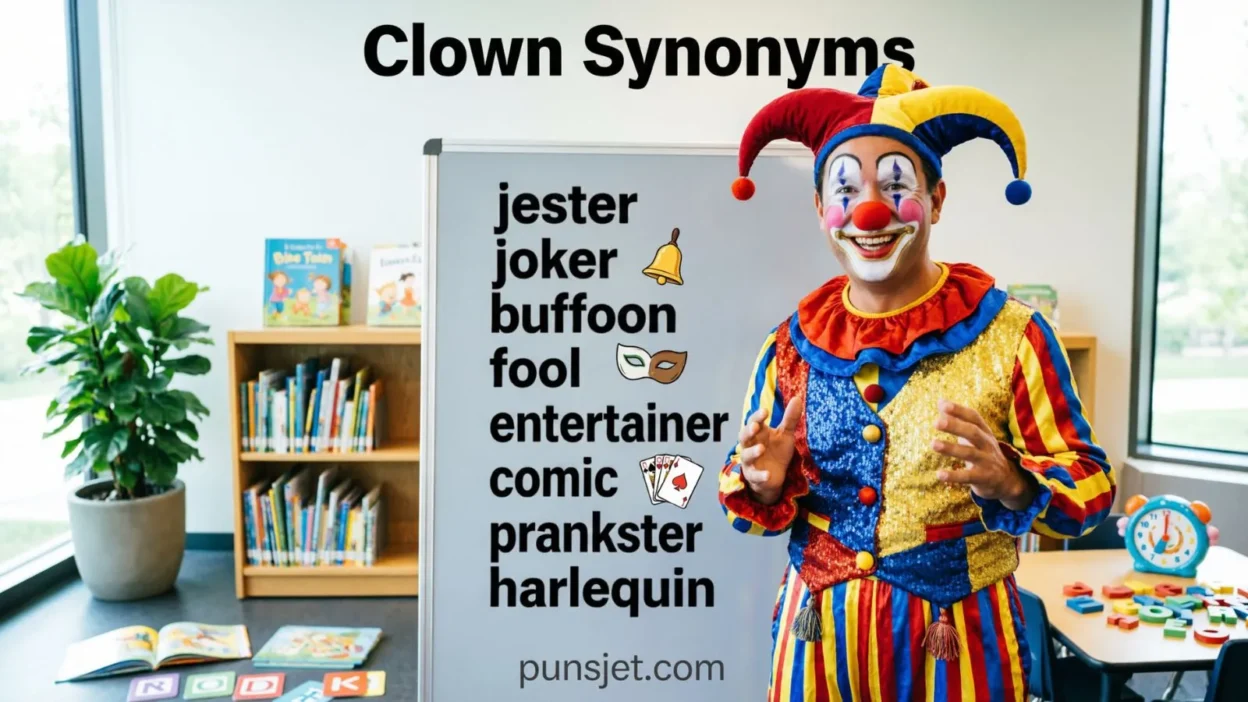
The word clown is commonly used to describe a person who entertains others through comedy, jokes, and funny behavior.
Traditionally, a clown performs in circuses, parties, and theatrical shows while wearing colorful costumes and makeup. However, in everyday language, the word can also refer to someone who acts silly, foolish, or amusing.
Learning clown synonyms can help students, ESL learners, writers, and content creators expand their vocabulary.
Different synonyms carry different meanings and tones. Some are playful and friendly, while others may sound critical or humorous.
In this guide, you’ll discover the meaning of clown, explore 30 useful clown synonyms, learn when to use each one, and understand how to choose the best alternative based on context.
What Does “Clown” Mean?
A clown is a person who entertains others by performing funny actions, telling jokes, or behaving in an amusing way.
Simple Definition
Clown (noun): A funny entertainer or a person who acts silly to make others laugh.
Example Sentences
- The clown entertained children at the birthday party.
- Stop acting like a clown during the meeting.
- He became the class clown because he always made everyone laugh.
Common Usage Contexts
- Circus performances
- Birthday parties
- Comedy shows
- Informal conversations about silly behavior
- Creative writing and storytelling
30 Clown Synonyms With Meanings and Examples
1. Jester
Meaning: A person who entertains with jokes and humor.
Example: The jester kept the king laughing all evening.
Best Usage Context: Historical or playful settings.
2. Comedian
Meaning: A professional entertainer who performs comedy.
Example: The comedian received applause from the audience.
Best Usage Context: Stand-up shows and entertainment.
3. Joker
Meaning: Someone who enjoys making jokes.
Example: He’s the joker of the group.
Best Usage Context: Casual conversations.
4. Buffoon
Meaning: A person who behaves in a ridiculous way.
Example: The buffoon embarrassed himself at the event.
Best Usage Context: Critical or humorous descriptions.
5. Fool
Meaning: Someone who acts unwisely or silly.
Example: Don’t be a fool and ignore the warning signs.
Best Usage Context: Everyday speech.
6. Entertainer
Meaning: Someone who performs to amuse others.
Example: She is a talented entertainer.
Best Usage Context: Professional performances.
7. Prankster
Meaning: A person who enjoys playing tricks.
Example: The prankster hid everyone’s pencils.
Best Usage Context: Fun and mischievous situations.
8. Wisecracker
Meaning: Someone who frequently makes clever jokes.
Example: The wisecracker had a funny response for everything.
Best Usage Context: Informal conversations.
9. Humorist
Meaning: A person known for humor.
Example: The humorist wrote entertaining articles.
Best Usage Context: Writing and literature.
10. Mimic
Meaning: Someone who imitates others for amusement.
Example: The mimic copied the teacher’s voice.
Best Usage Context: Comedy performances.
11. Trickster
Meaning: A person who enjoys deceiving or teasing others.
Example: The trickster fooled everyone with his act.
Best Usage Context: Stories and folklore.
12. Goofball
Meaning: A silly and amusing person.
Example: My brother is such a goofball.
Best Usage Context: Friendly informal speech.
13. Cut-Up
Meaning: Someone who constantly jokes around.
Example: The class cut-up made everyone laugh.
Best Usage Context: School and social settings.
14. Funny Person
Meaning: Someone naturally amusing.
Example: She’s a funny person to be around.
Best Usage Context: Everyday conversation.
15. Wag
Meaning: A witty and humorous individual.
Example: The wag entertained guests at dinner.
Best Usage Context: Formal or literary writing.
16. Comic
Meaning: A comedy performer.
Example: The comic performed at the festival.
Best Usage Context: Entertainment industry.
17. Banterer
Meaning: Someone who enjoys playful conversation.
Example: The banterer kept the discussion lively.
Best Usage Context: Social interactions.
18. Showman
Meaning: A skilled entertainer who attracts attention.
Example: The showman captivated the crowd.
Best Usage Context: Public performances.
19. Zany
Meaning: A wildly funny or eccentric person.
Example: His zany behavior made everyone laugh.
Best Usage Context: Comedy and entertainment.
20. Mischief-Maker
Meaning: Someone who causes harmless trouble.
Example: The mischief-maker played another prank.
Best Usage Context: Informal situations.
21. Rascal
Meaning: A playful person who gets into trouble.
Example: That little rascal hid my keys.
Best Usage Context: Friendly teasing.
22. Clown Prince
Meaning: An exceptionally funny entertainer.
Example: He became the clown prince of local comedy.
Best Usage Context: Entertainment discussions.
23. Performer
Meaning: Someone who entertains an audience.
Example: The performer impressed everyone.
Best Usage Context: Arts and entertainment.
24. Satirist
Meaning: Someone who uses humor to criticize society.
Example: The satirist mocked political issues.
Best Usage Context: Literature and media.
25. Funnyman
Meaning: A man known for making people laugh.
Example: The funnyman was popular on television.
Best Usage Context: Comedy and media.
26. Jokester
Meaning: Someone who constantly tells jokes.
Example: Every group has a jokester.
Best Usage Context: Casual speech.
27. Silly Goose
Meaning: A playful term for a silly person.
Example: You’re such a silly goose.
Best Usage Context: Friendly conversations.
28. Eccentric
Meaning: A person with unusual behavior.
Example: The eccentric artist entertained visitors.
Best Usage Context: Describing unique personalities.
29. Court Fool
Meaning: A traditional entertainer in royal courts.
Example: The court fool amused the royal family.
Best Usage Context: Historical writing.
30. Humor Maker
Meaning: Someone who creates laughter.
Example: He became a humor maker for local events.
Best Usage Context: General descriptions.
Clown Synonyms Comparison Table
| Synonym | Tone | Best Used For |
|---|---|---|
| Jester | Playful | Historical settings |
| Comedian | Professional | Entertainment |
| Joker | Casual | Daily conversations |
| Buffoon | Negative | Criticism |
| Goofball | Friendly | Friends and family |
| Prankster | Mischievous | Tricks and jokes |
| Comic | Professional | Stage performances |
| Satirist | Intellectual | Social commentary |
| Rascal | Playful | Friendly teasing |
| Zany | Energetic | Comedy writing |
How to Choose the Right Clown Synonym
Different situations require different words. Here’s a simple guide.
For Professional Entertainers
Use:
- Comedian
- Comic
- Entertainer
- Performer
- Showman
For Funny Friends
Use:
- Goofball
- Jokester
- Joker
- Funny Person
- Silly Goose
For Historical or Literary Writing
Use:
- Jester
- Court Fool
- Wag
- Humorist
For Mischievous People
Use:
- Prankster
- Trickster
- Rascal
- Mischief-Maker
For Negative or Critical Tone
Use:
- Buffoon
- Fool
- Zany (depending on context)
Common Mistakes When Using Clown Synonyms
Assuming All Synonyms Mean Exactly the Same
Many clown synonyms have different tones. For example, comedian sounds professional, while buffoon sounds insulting.
Ignoring Context
A word suitable for a comedy show may not fit a formal business article.
Using Negative Terms Accidentally
Words like fool and buffoon can offend people if used carelessly.
Why Learning Clown Synonyms Improves Writing
Using a variety of clown synonyms can make your writing more engaging and precise. Instead of repeating the word “clown,” you can choose alternatives that better match your intended tone.
Benefits include:
- Better vocabulary
- More natural writing
- Improved creativity
- Stronger communication skills
- Better SEO content quality
FAQs:
What is the best synonym for clown?
The best synonym depends on context. Comedian, joker, and jester are among the most common alternatives.
Is clown always an insult?
No. A clown can be a professional entertainer or simply someone who enjoys making people laugh.
What’s the difference between a clown and a comedian?
A clown often uses physical comedy and costumes, while a comedian mainly relies on jokes and storytelling.
Which clown synonym is most professional?
Comedian, performer, and entertainer are generally the most professional choices.
Conclusion
Understanding clown synonyms helps you express ideas more accurately and creatively.
While the word clown often refers to a funny entertainer, many alternatives offer unique shades of meaning.
Words like jester, comedian, joker, goofball, and prankster can help you match the exact tone you want.
If you’re a student, ESL learner, writer, or content creator, expanding your vocabulary with these clown synonyms will make your communication stronger, clearer, and more engaging.

Joshua Paul is a creative writer and contributor at PunsJet.com who enjoys crafting witty puns and clever wordplay. With a strong sense of humor and a love for language, he creates entertaining content that readers can easily share and enjoy. Joshua’s goal is to spread laughter through fun and memorable jokes.